Meaning at a glance
The broken chain motif has documented roots in European sentimental and mourning contexts and appears across periods as a visual shorthand for interruption, loss, or changed bonds; modern interpretations are more personal and varied. This article separates museum-documented history from later symbolic readings, explains how the motif and gemstones appear in jewelry, and offers practical guidance for choosing and gifting broken chain pieces.
Quick answer
In short: historically the broken chain motif appears in museum-documented sentimental and mourning jewellery and in other contexts to indicate interruption or severed connection; contemporary wearers often adopt the motif for personal meanings such as survival, breakups, or liberation. The Victoria and Albert Museum (V&A) frames these shifts as part of jewellery’s changing social contexts, and modern buying guidance should consider both symbolic sensitivity and material disclosure (FTC).
What the historical evidence shows (and which periods are documented)
When assessing the meaning of a jewellery motif, it helps to follow the documentary trail in museum collections and scholarship rather than assume a single, timeless symbolism. The Victoria and Albert Museum’s materials on jewellery history emphasize that motifs acquire specific meanings within particular social and aesthetic contexts, and that those meanings change over time.
For European nineteenth-century jewellery, V&A documentation links a range of sentimental and mourning motifs to practices around memory and grief. In that period, jewellers used interrupted or broken forms—including broken columns, broken rings, and forms suggesting a break—to register a life cut short or a disrupted relationship. The museum’s coverage of jewellery history positions these motifs within Victorian commemorative practices and the broader nineteenth-century taste for symbolic design.
Earlier and later periods show different uses and emphases. The V&A’s broader exhibition and collection materials illustrate that chain imagery more generally has served varied functions: as purely decorative links in functional bracelets and necklaces, as status markers where craftsmanship mattered, and occasionally as symbolic devices whose meaning depends on the wearer’s cultural frame. Where a museum catalogue or exhibition labels an object with a specific funerary, religious, or civic meaning, that attribution is based on documented provenance or historical records; otherwise descriptions remain stylistic or contextual.
Separating documented historical meanings from modern interpretations
Documented historical meanings are the ones recorded by curators, provenance records, or contemporary texts. For example, when a museum like the V&A catalogs a nineteenth-century brooch with interrupted decorative elements as part of mourning jewellery, that is a documented historical meaning rooted in the object’s date, maker, inscription, or recorded usage.
Modern personal interpretations are different: from the late twentieth century onward, a broken chain motif has been adopted in fashion and subcultural jewellery to express a range of ideas including personal liberation, recovery from abuse, a relationship breakup, or political statements about breaking oppressive systems. These contemporary meanings are personal, social, and often intentional re-readings of the motif rather than continuations of a single historical tradition.
It is important not to treat either category as universally applicable. A nineteenth-century broken motif documented in a European mourning context does not automatically mean that a contemporary designer’s broken-chain necklace carries the same intent. Conversely, a modern wearer’s strong personal meaning added to an antique piece is valid at the level of individual expression, even if that meaning was not the piece’s original function.
How the broken chain motif and related traditions appear in jewellery
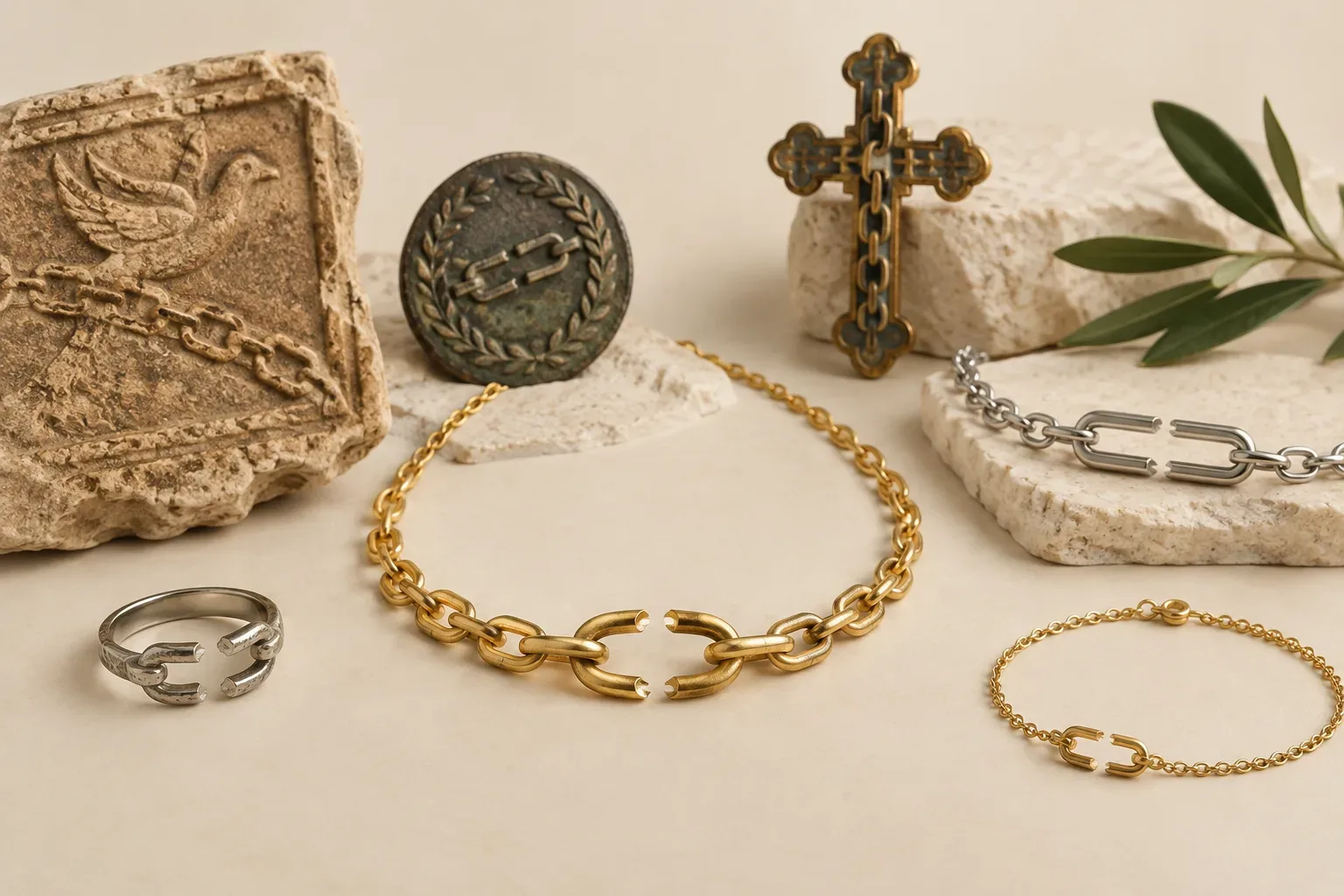
As a motif, a broken chain can be literal—a necklace or bracelet with an intentionally open link, a clipped ring, or a link fashioned to look fractured—or figurative, rendered as an engraved line, a pendant shaped like separated links, or a composition of fragmented metalwork. Museums document examples where interrupted forms are used along with other clear markers such as inscriptions, hairwork, or black enamel so curators can place them in a mourning or commemorative category.
Gemstones and materials also shape interpretation. The Victoria and Albert Museum’s resources on gemstones describe how specific stones and treatments have been used across periods. In historical commemorative jewellery, materials such as jet or black enamel commonly signal mourning in the nineteenth century, while pearls and certain stones were read as symbols in particular contexts. In modern designs, designers might set a broken-chain motif with diamonds, colored gemstones, or mixed metals to shift the register from somber to celebratory.
Beyond pendants, the motif appears in lockets, brooches, rings, and bracelet clasps. The visual language—whether a tiny fractured ring on a charm bracelet or a bold, intentionally snapped curb link—affects whether the piece reads as subtle symbolic jewellery or an overt statement piece.
Selecting or gifting broken chain jewellery: practical and respectful guidance
Consider the recipient’s cultural and emotional context. Because broken-chain imagery can reference loss, separation, or liberation, think about how the person you’re buying for interprets such symbols. If the piece is meant to commemorate a sensitive event—bereavement, a divorce, or recovery—ask whether the recipient welcomes an explicit symbol or would prefer something more private.
Choose materials and craftsmanship with care. The V&A’s material histories remind us that design and materials anchor meaning, and the Federal Trade Commission’s consumer guidance stresses the importance of disclosed treatments and accurate descriptions when buying gemstones or imitation materials. Ask the seller about metal content, gemstone treatments, and returns policy so the piece’s physical qualities match the emotional intent behind the gift.
Respect provenance when buying antique pieces. If you are purchasing an antique item that you believe carries a historical meaning, verify catalogue or provenance notes where possible. Museums and reputable dealers can often provide contextual documentation; this helps ensure you’re not projecting a modern meaning onto an object with a clearly recorded historical purpose.
Communicate your intention when appropriate. A short note explaining why you chose the motif—whether to mark resilience, a new start, or a private memory—can make the gift more meaningful while avoiding misunderstandings. If the design could be misread, the explanation lets the recipient place the object in the intended emotional frame.
Finally, prefer reputable sellers. For gemstones and precious metals, consult the FTC’s guidance on honest disclosure of treatments and imitations. If you have concerns about authenticity or lab-grown versus natural stones, request documentation and ensure return options in case the piece doesn’t meet expectations.
Wearing and styling broken chain jewellery today
Styling choices can influence how the motif reads. A delicate broken-link pendant worn close to the heart signals intimacy and personal meaning, while a heavy, intentionally snapped chain bracelet worn visibly functions as a bold stylistic statement. Layering broken-chain pieces with other symbolic jewellery can either reinforce a narrative—such as pairing a broken-chain charm with a locket—or create a contrasting dialogue.
Respectfulness extends to public contexts. If the piece commemorates loss, wearing it publicly is a personal choice; others seeing the motif may not infer its meaning, and that ambiguity is sometimes useful. If the piece is intended to make a political point, consider the likely public reception and whether the setting is appropriate.
Final note
The broken chain motif demonstrates how a single visual element can travel across time and registers: museum-documented usages anchor the motif in particular historical practices while contemporary wearers and designers continue to reinterpret it. For collectors, givers, and wearers, the clearest approach is to distinguish documented provenance from personal meaning, choose materials and sellers responsibly, and communicate intent when needed.
Frequently asked questions
Does a broken chain always mean mourning?
No. While museums such as the Victoria and Albert Museum document instances in nineteenth-century European jewellery where interrupted or broken forms appear in mourning and commemorative pieces, the motif is not universally tied to grief. Contemporary designers and wearers may use it to express breakups, liberation, survival, or purely aesthetic preference.
Can I gift broken chain jewellery after a breakup or bereavement?
Yes, but do so with sensitivity. Consider the recipient’s feelings and whether they prefer a private token or a public symbol. A brief note explaining your intention can help avoid misunderstanding. If you are unsure, choose a subtler design or ask the recipient about their preferences.
How do I verify whether an antique broken-chain piece is a mourning item?
Look for provenance, inscriptions, and associated materials. Museums and reputable dealers often provide catalogue information that places an item in its historical context. If provenance is unclear, research or consult a trusted appraiser or museum curator rather than assuming original intent.
Are there gemstone or material considerations when buying broken chain jewellery?
Yes. Materials influence both appearance and meaning. Consult reputable sellers about metal content and gemstone treatments, and follow the Federal Trade Commission’s guidance on disclosure for gemstones, diamonds, and pearls to ensure what you buy matches the description.
Is it offensive to wear broken chain jewellery publicly?
Not inherently. Meaning is socially constructed and personal. Some wearers use the motif as a private signifier and others as a public statement. Consider the context and whether the piece references a sensitive event; if it does, be mindful of settings where that symbolism might be misunderstood.
How can I learn more about a specific broken-chain design I own?
Start by checking any maker’s marks, hallmarks, or inscriptions, and ask the seller for provenance. Use museum resources and specialist literature to compare motifs and materials. If necessary, consult an appraiser or contact a museum with relevant collections for further guidance.
Sources and further reading
- Bedazzled: A History of Jewellery — Victoria and Albert Museum
- An A-Z of Gemstones — Victoria and Albert Museum
- Buying Gemstones, Diamonds, and Pearls — Federal Trade Commission