Meaning at a glance
This guide explains the documented history and changing contexts of Celtic-style jewelry (as recorded by museum scholarship), separates historic meanings from modern personal interpretations, describes how motifs and gemstones appear in revival and contemporary pieces, and gives practical, culturally respectful advice for buying or gifting.
What the historical evidence shows — which culture or period?
When we talk about “Celtic” motifs in jewelry we are referring to visual traditions that appear across different cultures and times rather than a single, uniform practice. Museum treatment of jewelry history emphasizes that ornament styles and functions change with context; the Victoria and Albert Museum (V&A) frames jewellery as an object shaped by social, technological and cultural forces rather than a static symbol set.
Historically, motifs often associated today with Celtic identity — such as spirals, interlace or certain animal forms — appear in early medieval Insular art across the British Isles and Ireland. That same visual language was later rediscovered, adapted and reinterpreted during the 19th century and beyond. The V&A exhibition material on the history of jewellery describes how past forms were reused in later social contexts, including revival movements that repurposed older motifs to express new ideas.
Because V&A’s history emphasizes changing social context, recognize three distinct periods you will encounter when buying: original historic objects (archaeological or early-medieval), 19th- and early-20th-century revival pieces that intentionally referenced those older forms, and contemporary commercial or artisan jewelry that borrows historic motifs for aesthetic or personal reasons.
Documented historical meanings versus modern interpretations
Museums and jewellery historians caution against assuming that modern symbolic explanations match historical usage. The V&A’s narrative on jewellery history points out that the original functions of many historical pieces were practical, social, or status-related — wearing a torque, brooch or ring could signal rank, allegiance, or local fashion rather than a fixed spiritual meaning.
Modern meanings commonly applied to motifs — for example, assigning specific spiritual or blanket ‘Celtic’ cultural meanings to knots, spirals, or animal designs — are most often later layers added during the Celtic Revival or in contemporary popular culture. Those interpretations can be meaningful for the wearer but should not be read as universal historic truths.
If a seller or label attributes a specific ancient ritual meaning to a motif, ask what evidence supports that claim and whether they are describing a documented historical context or a modern interpretation intended for personal symbolism.
How motifs and traditions appear in jewelry today
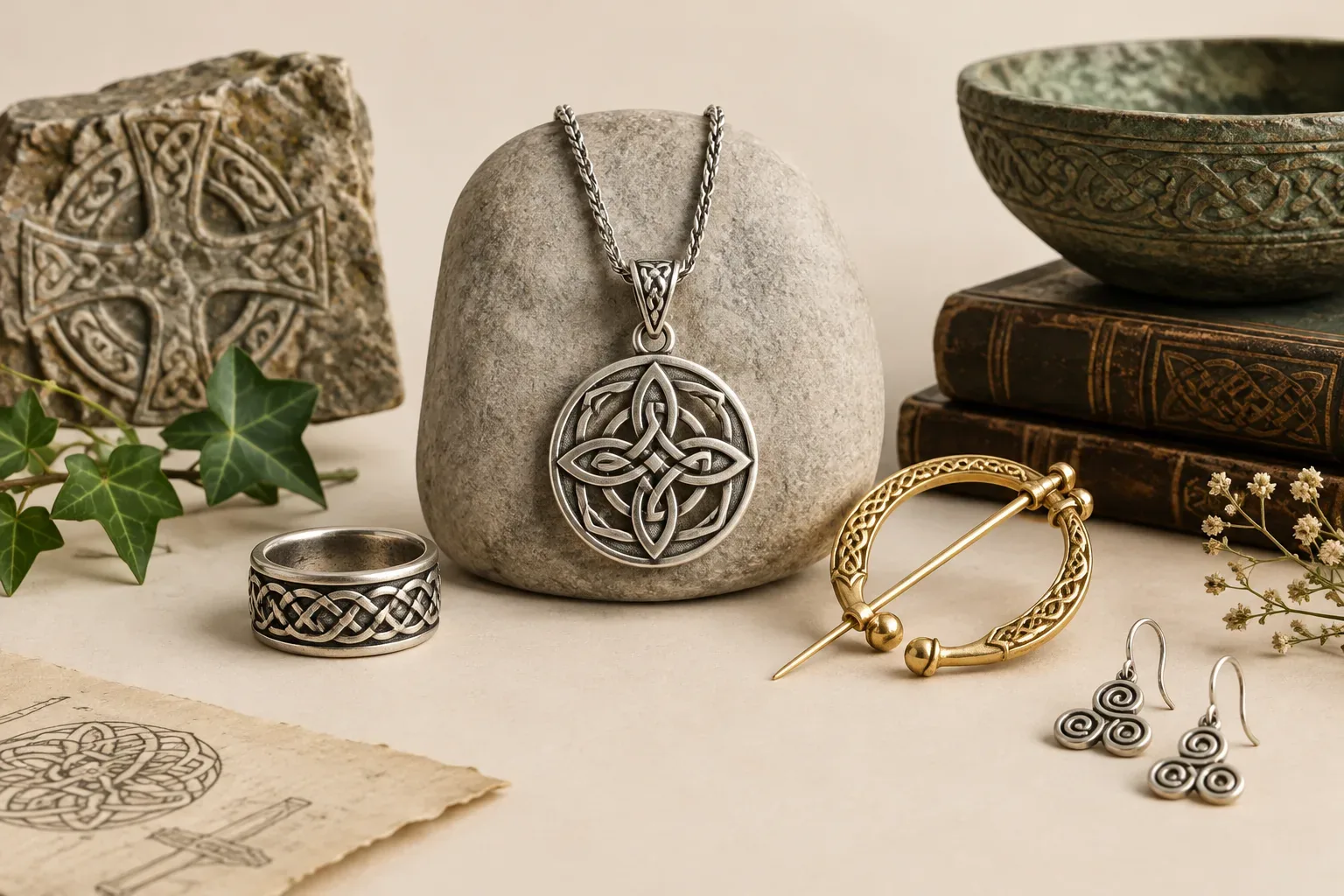
Revival and contemporary pieces draw on historical forms in specific ways. Knotwork and interlace are frequently stylized into pendants, rings, and bracelets as continuous-line designs cut into metal, engraved, or produced in filigree. Spirals and triskele motifs appear as engraved discs, cast charms, or as part of openwork brooches and pendants.
The Claddagh motif (hands, heart, crown) and other regionally-known designs have been popularized in the last two centuries and now exist both as traditional tokens and as commercial variants. Whether a piece is an antique, a 19th-century revival, or a modern reinterpretation will often show in finishing techniques, hallmarks, and construction methods; the V&A’s account of jewellery history emphasizes these material and technical clues when dating objects.
Gemstones and materials also follow historical echoes and modern supply chains. Historically used materials (amber, glass, gold, and local stones) are recreated alongside modern gems and treated stones. For reliable information about gemstone treatments, disclosures, and industry standards, the U.S. Federal Trade Commission provides consumer guidance on what sellers should disclose about treated and synthetic gems.
Practical guidance for selecting Celtic-style jewelry
Decide what you want the piece to do: represent historic continuity, express a personal meaning, or simply provide an aesthetic inspired by certain motifs. If historical authenticity matters, look for clear provenance, museum-style documentation, maker’s records, or recognized hallmarks and ask whether the piece is an original, a documented period reproduction, or a contemporary design.
Examine materials and disclosure. Ask the seller to confirm metal type, karat or silver fineness, and any surface treatments. For gemstones, request written confirmation of identity and any treatments or synthetics; the FTC’s consumer guidance explains common treatments and the obligation of sellers to disclose them.
Choose maker transparency over marketing labels. Reputable makers will explain their research into motifs, note whether a design is a direct copy of a historic pattern or an interpretation, and describe fabrication methods. That information lets you evaluate whether the piece is a respectful revival, a commercialized appropriation, or an inventive contemporary work.
Respectful and informed gifting
When giving Celtic-style jewelry as a gift, be mindful of the recipient’s relationship to the cultures referenced. If the wearer identifies with an Irish, Scottish, or other regional heritage, a well-researched piece with provenance may be welcome. If the recipient does not share that background, frame the gift as an aesthetic choice or personal-symbol gift rather than a claim about ethnic identity.
Avoid claiming that a motif has one immutable cultural or spiritual meaning. Instead, present what is documented and what is interpretative: tell the recipient if a meaning is a modern attribution or a revival-era interpretation. That approach respects both historical accuracy and the recipient’s personal relationship with the object.
Consider commissioning an artisan who is clear about their research and intentions. A custom piece lets you control materials and context and supports makers who treat historic forms with care.
Assessing quality and value
Look at construction and finishing: solder joints, symmetry of repeated motifs, and the crispness of engraving or casting give clues to quality. For metal, check for hallmarks or assay marks where applicable and ask for metal tests or certificates when buying high-value items.
For gemstones, ask for certification or written identification when the gem’s identity matters to price. Consult the V&A’s A–Z of Gemstones for a basic sense of how different stones figure in jewellery history and the kinds of materials traditionally used. Use FTC guidance to ensure sellers disclose treatments, which affect both value and care.
Bear in mind that the market for ‘Celtic’ jewelry includes mass-produced costume jewellery; such pieces can be attractive and meaningful but should be priced and cared for as fashion jewellery rather than as historic or high-value items.
Care, documentation, and next steps
Ask your seller for care instructions specific to the metal and any gemstones. Keep receipts, maker information, and any certificates together; these form the provenance record that matters for future resale or donation.
If you are researching an item’s history, look for recognized institutional resources or catalogues and consider consulting specialists when provenance or authenticity matters. The V&A’s work on jewellery history is a good starting point to understand how styles have moved between periods and meanings.
Finally, let the piece mean what it means to you while being transparent about its context: distinguishing documented historical usage from revival-era or modern symbolism is both responsible and enriching.
Frequently asked questions
Is it authentic to call modern designs “Celtic”?
Many contemporary designs borrow motifs associated with historical Insular art, but calling a modern piece ‘Celtic’ is a stylistic descriptor rather than proof of continuous cultural use. If authenticity matters, ask the seller about provenance, maker notes, and whether the design is a documented reproduction or a modern interpretation.
How can I tell if a gem in a Celtic-style piece is treated or synthetic?
Ask the seller for written disclosure or a gem identification report. The U.S. Federal Trade Commission requires disclosure of many common treatments and synthetics; reliable sellers will state whether a stone is natural, treated, or lab-grown and provide documentation on request.
Are there motifs I should avoid wearing to be respectful?
There is no universal rule, but avoid claiming that a motif represents a single sacred or ethnic identity unless you can document that meaning. If a design is explicitly tied to contemporary religious practice or community symbols, seek guidance from knowledgeable community members before using it as a personal emblem.
Does a high price always mean authentic or historical?
No. Price can reflect materials, maker reputation, rarity, or marketing. Verify provenance, hallmarks, maker records, and material certificates to substantiate claims of authenticity or historical origin rather than relying on price alone.
Should I commission a custom piece if I want cultural accuracy?
Commissioning a thoughtful artisan who documents their sources and fabrication methods can be a good choice. Request details on the motifs’ origins, materials, and whether the design is an interpretation or a direct copy of a historic pattern.
How should I care for Celtic-style jewelry?
Follow care instructions for the specific metal and gemstones. Keep records of materials and any treatments, store pieces away from harsh chemicals and physical abrasion, and consult the maker for recommended cleaning methods to preserve finishes and stones.
Sources and further reading
- Bedazzled: A History of Jewellery — Victoria and Albert Museum
- An A-Z of Gemstones — Victoria and Albert Museum
- Buying Gemstones, Diamonds, and Pearls — Federal Trade Commission