Meaning at a glance
Documented museum evidence shows Celtic jewelry techniques developed in distinct cultural contexts and served social and economic functions; later popular meanings have layered modern spiritual or national interpretations. This article separates what the Victoria and Albert Museum records about craft, materials, and trade from contemporary uses of motifs and gives practical guidance for selecting and gifting Celtic-inspired jewelry.
What the historical evidence shows (cultures and periods)
Museum collections and catalogues treat what we call “Celtic” jewelry as the product of several related but distinct cultural and chronological traditions. The Victoria and Albert Museum places Celtic metalwork and ornament within a broad history of jewellery that highlights both continental Iron Age peoples who produced La Tène-style metalwork and the Insular art of the early medieval British Isles. Each of those traditions used characteristic forms and techniques and should be identified separately when possible rather than lumped together as a single monolithic “Celtic” style.
On the European continent, museum studies emphasize finely worked metal forms that circulated in elite exchange networks; in the British Isles, later Insular craftsmen adapted and reinterpreted similar decorative vocabularies into brooches, pins, and liturgical objects. The V&A’s survey of jewelry history underlines how changes in technique, patronage, and trade routes shaped what people made and why, so the same motifs can mean different things in different places and times.
Craft techniques and trade contexts documented by museums
Across the museum literature, including the V&A’s exhibitions and catalogues, several broad types of metalworking practice recur. Craftspeople used casting, hammering and forming, and fine wirework to achieve complex ornamentation; techniques such as repoussé (working metal from the reverse), chasing (refining a surface), and controlled joining allowed for raised decoration and openwork. These are technical categories visible in surviving objects and in V&A interpretation of jewelry history.
The V&A also places jewelry in a trade context: materials themselves could travel long distances and the finished objects circulated through gift exchange, elite display, and market networks. The presence of certain metals or encrusted stones in archaeological finds and museum collections demonstrates that craft, commerce, and status were tightly linked in the production and distribution of high-end ornament.
Motifs, gemstones, and traditions: documented uses versus modern meanings
Museum documentation tends to treat motifs and gemstones descriptively and in context. For example, interlace patterns, spirals, and stylized animal forms appear in both continental and Insular works, and the V&A explains these as recurring decorative vocabularies rather than single, fixed symbols with one agreed meaning. Archaeological context and comparanda help curators suggest functions — such as personal display, emblematic decoration on clothing fastenings, or liturgical use — rather than asserting universal symbolic readings.
Gemstones and glass in historic pieces are described by material and provenance. The V&A’s A–Z of Gemstones provides context on how certain stones were identified and valued historically and how their physical properties influenced use in jewelry. Modern narratives that attach specific spiritual or protective properties to a motif or a stone are contemporary readings and not necessarily documented for each historical culture. Separate those personal or neo-traditional meanings from the material evidence when you interpret a piece.
How Celtic motifs and gemstones appear in jewelry today
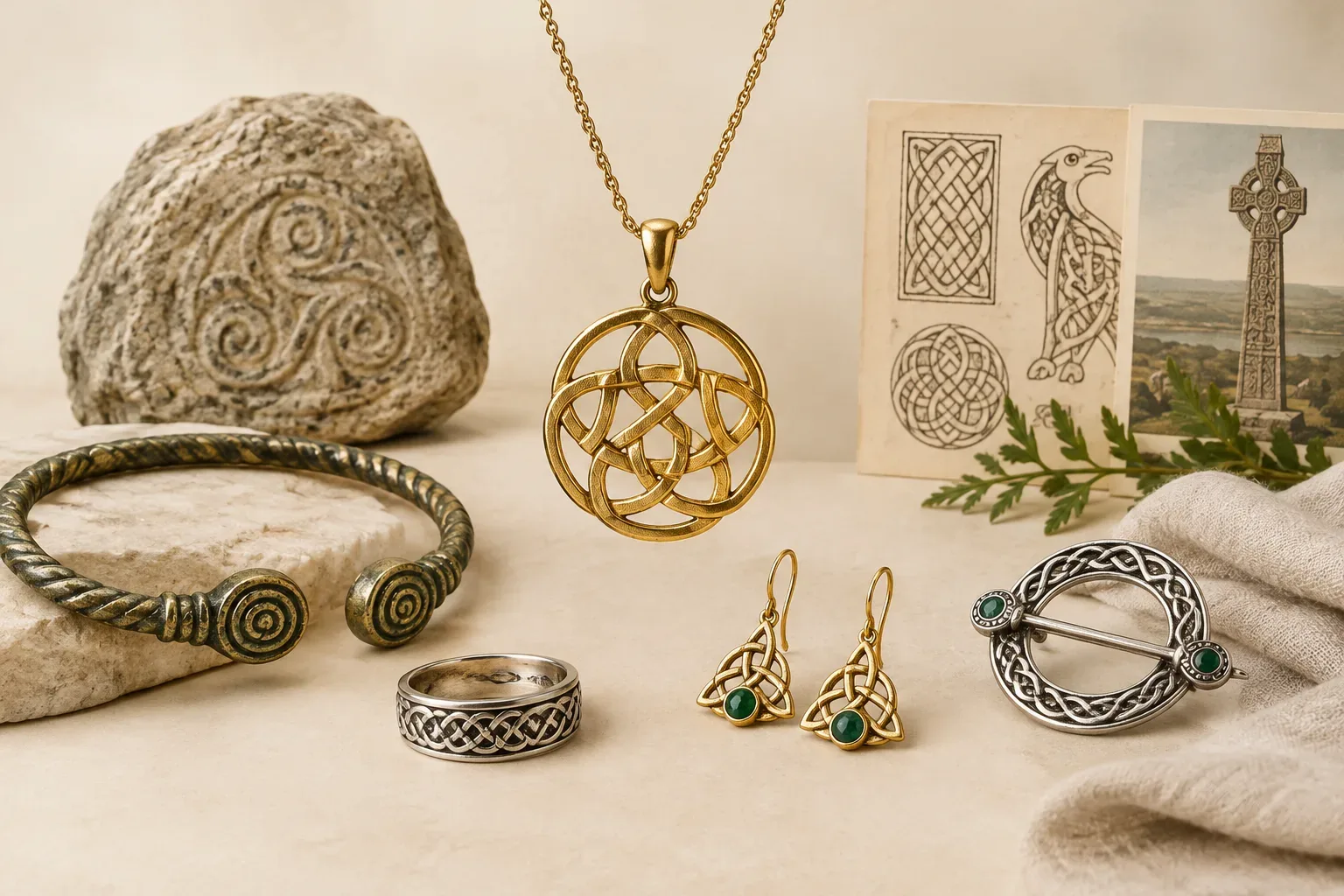
Contemporary makers and manufacturers draw on historic forms and motifs in many ways. Knotwork, spirals, and zoomorphic interlace appear as engraved or cast patterns on rings, pendants, brooches, and cufflinks. Some designers work from historical models and employ traditional hand techniques; others use CAD and casting to reproduce motifs on a larger, more affordable scale. Museums such as the V&A document both the historic originals and the ongoing revival of these motifs in modern production.
Gemstones commonly associated with ‘Celtic’ or historic-styled pieces today—such as garnet, amber, and various chalcedonies—are used for their colour and period resonance. The V&A’s gemstone guidance helps identify materials and explains historical preferences, while contemporary pieces may also use simulated gems or treatments. The Federal Trade Commission’s guidance on buying gemstones recommends that sellers disclose treatments and imitations so buyers can make informed choices.
Separating documented historical meanings from modern personal interpretations
If you are researching a particular object or motif, start with museum attributions and provenance. The V&A and similar institutions frame what is documented: where an object was found, how it was made, and how comparable items have been interpreted by scholars. When there is a clear archaeological context indicating function — for example, a brooch found in a burial or a piece catalogued with a secure find-spot — that evidence is the strongest basis for historical interpretation.
Modern spiritual, nationalist, or personal meanings attached to motifs are valid as contemporary cultural practices but should be presented as later layers of meaning. Avoid treating recent attributions as if they were historically documented facts. Distinguish in your language whether a claim is archaeological and museum-based or whether it is a modern reinterpretation.
Practical, respectful guidance for selecting and gifting Celtic-inspired jewelry
Decide whether you want a historically faithful piece, a contemporary reinterpretation, or a fashion item. If authenticity to museum forms matters, look for makers who explain their sources and methods and who can discuss how their design relates to specific artifacts or regional styles. The Victoria and Albert Museum’s work on jewelry history is a good reference point to understand how objects are classified and described.
Ask sellers about materials and treatments. The Federal Trade Commission recommends that buyers request disclosure of gemstone treatments, synthetics, and imitations. For gemstones, request testing or certification when accuracy matters and be wary of claims that a stone has a specific ancient provenance unless documentation is provided.
Consider cultural sensitivity. Recognize that many so-called Celtic motifs are tied to distinct communities and historical contexts. Gifting a piece as a symbol of heritage is often appreciated if the giver understands and respects that heritage; avoid claiming that a motif has a universal sacred power. If you are buying as a meaningful gift, include a note explaining what the motif means to you personally and, where possible, cite the historical source or maker who inspired the design.
Balance durability and wearability. Traditional techniques often produced robust objects made for everyday use. For a piece meant to be worn daily, choose solid metals and secure settings; for occasional wear, more delicate filigree or plated finishes may be acceptable. Ask the maker about repairability and care recommendations so your gift can be preserved.
Documentary and buying resources
For further reading on jewellery history and how authorities frame historical evidence, the Victoria and Albert Museum’s exhibition material and articles are an accessible starting point. Their work emphasizes material culture, craft techniques, and changing social contexts for jewellery.
For practical information on gemstones, including identification and historical context, consult the V&A’s A–Z of Gemstones. For consumer protection and disclosure standards related to gem treatments and imitations, see the Federal Trade Commission’s guidance on buying gemstones, diamonds, and pearls.
Closing note
Celtic jewelry techniques are best understood as a set of related craft traditions that evolved in specific cultural and trade contexts. Museums like the Victoria and Albert Museum provide the foundation for those documented claims; modern makers and wearers then add meanings and uses that reflect contemporary identities. Recognizing the difference lets you enjoy and share these designs with both historical awareness and personal respect.
Frequently asked questions
Are Celtic knots religious symbols?
Museum documentation treats knotwork and similar motifs as decorative forms that recur across many objects and contexts; the Victoria and Albert Museum presents these patterns as part of a decorative vocabulary rather than as a single, documented religious symbol. Later spiritual or neo-traditional claims about knotwork are modern interpretations and should be distinguished from the archaeological record.
How can I tell if a piece is an authentic antique or a modern reproduction?
Provenance, maker documentation, and technical examination are the best indicators. Museums and reputable dealers provide provenance and condition reports; if those are not available, ask for scientific testing or an independent appraisal. The Victoria and Albert Museum’s approach to jewelry history emphasizes context and comparanda when assessing authenticity.
Which gemstones were used historically in Celtic-style jewelry?
The Victoria and Albert Museum’s A–Z of Gemstones explains that a variety of stones—both local and imported—appear in historical jewellery, chosen for colour and availability. Modern pieces may use natural, treated, or synthetic stones; consult sellers about treatments and ask for disclosure as recommended in the Federal Trade Commission’s guidance on buying gemstones.
Should I be concerned about cultural appropriation when wearing Celtic designs?
Wearing Celtic-inspired jewelry is not inherently inappropriate, but cultural sensitivity matters. Learn the specific cultural context of the motif, buy from makers who acknowledge sources and inspirations, and avoid claiming a historic or sacred status for a motif unless it is clearly documented. Thoughtful attribution and respectful presentation make such gifts and purchases more appropriate.
What questions should I ask a seller when buying Celtic-style jewelry?
Ask about the design’s historical inspiration, the maker’s process, materials and any gemstone treatments, and provenance if the piece is marketed as antique. The Federal Trade Commission recommends that sellers disclose gem treatments and imitations, so request that information in writing before purchase.
Sources and further reading
- Bedazzled: A History of Jewellery — Victoria and Albert Museum
- An A-Z of Gemstones — Victoria and Albert Museum
- Buying Gemstones, Diamonds, and Pearls — Federal Trade Commission