Meaning at a glance
Explain the documented history and changing contexts of the celtic jewelry identification motif, separate cultural or religious evidence from later popular interpretations, and give practical guidance for choosing and wearing the motif in modern jewelry.
Quick answer
The term "Celtic" in jewelry identification covers motifs and forms that originated in multiple periods and places—principally medieval Insular art and later revival styles—and does not have a single, universal symbolic meaning. Museum scholarship emphasizes that many motifs began as decorative or status markers and were reinterpreted over time; modern sellers and makers often add new personal or spiritual meanings. When identifying a piece, look first at documented design features, materials, and manufacturing techniques to place it historically, then treat spiritual or symbolic claims as contemporary interpretations unless backed by specific historical sources (for example, museum catalogues or archaeological reports).
What collectors and shoppers mean by "Celtic"
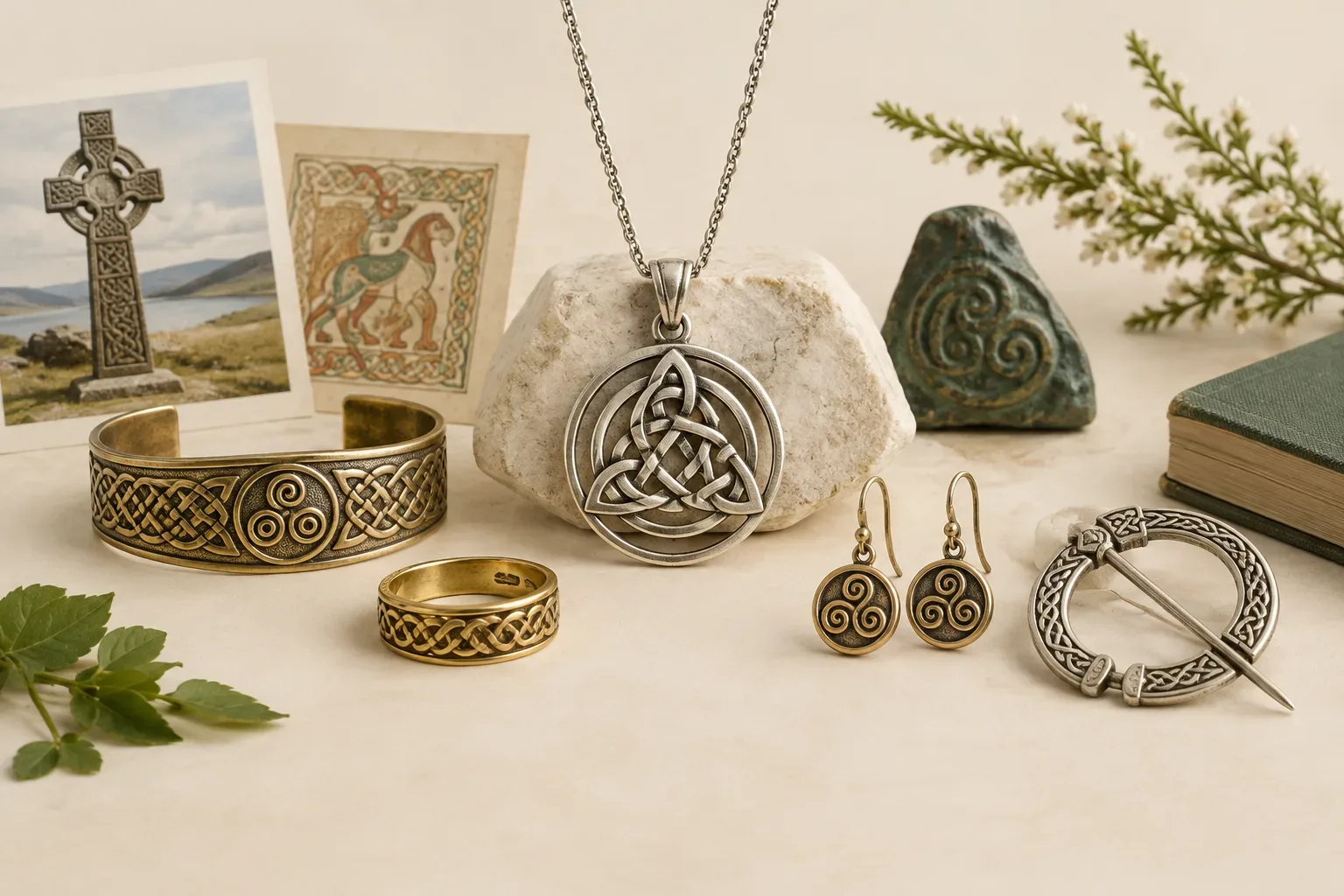
In contemporary jewelry markets, "Celtic" is a broad label applied to knotwork, spirals, triskele-like forms, stylized animals, and certain brooch or ring types. The label bundles imagery from distinct times and cultures: chiefly the Insular art of medieval Ireland and Britain and later historicizing movements that revived or reinterpreted those forms.
The Victoria and Albert Museum frames jewelry as a changing social practice and stresses that design meanings evolve with context. Use that perspective when you see the word "Celtic"—it is useful shorthand for a family of motifs but not a precise cultural or chronological identifier.
Historical evidence and the cultures or periods involved
Most motifs now called "Celtic" can be traced to two broad historical contexts. The first is Insular art, the style that developed in early medieval Ireland and Britain and appears in manuscripts, metalwork, and stone sculpture. These objects combine interlace, spirals, and animal ornament in complex, often abstract compositions. Museum histories, including catalogues and overviews from the Victoria and Albert Museum, explain how such motifs were used in personal and ecclesiastical objects and how design related to status and craft tradition rather than fixed symbolic language.
The second important context is the later historicizing or revival movements that reintroduced and reshaped these motifs for new audiences. During revival periods—when makers and collectors intentionally looked back to medieval models—designs were adapted to contemporary tastes and meanings. The Victoria and Albert Museum emphasizes jewellery's changing social role, showing how revival-era pieces often reflect the values and narratives of their own time rather than those of the earlier cultures they imitate.
Documented historical meanings vs modern interpretations
Documented historical meanings are rare and specific. Where museums and archaeological reports can link a motif to a context—such as ornament on a high-status brooch—they tend to interpret it in social, aesthetic, or craft terms: a sign of wealth, regional style, or workshop practice. The Victoria and Albert Museum’s work on jewellery history stresses social function and changing context rather than one-to-one symbolic translations.
Modern personal or spiritual interpretations—for example, claiming that a particular knot guarantees protection, eternal love, or a specific religious belief—are usually contemporary attributions. Those meanings are valid for personal expression but should not be presented as universal historical facts. Treat modern symbolism as part of the living history of a motif: meaningful to the wearer now, but not necessarily documented in the period when the motif first appeared.
How these motifs, gemstones, and traditions appear in jewelry
Motifs: Knotwork and interlace often appear as surface decoration on brooches, penannular rings, pendants, and rings. Spirals and triple-spiral (triskele-like) forms may be incised, cast, or formed in silver or bronze. Stylized animal heads or zoomorphic interlace are common on high-status metalwork. In revival and contemporary pieces, these designs are frequently simplified, repeated, or combined with modern settings.
Gemstones and materials: Historically, a range of materials were used—precious metals for high-status pieces and glass, enamel, or semi-precious stones for inlay and accent. The Victoria and Albert Museum’s guidance on gemstones emphasizes that material choice reflects availability, fashion, and social meaning at the time. In the modern market, green stones (such as emerald, peridot, or treated/imitated materials) are often used because they evoke an association with Ireland or nature, but the stone alone does not confirm a historical origin.
Manufacture and finish: Look at construction details—how a stone is set, soldering marks, tool marks, and wear patterns. Historic hand-forged work will show different tool traces than mass-produced cast reproductions. Museum studies of jewelry history highlight such technical details as key evidence when dating and attributing pieces.
Common mislabels and how to spot them
Mislabels fall into three common types: attributing a modern piece to an ancient period, calling a generic knotwork design "authentic Celtic" without provenance, or assigning an invented symbolic meaning as if it were historically documented. To spot these problems, ask for provenance documentation, photographs of hallmark or maker’s marks, and any conservation or appraisal reports. Compare construction techniques to museum descriptions of historic objects—the Victoria and Albert Museum’s materials on jewellery history can help you understand period-appropriate techniques.
Also be alert to material claims. The Federal Trade Commission provides guidance on disclosure: sellers must not misrepresent treatments, imitations, or the nature of gemstones. If a seller advertises an expensive stone, ask for testing or certification and whether the stone is natural, treated, synthetic, or an imitation.
Practical and respectful guidance for selection and gifting
Decide whether you want historical authenticity, revival-style aesthetics, or a modern piece inspired by "Celtic" motifs. For genuine historic objects, seek reputable dealers, auction catalogues, or museum-verified provenance and be prepared for conservation concerns and higher prices. For revival or contemporary work, assess the maker’s reputation and the quality of materials.
When gifting, consider the recipient’s background and beliefs. If a design references a specific cultural tradition, gifting with respectful context is appropriate—mentioning the design history and whether the piece is a modern interpretation can help. If a symbolic meaning is important to the recipient, choose a maker who confirms the intended symbolism in writing rather than relying on generalized claims.
Verify materials and treatments. Ask sellers to disclose gemstone treatments, synthetic origins, or whether gold and silver are plated or solid. The FTC’s consumer guidance recommends such questions to avoid surprises about value and care requirements. Finally, prefer makers who acknowledge the historical sources for their designs and who credit inspiration rather than implying direct cultural or ancestral continuity when that cannot be documented.
Practical checks and care tips
For authenticity and value, examine maker’s marks, hallmarks, soldering, and setting techniques; request written provenance where possible. For gemstones, consider independent testing if the stone is costly or the seller’s claim seems vague; the Victoria and Albert Museum’s materials on gemstones remind us that appearance alone can be misleading.
Care for pieces according to their materials: precious metals and traditional stones require different cleaning and storage than plated or composite pieces. Always follow the maker’s care instructions, and when in doubt seek a professional conservator for historically significant items.
Frequently asked questions
How can I tell if a piece is genuinely medieval or a modern replica?
Ask for provenance, maker’s or auction records, and high-resolution images of hallmarks and construction details. Compare tool marks, soldering, and setting techniques with museum descriptions of historic pieces. For expensive items, seek an independent appraisal or ask for lab testing; reputable sellers will provide documentation or allow third-party inspection.
Do specific Celtic knots have documented historical meanings?
Historically, many knot and interlace designs functioned as decoration or markers of style and status rather than fixed symbolic messages; museum scholarship, such as the Victoria and Albert Museum’s studies, tends to emphasize social and craft contexts. Modern attributions of fixed meanings are normally contemporary interpretations.
Are gemstones in "Celtic" jewelry special or symbolic?
Gemstone choice often reflects fashion, color symbolism, or availability. The Victoria and Albert Museum’s gemstone resources explain historical uses and materials. The FTC advises buyers to ask sellers about treatments, synthetic origins, and imitations before relying on a gemstone’s purported value or symbolism.
Is it respectful to wear or gift "Celtic" jewelry if I am not of Celtic heritage?
Yes, provided you choose pieces thoughtfully and avoid claiming ancestral or sacred meanings that cannot be documented. When gifting, explain whether the piece is a modern interpretation or an authentic historic object, and respect the cultural origins by crediting inspiration rather than asserting false provenance.
What should I ask a seller before buying?
Request provenance, maker or hallmark photographs, details of materials and gemstone treatments, and return or appraisal policies. If a seller claims historical or symbolic meaning, ask what evidence supports that claim. The Federal Trade Commission recommends clear disclosure of treatments, synthetic stones, and imitations.
Sources and further reading
- Bedazzled: A History of Jewellery — Victoria and Albert Museum
- An A-Z of Gemstones — Victoria and Albert Museum
- Buying Gemstones, Diamonds, and Pearls — Federal Trade Commission