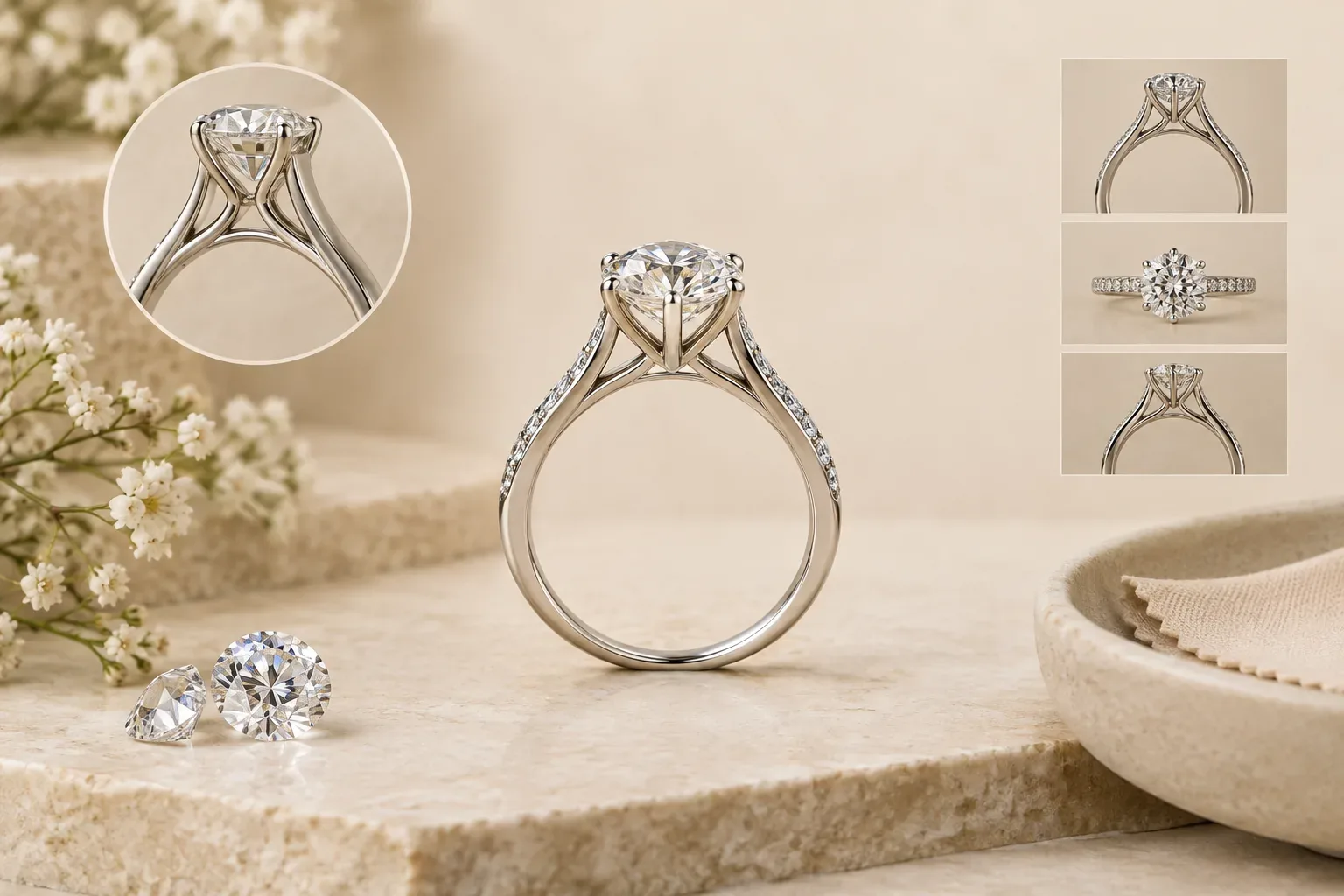
Meaning at a glance
A cathedral setting engagement ring raises the center stone on arching shoulders for elegance and presence; it suits buyers who want a lifted profile, classical lines, and visual drama but who accept slightly greater snag risk, potential cleaning needs, and the limits of home verification for stone identity and treatments.
What a cathedral setting is and how it appears in jewelry
In jewelry form, a cathedral setting places the center gemstone above the band on arches or raised shoulders that taper into the main shank. The arches can be metal work only, or they can be pierced or set with small side stones for additional sparkle. The visual effect is similar to an architectural cathedral arch: a raised, framed focal point with open space beneath the stone. Designers use this construction with diamonds and colored gemstones, in solitaire compositions and in designs that include side stones, pavé or milgrain decoration.
Documented historical evidence and what the approved sources say
The approved sources provided for this guide do not offer a documented origin story tying the cathedral setting to a specific culture or historical period. Contemporary trade and search data point to what customers are asking for today rather than to early provenance. For example, 2026 UK search estimates reported by Imaginaire Digital show strong consumer demand for engagement rings and other classic ring types, indicating continued popularity rather than historical attribution. Jewelers Mutual’s 2026 trends note that buyers are prioritizing craftsmanship, versatility and fluid forms—traits that help explain why elevated and architectural settings like the cathedral remain in fashion, but those observations are descriptive of current demand rather than of historical meaning.
Distinguishing documented history from modern personal interpretation
Because the sources here do not record a formal historical meaning or a direct cultural lineage for the cathedral setting, any symbolic interpretations you encounter today are modern and personal rather than universally documented. Contemporary owners, designers, and retailers may describe the cathedral silhouette as evoking protection, elevation, or architectural beauty, but that is a stylistic or emotional association rather than a verifiable historical meaning recorded in the approved references. Be careful when you read labels that claim a longstanding cultural symbolism: without explicit documentation from historical scholarship or primary records, those claims reflect marketing or personal interpretation, not established fact.
Pros: why shoppers choose a cathedral setting
A cathedral setting emphasizes the center stone by lifting it above the band and directing light into the gemstone, often producing a more striking presence on the finger. The raised shoulders can visually lengthen the finger and frame the stone attractively. The elevated architecture also makes it easier to show off a round, oval or emerald cut by increasing its apparent size. Because many cathedral settings offer space beneath the stone, they can accommodate design touches such as under-gallery detailing or contrast metal work that are popular with buyers who value craftsmanship, a trend noted by Jewelers Mutual for 2026.
Cons and practical trade-offs
The cathedral’s height and open space under the stone increase the chance of snagging on clothing and can make some daily activities awkward compared with lower-profile settings. The elevated stone and prongs may collect dirt more readily, requiring more frequent cleaning to maintain brilliance. Structurally, taller settings can place different stresses on prongs and the gallery; regular inspection by a jeweler is advised to ensure the stone remains secure. Budget-wise, the extra metalwork and possible side-stone labor can increase cost compared with a simple bezel or low solitaire setting.
Who the cathedral setting suits
A cathedral setting suits buyers who prioritize a pronounced center stone and appreciate architectural lines. It’s a strong choice for formal or vintage-inspired tastes, for people who want their ring to have visible presence, and for those who value the option of decorative under-gallery work. It is less well suited to highly physical lifestyles where snagging, impact or exposure to rough tasks is frequent, unless the wearer commits to protective habits or opts for a sturdier prong design and metal choice. Gender-neutral and modern styling trends favor adaptable designs; Jewelers Mutual’s trend research suggests buyers increasingly expect versatility, so consider how the ring will pair with daily jewelry choices and potential stacking.
Choosing gemstones and metal for a cathedral setting
The cathedral form works with diamonds and many colored gemstones, but stone hardness and toughness affect long-term suitability. Harder stones such as diamonds, sapphires and rubies are better for elevated settings because they resist abrasion and chipping. Softer gems require more care and may be better in lower settings. Treatments and enhancements can alter how a stone should be handled; the Gemological Institute of America (GIA) makes clear that treatments, detectability and special care are important consumer questions. Metal choice influences the look and durability: platinum gives strength at thin profiles, while gold alloys allow warmer or cooler color options and easier resizing in some cases.
Selection checklist: practical steps before purchase
Decide the primary priorities—appearance, daily wearability, or long-term durability—and examine candidate rings in multiple lighting conditions to judge how the raised setting displays the stone. Ask the seller for written disclosures about gemstone origin, treatments and whether the stone is natural, lab-created, treated, or an imitation; the Federal Trade Commission advises consumers to require clear written distinctions. Request any available grading reports for diamonds or lab reports for colored stones and confirm what the report covers. Verify sizing options and potential resizing costs because cathedral shoulders sometimes limit how much a ring can be resized without altering the design. If the ring will be a surprise gift, obtain a flexible return policy and an accurate size estimate from a trusted friend, family member, or pre-existing ring measurement.
What you cannot reliably verify at home
Without a qualified jeweler or gemological laboratory you cannot conclusively determine whether a diamond is natural versus lab-created, whether a gemstone has undergone heat or other treatments, or whether there are internal issues that affect durability. The FTC and the GIA both emphasize that these distinctions require written seller disclosure and laboratory testing. You also cannot reliably assess microscopic prong wear or internal cracks that may compromise the setting’s security; these require professional inspection and testing.
Care, maintenance and insurance
Routine care for cathedral settings includes regular gentle cleaning to remove build-up beneath the stone and between gallery arches, periodic inspection of prongs and the gallery by a jeweler, and prompt repair if any loosening is suspected. Follow guidance specific to the gemstone: for instance, certain treated stones and softer gems need milder cleaning and avoidance of ultrasonic machines—consult authoritative guidance such as the GIA’s materials on gem treatment for specifics. Consider insurance or extended warranty options; Jewelers Mutual and other professional bodies recommend coverage for loss, theft, and damage, especially for elevated settings whose structural repairs can be more costly.
Decision summary and limits of consumer verification
A cathedral setting is a stylistic choice favoring elevated display and decorative architecture. It trades greater presence and framing for a higher profile that can require more care and occasional professional attention. Use the selection checklist to align the setting with lifestyle and stone choice, insist on written disclosures for gemstone origin and treatments, and obtain any available grading or lab reports. Remember that final determinations about a stone’s treatment status, origin, or hidden structural concerns require a qualified jeweler or gemological laboratory; written documentation and professional inspection are the reliable routes to verification rather than visual appraisal alone.
Frequently asked questions
Is a cathedral setting good for everyday wear?
A cathedral setting can be worn daily, but its taller profile increases the chance of snagging and dirt accumulation. If you lead a very active or hands-on lifestyle, choose stronger prongs, harder gemstones like diamonds or sapphires, and plan for more frequent inspections and cleaning.
Will a cathedral setting make a small diamond look bigger?
Yes. The raised profile and tapering shoulders of a cathedral setting can enhance the perceived size of the center stone by increasing visible surface area and by lifting the stone into more light.
Can a cathedral setting be resized later?
Resizing is possible, but the presence of elevated shoulders or side decoration can limit how much a ring can be adjusted. Ask the jeweler about the planned range of resizing and any additional cost before purchase.
How do I verify if a diamond is natural or lab-created?
You should request written disclosure and a grading report. Conclusive verification requires testing by a qualified gemological laboratory; visual inspection alone is not sufficient, per FTC guidance.
Are there special cleaning rules for cathedral rings?
Yes. Clean beneath the center stone and in the gallery regularly with a soft brush and mild solution suitable for the specific gemstone. Avoid ultrasonic or steam cleaning for stones or treatments that the GIA advises against, and consult a jeweler if unsure.
Should I insure a cathedral setting engagement ring?
Insurance or a protection plan is recommended because elevated settings can incur repair costs if prongs or gallery elements are damaged. Professional insurers and trade bodies advise coverage for loss, theft and accidental damage.
Sources and further reading
- Imaginaire Digital — Imaginaire Digital
- Jewelers Mutual — Jewelers Mutual
- Gemological Institute of America — Gemological Institute of America
- Federal Trade Commission — Federal Trade Commission