Meaning at a glance
This guide explains documented Byzantine jewellery practices and motifs as described by museum research, separates historically recorded meanings from later personal or popular readings, and offers practical, ethically minded guidance for buying, wearing, and gifting revival or historic Byzantine-style jewellery.
Quick answer
The short answer: use museum-backed descriptions to understand what is documented about Byzantine jewellery, treat religious or cultural motifs with contextual sensitivity rather than assuming universal meaning, and apply practical buyer protections—provenance, condition reports, and disclosures about treatments or imitations—when choosing revival or antique pieces.
What the historical evidence actually shows
The Victoria and Albert Museum frames jewellery history through objects, techniques, and changing social contexts; its exhibitions and articles are a reliable source for what is documented about medieval and later historic jewellery styles. Museum catalogues and scholarship record that jewellery associated with the Byzantine world was notable for highly skilled goldsmithing, use of enamel work, and incorporation of precious stones and pearls. These items circulated as high-status personal adornment and as gifts exchanged within elite networks.
When we say “Byzantine” we refer to the material and visual traditions linked to the medieval Eastern Roman Empire and to later jewellery that consciously adopts those styles. The V&A’s collection and interpretive materials emphasize the continuity of certain techniques (for example, detailed metalwork and enamel) and the way motifs could move across geographic and chronological boundaries through trade and diplomatic exchange. Relying on a museum source helps separate object-based documentation from romantic or modern storytelling about a piece.
Separating documented historical meanings from modern interpretation
Museum documentation typically records what objects are, how they were made, and what contexts they were used in; it rarely endorses single, universal symbolic meanings for motifs. According to Victoria and Albert Museum material on jewellery history, many motifs in medieval and Byzantine-related jewellery served multiple functions: markers of rank, signs of piety, or simply fashionable ornament influenced by available materials and technical skills.
Modern sellers and wearers often layer contemporary meanings onto historic-looking pieces—for example, treating a revival cross pendant primarily as a personal spiritual emblem, or as a statement of fashion. Those modern interpretations are valid personal responses, but they are not the same as documented historical practice. The museum-based record should be the starting point for claims about what an object meant in its original context; personal or contemporary meanings should be acknowledged as recent and culturally specific.
How Byzantine motifs, techniques and gemstones appear in jewellery
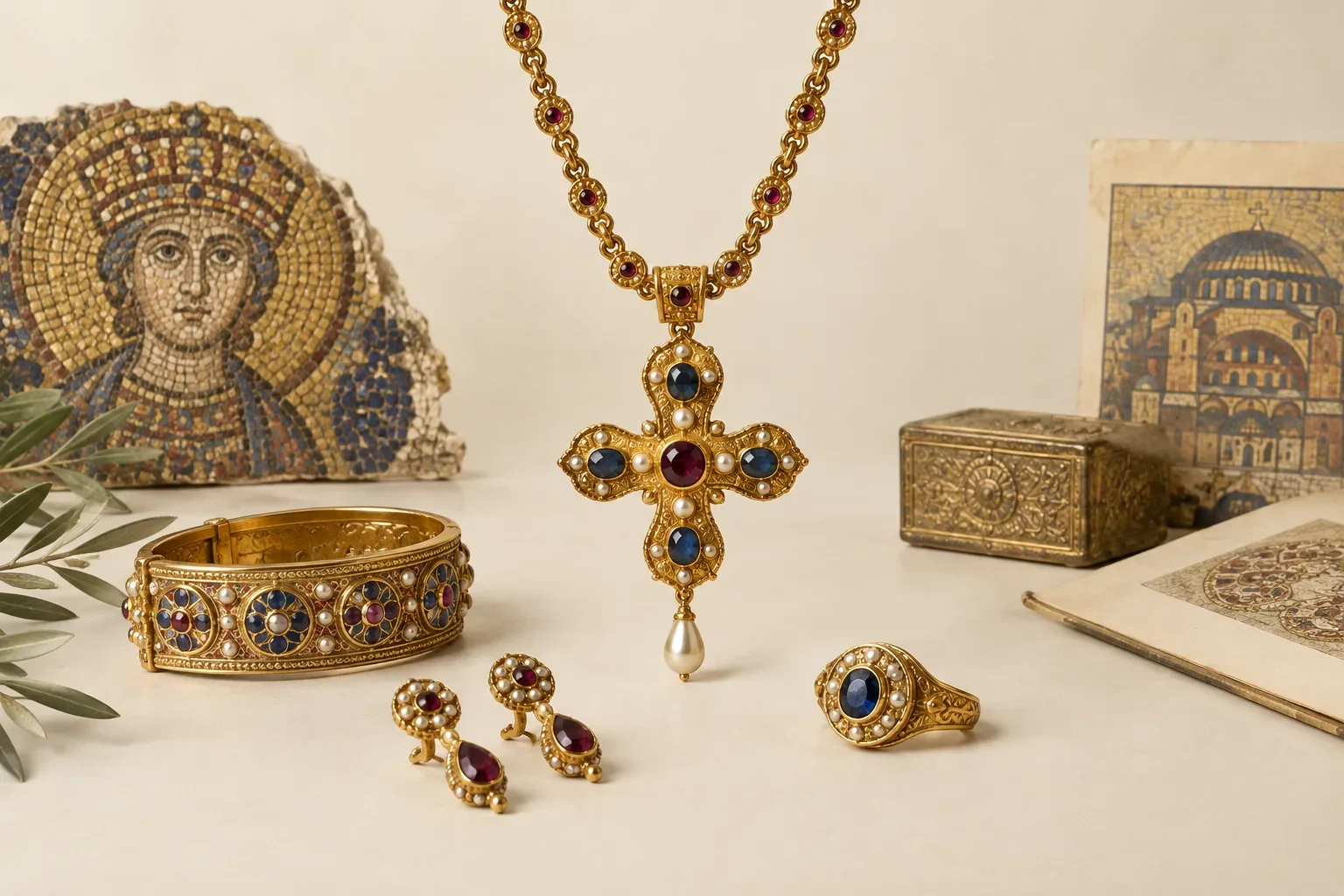
In both originals and revival pieces, certain technical and decorative features recur. Museums note techniques such as cloisonné and enamel, fine goldwork including granulation and filigree, and the setting of gems and pearls to create surface pattern and highlight form. Revival pieces reproduce these visual cues—enamel panels, heavy gold settings, and beaded or granulated borders—to evoke historic craftsmanship.
Gemstones and pearls appear in jewellery for their color, rarity, and surface effect. The Victoria and Albert Museum’s A–Z of Gemstones explains how different stones were used across time for aesthetic, status, and occasionally cultural reasons. In historic and revival Byzantine-style pieces you will often see richly colored stones and polished cabochons chosen to contrast with gold and enamel surfaces. Modern makers also use new materials and techniques to imitate those historic looks; contemporary pieces may include synthetic stones, glass, or treated gems that visually echo historic originals.
Assessing authenticity, condition and disclosure
When you are buying an antique or a revival piece marketed as “Byzantine,” ask for objective documentation. Provenance statements, condition reports, and clear photographs allow you to compare claims against the object. The Victoria and Albert Museum’s exhibitions underline that context matters: a piece’s documented origin, previous ownership, and how it entered a collection all affect its historical value and interpretation.
For gemstones and treatments, consult the Federal Trade Commission guidance on buying gemstones, diamonds, and pearls. The FTC advises buyers to ask whether gems are natural, treated, synthetic or imitation and to request written disclosure. Treatment types and the presence of laboratory certification materially affect value and appropriate care. Sellers should disclose treatments and whether a gemstone is a laboratory-grown substitute or a simulant.
Respectful selection and gifting guidance
Think about cultural and religious context before purchasing motifs explicitly associated with faith or identity. If a piece features sacred imagery—icons, crosses, or depictions of saints—recognize that for some recipients these images carry specific religious meaning, and for others they may be primarily decorative. If you are unsure, ask the intended recipient or choose a neutral motif inspired by the historic style rather than a clearly sacred image.
Select revival pieces and antiques using the same care you would for any important jewellery purchase. Prioritize sellers who provide clear photographs, provenance or makers’ information, and written disclosures about materials and treatments. For higher-value antiques, consider an independent appraisal or condition report that identifies repairs, restorations, and the stability of enamels and settings.
If you are buying a replica or contemporary piece in a Byzantine style as a gift, consider the maker’s approach to historical accuracy and to labour and material sourcing. Many modern jewellers explain whether their work is handcrafted or cast, which metals are used, and what kinds of stones. Ask whether a piece uses natural gemstones, lab-grown stones, or glass simulants, and whether any gemstones have undergone treatments; use FTC guidance to frame these questions.
Caring for historic and revival pieces
Historic jewellery with enamels, fragile settings, or delicate solder work should be handled conservatively. Museums advise limited wear for fragile historic pieces; if you intend to wear an antique item, ask a conservator or jeweller about stabilizing fragile elements and appropriate insurance. For revival and modern pieces, care depends on materials—gold alloys, plated metals, glass stones and treated gems all have different cleaning and storage needs.
When in doubt, consult a qualified conservator or a trusted jeweller before attempting repairs or deep cleanings. Conservators and museum documentation emphasize reversible and minimal intervention for historic objects; for modern pieces, choose reliable repair services that respect the maker’s techniques and materials.
Practical buying checklist (summary)
Before purchasing, verify the seller’s documentation, ask about provenance and condition, request written disclosure of gemstone treatments and lab-grown or imitation materials, and consider how the piece’s imagery relates to the wearer’s cultural or religious identity. Use reputable museum descriptions as a factual baseline for historical claims and rely on FTC guidance for gemstone disclosure and buyer protections.
Frequently asked questions
How can I tell if a piece is an authentic Byzantine-era object or a modern revival?
Authenticating an item requires objective evidence: provenance records, specialist condition reports, and comparison with museum-documented examples. Museums such as the Victoria and Albert Museum emphasise that stylistic similarity alone is not proof of age. If a seller claims an object is antique, request written provenance, high-resolution images of hallmarks or maker’s marks, and, for higher-value items, an independent appraisal from a qualified specialist.
What should I ask about gemstones and treatments when buying Byzantine-style jewellery?
Follow the Federal Trade Commission’s guidance: ask whether gemstones are natural, treated, synthetic, or simulants and request written disclosure. Ask for laboratory certificates if available, and clarify any stabilizing or enhancing treatments. Sellers should disclose treatments and whether gems are lab-grown or imitation, because those factors affect value and care.
Is it respectful to wear jewellery with religious imagery if I don’t belong to that faith?
Respect depends on context and individual sensibilities. Many people treat historic religious images as cultural or artistic motifs, while others regard them as sacred. If in doubt about a gift or public wearing, ask the intended recipient about their sensitivities or choose a piece inspired by the style without explicit sacred imagery.
How should I care for a fragile historic or enamelled Byzantine-style piece?
Museums recommend conservative handling for fragile historic objects. Avoid wearing delicate antiques daily, store items in stable conditions away from extreme humidity and sunlight, and consult a conservator or a reputable jeweller before cleaning or repairing. For modern pieces, follow care instructions based on materials—gold alloys, plated metal, treated gems, and glass simulants all need different approaches.
Can I rely on a seller’s description on online marketplaces?
Seller descriptions are a starting point but should be verified. Seek sellers who provide detailed photographs, written disclosure about materials and treatments, and a transparent returns policy. For higher-value purchases, request documentation and consider an independent appraisal.
Sources and further reading
- Bedazzled: A History of Jewellery — Victoria and Albert Museum
- An A-Z of Gemstones — Victoria and Albert Museum
- Buying Gemstones, Diamonds, and Pearls — Federal Trade Commission