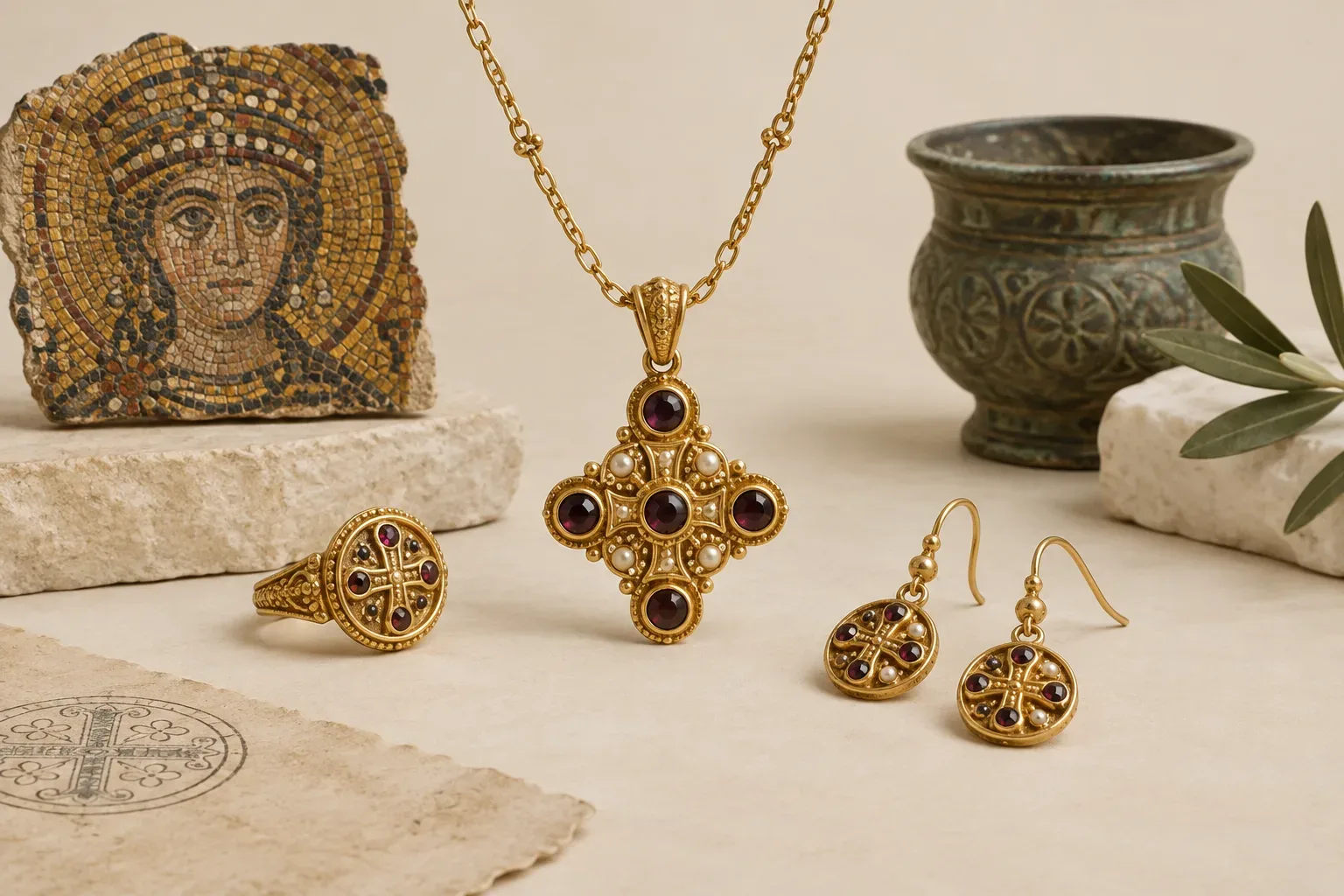
Meaning at a glance
Document the historical forms, materials, and symbolic uses of jewelry made in the Byzantine world as recorded by museum research; separate those documented meanings from later or personal interpretations; and give clear, practical steps to spot mislabels and to choose or gift genuine or modern Byzantine-style pieces.
Quick answer
Byzantine jewelry identification should begin with the historical record: museum research shows that objects produced in the Byzantine world commonly feature Christian iconography, imperial and late-Roman motifs, elaborate goldworking techniques such as cloisonné and granulation, and a frequent use of garnets, glass and pearls in high‑status items. Modern sellers often reuse the term “Byzantine” to describe a look—heavy gold, certain chain patterns, or garnet-like inlay—that may be a revival or a marketing label rather than an antique object. Documented history and archaeological study are the best sources for identifying authentically Byzantine pieces, while consumer-protection guidance helps you test claims about materials and treatments.
What the historical evidence shows (and which culture and period that covers)
When we speak of “Byzantine” jewelry in a historical sense we mean objects produced in the Eastern Roman Empire and its cultural sphere. According to the Victoria and Albert Museum, the Byzantine world inherited late Roman craftsmanship and blended Mediterranean and Near Eastern influences, producing distinctive jewellery over many centuries. The V&A frames Byzantine jewellery as part of a long, changing social and artistic history rather than a single uniform style.
Museum scholarship groups the surviving evidence—liturgical pieces, burial finds, and objects preserved in collections—by technique and iconography rather than by a single provenance. This is why identification relies on a combination of stylistic comparison, technical analysis (how a piece was made), and documented find‑spots or provenance, as explained in the V&A’s work on jewellery history.
Documented motifs and what the historical record attributes to them
Contemporary Byzantine jewellery commonly uses Christian imagery in explicitly religious contexts: crosses, small icons and Christ or saint figures appear on reliquary pendants and liturgical fittings. The V&A’s catalogue of jewellery history associates these motifs with devotional use and public display of faith rather than later sentimental meanings.
Imperial and imperializing motifs—such as stylized eagles, diadems and medallion portraits—reflect courtly identity and ties to imperial power in the surviving corpus. Where jewellery was used to display rank and alliance, these motifs functioned as political and social signifiers in addition to any personal devotion, a distinction emphasized in museum narratives.
Animal and vegetal ornament, geometric patterns, and repeating palmettes derive from a wider Mediterranean and Near Eastern decorative vocabulary. These motifs often served ornamental and symbolic roles familiar across several neighboring cultures; careful attribution relies on context and technique rather than motif alone.
How motifs, gemstones and techniques actually appear in Byzantine pieces
Technical features are as informative as iconography. The V&A and comparable museum research note particular goldworking techniques such as granulation and filigree, and the use of cloisonné settings filled with glass or garnets. In the best-preserved examples, small garnets (or garnet-like glass) are cut and set in cells formed by thin gold wires, a technique that creates the characteristic richly textured surfaces associated with Byzantine high-status jewellery.
Pearls and carved gems also appear, often bezel-set in plain gold frames or used as punctuating highlights around a central motif. Enamel—where used—tends to be applied in reserved panels, and engraved gems (intaglios and cameos) survive on signet rings and personal seals.
Construction details—how a loop is soldered, how a chain is formed or how granules are attached—are robust indicators of period technique. The V&A encourages comparison with securely dated examples in museum collections when assessing an object’s origin.
Which meanings are documented and which are later or personal interpretations
Museum documentation supports specific, contextual meanings: crosses and icons on jewelry were used in devotional contexts; imperial images signaled rank or patronage; and precious materials indicated wealth and access to trade networks. These are the kinds of attributions grounded in archaeological context and contemporary texts that museums like the V&A report in their histories.
By contrast, many modern interpretations—such as reading a small decorative palmette as a universal good‑luck symbol, or assuming every garnet in a pendant represents a particular saint—are personal or retrospective readings rather than conclusions drawn from contemporary Byzantine evidence. Popular contemporary meanings often reflect modern tastes, nationalist narratives, or marketing choices and should not be conflated with the historical record.
Common mislabels and how ‘Byzantine’ is used today
The term “Byzantine” is frequently applied in three distinct ways by modern sellers: to authentic antiquities, to modern reproductions made in historic techniques, and to contemporary jewellery that borrows the visual vocabulary (heavy gold surfaces, garnet-coloured inlay, ornate chains). The result is an inconsistent market where the same label can mean very different things.
Mislabels can arise through honest confusion or deliberate marketing. The Federal Trade Commission’s guidance on buying gemstones and pearls highlights the need for sellers to disclose treatments, imitations, and whether an item is an original or a modern copy. If a listing calls a piece “Byzantine” but gives no provenance, no hallmarks, and no technical description, treat the label as stylistic rather than automatic proof of age.
Practical steps for identification, selection and respectful gifting
Begin with your intention: do you want an authenticated antique, a high-quality modern reproduction using historic techniques, or a piece that simply carries the Byzantine look? Each choice requires different questions and different standards of proof. For an antique, ask for provenance, condition reports, and comparison to museum examples; for a reproduction, ask about workmanship and materials; for a style purchase, judge by aesthetic and budget.
Request written disclosures about materials and treatments. The FTC recommends that sellers disclose treated or simulated gemstones and should be able to identify whether a stone is natural, lab-grown or imitation. For gold, ask for karat marks and, when possible, independent assay or X‑ray fluorescence testing in professional contexts.
Examine construction and wear. Authentic historic pieces often show tool marks, patina and wear consistent with age; reproductions may show modern soldering techniques, machine‑finished joins or uniform modern polishing. If the seller claims museum-quality authenticity, seek independent verification from a qualified conservator, auction house specialist or academic comparison.
Be culturally and religiously respectful when gifting. If the object features explicit Christian iconography, recognize it as a devotional emblem in its historical setting; some recipients may prefer a secular version of the motif. Explain whether the piece is an antique, a reproduction, or a contemporary design so the recipient understands its context and significance.
When buying online or from a private seller, use your right to return if documentation is inadequate. For investment or valuable pieces, obtain a condition report and written provenance before completing purchase.
Short conclusion
Byzantine jewellery identification rests on combining stylistic, technical and documentary evidence. Museum scholarship provides the baseline for historical attributions, and consumer‑protection guidance helps you evaluate material claims. Separating the documented, contextual meanings recorded by museums from later popular readings protects both the history and the respectful use of these motifs in modern jewellery.
Frequently asked questions
How can I tell if a piece is genuinely Byzantine?
Look for provenance, museum or auction documentation, and technical indicators such as granulation, cloisonné garnet inlays, and construction consistent with hand tools. Compare the object with dated museum examples and request independent verification for high-value pieces. The Victoria and Albert Museum recommends combining stylistic and technical comparison with documented find‑spots or provenance when possible.
Are garnet‑inlaid pieces always Byzantine?
No. Garnet cloisonné is characteristic of many high‑status Byzantine pieces but the technique is also found in neighboring cultures and is widely revived in modern jewellery. Use museum comparison and ask for testing or provenance rather than relying on the presence of garnet alone; the V&A’s gemstone guidance can help you assess materials.
What does the FTC recommend when buying claimed antiques or gemstone jewellery?
The Federal Trade Commission recommends that sellers disclose treatments, imitations, and whether a gemstone is natural, lab-grown or simulated, and that buyers ask for written disclosures. For high-value purchases, obtain independent testing and documentation.
Is it okay to gift jewellery with religious motifs from the Byzantine style?
Yes, provided you are respectful and transparent. Explain whether the piece is an antique, a reproduction, or a modern design, and consider the recipient’s beliefs and preferences. Historical context matters: many such motifs were devotional in origin, so clarity avoids misunderstanding.
Can modern ‘Byzantine’ chain or jewellery carry the historical meaning?
Modern pieces that borrow Byzantine visual elements can evoke the historical aesthetic but do not automatically carry the original social or religious significance. If historical meaning matters to you, look for properly documented antiques or for modern makers who clearly explain which traditions they are referencing.
Sources and further reading
- Bedazzled: A History of Jewellery — Victoria and Albert Museum
- An A-Z of Gemstones — Victoria and Albert Museum
- Buying Gemstones, Diamonds, and Pearls — Federal Trade Commission