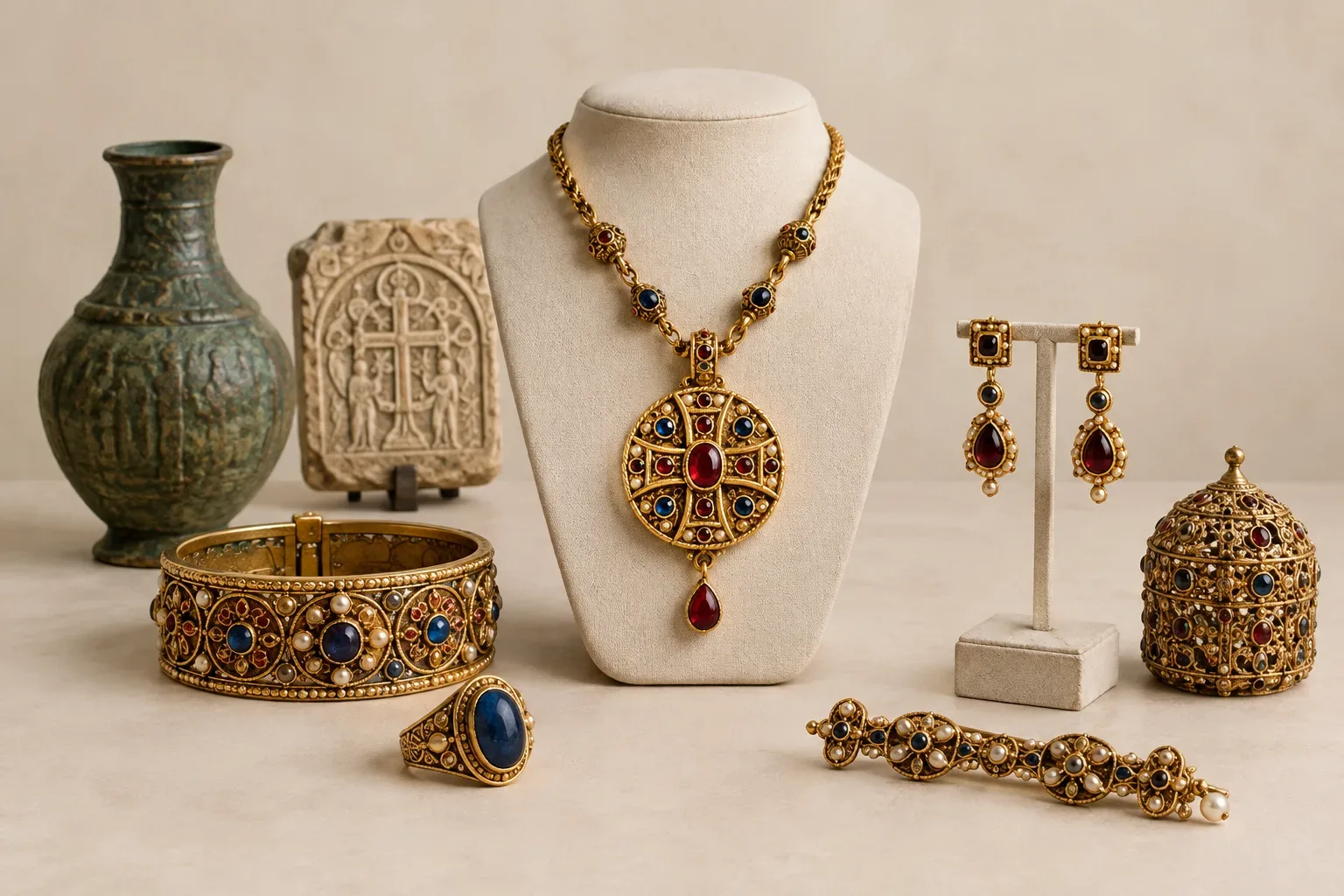
Meaning at a glance
Explain the documented history and changing contexts of the byzantine jewelry techniques motif, separate cultural or religious evidence from later popular interpretations, and give practical guidance for choosing and wearing the motif in modern jewelry.
What the historical evidence shows and which cultures it describes
Museum scholarship treats Byzantine jewellery within the longer history of late antiquity and the medieval Eastern Roman, or Byzantine, world and the wider Mediterranean trade networks that supplied materials and influence. The Victoria and Albert Museum's materials on jewellery history emphasize that jewellery practices change with social context, technology and trade, and that surviving objects reflect workshop conventions and patronage rather than universal beliefs.
When discussing Byzantine jewellery techniques it is important to be precise about cultural frames. The term covers work produced in the Eastern Roman/Byzantine cultural sphere and in adjacent regions influenced by its court aesthetic. Surviving pieces and literary references show links to imperial ateliers, ecclesiastical commissions, and private elite consumption, and later medieval and Renaissance workshops sometimes adapted or revived Byzantine forms.
Documented craft techniques
The technical vocabulary associated with Byzantine jewellery—terms such as filigree, granulation, cloisonné enamelling, inlay and repoussé—describes specific goldsmithing and decorative methods that craftspeople in the medieval Eastern Mediterranean used and adapted. Surviving metalwork and technical studies reproduced in museum overviews show these are working techniques rather than symbolic shorthand.
Filigree uses fine gold or silver threads twisted and soldered into lace-like patterns, while granulation involves fixing tiny metal spheres to a surface to create texture and pattern. Cloisonné enamelling builds coloured glass compartments on a metal base, and gem-inlay places cut stones or glass into settings and cells. Each of these techniques leaves physical traces—tool marks, solder joins, and construction logic—that conservators and curators use to attribute objects to particular workshops or periods.
Trade, materials and gemstones
The visual richness of Byzantine jewellery depended on access to precious metals, gemstones and pearls obtained through long-distance trade. Museum discussions of gemstones note that many materials found in medieval Mediterranean jewellery were moved along established trade routes linking the Mediterranean, the Near East, and beyond.
The Victoria and Albert Museum's introductory materials on gemstones emphasize that jewellery historians look at both the geological source of a gem and evidence of cutting, mounting and treatment to understand an object's history. Identifying a garnet, amethyst, pearl or glass paste in a piece helps reconstruct trade relationships but does not, by itself, prove a single symbolic meaning across time and place.
Design motifs and how they functioned historically
Documented motifs in Byzantine-influenced jewellery include Christian iconography such as crosses and stylized saints, imperial symbols including monograms and eagles, geometric and vegetal ornament derived from late antique decorative traditions, and patterned use of cloisonné cells and gem settings. Museum collections show such motifs were often tied to the object's patronage or function: liturgical items for churches, insignia for court use, and richly decorated jewelry for elite display.
It is essential to separate what contemporaries intended the motif to convey from how later viewers have interpreted it. Museums studying these objects treat motifs as situated social signals that could communicate rank, civic or religious affiliation, or access to courtly luxury, rather than as fixed spiritual formulas.
Documented historical meanings versus modern personal interpretations
Historical meanings that can be documented in museum and archival study are those that link object type, findspot or provenance, and contemporary textual evidence to specific social functions: for example, a jeweled cross used in a liturgical setting or a diadem associated with imperial regalia. The Victoria and Albert Museum's narrative of jewellery history stresses that social context and contemporary use are the key evidentiary bases for such claims.
In contrast, modern personal interpretations—such as reading a Byzantine-style motif primarily as an amulet for protection or a generic symbol of 'mystery'—are contemporary attributions. They are valid as personal meanings but should not be conflated with documented historical functions unless supported by period sources. When using Byzantine forms today, acknowledge the difference between historically attested uses and your own or the recipient's modern symbolism.
How the motifs, gemstones and techniques appear in actual jewellery
In surviving objects and museum reconstructions, the techniques appear as construction choices: cloisonné cells outlined in gold and filled with enamel, small globular granules soldered into patterned fields, densely worked filigree panels attached to a gold backing, and gems set into bezels or in the cells of an enameled ground. These are tangible features you can look for when examining an object.
Gemstones appear either as polished stones set into metal settings or as cut glass and paste that mimic precious materials; the physical quality of the setting, the presence of foil or backing, and the way stones are secured provide clues to whether a gem is natural, imitation, or later restored. Museum guides on gemstones recommend assessing cutting style, surface wear and mounting to understand a stone's history and authenticity.
Practical and respectful selection and gifting guidance
When choosing a Byzantine-style or historically inspired piece, start by clarifying what you want the object to communicate: historical interest, aesthetic preference, personal symbolism, or religious devotion. If the recipient has a faith that uses particular symbols, respect that context and consider selecting a design that aligns with their beliefs and uses rather than re-purposing sacred imagery in a way that might feel inappropriate.
Ask sellers for provenance and condition information, and for full disclosure about treatments and imitations. The U.S. Federal Trade Commission recommends clear disclosure of gem treatments and synthetic materials when buying gemstones; request written confirmation if the seller cannot answer questions on treatment or origin. For valuable or purportedly ancient objects, consider a professional appraisal or a dealer associated with a recognized museum or trade body.
Practical care matters: techniques like enamel and filigree are delicate. Avoid ultrasonic cleaners on pieces with old enamel or fragile settings and store items individually to prevent abrasion. If you are buying a period object rather than new work, ask about conservation history, any restorations, and documentation in a catalogue or collection database.
Final note: provenance, ethics and research
Appreciating Byzantine jewellery techniques responsibly means combining an interest in craft with attention to provenance and the social histories behind objects. Museum materials underscore the importance of treating historical pieces as cultural artefacts with complex biographies rather than as generic fashion accessories.
If you plan to display or wear a piece with strong religious or cultural associations, do a little research first. A practical place to start is museum catalogues and public-facing guides that contextualize motifs and materials, and the internal resources listed below can help you research meaning and select gifts thoughtfully.
Frequently asked questions
What are the main Byzantine jewellery techniques I should know?
The techniques commonly associated with Byzantine-influenced work include filigree, granulation, cloisonné enamelling, repoussé and gem inlay. These are physical methods of construction and decoration visible in surviving objects and museum studies; they describe how pieces were made rather than prescribing a single symbolic meaning.
How can I tell if a gemstone in an antique-style piece is natural or treated?
Examine the cutting style, mount, and surface wear, and ask the seller for written disclosure about treatments or imitations. The Federal Trade Commission recommends that buyers request clear information about treatments, synthetics and whether stones are natural; for high-value pieces a gemological report or reputable appraisal is advisable.
Are motifs like crosses or imperial images always religious or political?
Not necessarily. Museums note that motifs functioned in specific social contexts: a cross on a liturgical object would have a religious function, while similar images on secular jewellery might signal identity, protection or status. Modern wearers may attach different personal meanings, but historical interpretations should be based on context and provenance.
How do I respectfully gift a Byzantine-style or religiously themed piece?
Consider the recipient's cultural and religious background, choose an appropriate motif, and avoid repurposing sacred objects that were made for liturgical use. If in doubt, select historically inspired designs intended for modern wear and provide context about the piece's origin and materials.
Can modern jewellers still use Byzantine techniques?
Yes. Many contemporary goldsmiths work with filigree, granulation and enamelling and look to historical models for technique and decoration. Museum presentations of jewellery history show that historical methods are taught and adapted in modern craft practice, but modern pieces may combine techniques and materials differently from original period objects.
Sources and further reading
- Bedazzled: A History of Jewellery — Victoria and Albert Museum
- An A-Z of Gemstones — Victoria and Albert Museum
- Buying Gemstones, Diamonds, and Pearls — Federal Trade Commission