Meaning at a glance
This article outlines the documented history and changing contexts of brass jewelry, separates historical and modern interpretations, describes how brass appears in jewelry, and gives clear, practical guidance on maintenance, warning signs, and when to consult a professional.
Documented historical evidence and cultural contexts
The Victoria and Albert Museum’s materials on the history of jewellery describe how the social meaning and materials of jewelry changed over time and across regions rather than being fixed. Museums and exhibitions organized by the Victoria and Albert Museum document that metals beyond gold and silver — often called non-precious or base metals — were used for both purely decorative objects and in imitation or fashion jewellery. These changes reflect economic, technological, and stylistic shifts rather than a single cultural meaning.
When discussing specific cultures or periods, it is important to keep them separate. For example, European costume jewellery of the late 19th and 20th centuries increasingly used base metals and vermeil as affordable alternatives to precious metals for popular dress, a development tracked by museum collections and curatorial accounts at the Victoria and Albert Museum. In other regions, metalworking traditions produced distinct brass or bronze ornaments with local techniques and purposes recorded in museum catalogues; these are best understood within their own cultural and chronological frameworks rather than assumed to mean the same thing across places.
Historical meanings versus modern personal interpretations
Museum documentation establishes historical uses and contexts for different materials and motifs, but it does not prescribe personal meanings. The Victoria and Albert Museum’s work focuses on material culture and changing social contexts: it records how objects were made and used, and how fashions and meanings shifted over time. That recorded history is separate from contemporary wearers’ personal or symbolic interpretations.
Today, people may attribute new meanings to brass pieces — for example valuing the warm tone of the metal as a signature aesthetic, wearing aged patina as a sign of authenticity, or choosing brass as an ethical or budget-conscious alternative. These modern interpretations are valid personal or social choices, but they are not the same as historically documented symbolic uses unless a clear historical source ties a motif or metal to a specific meaning in a specific culture and period.
How brass appears in jewelry: motifs, surface treatments, and settings
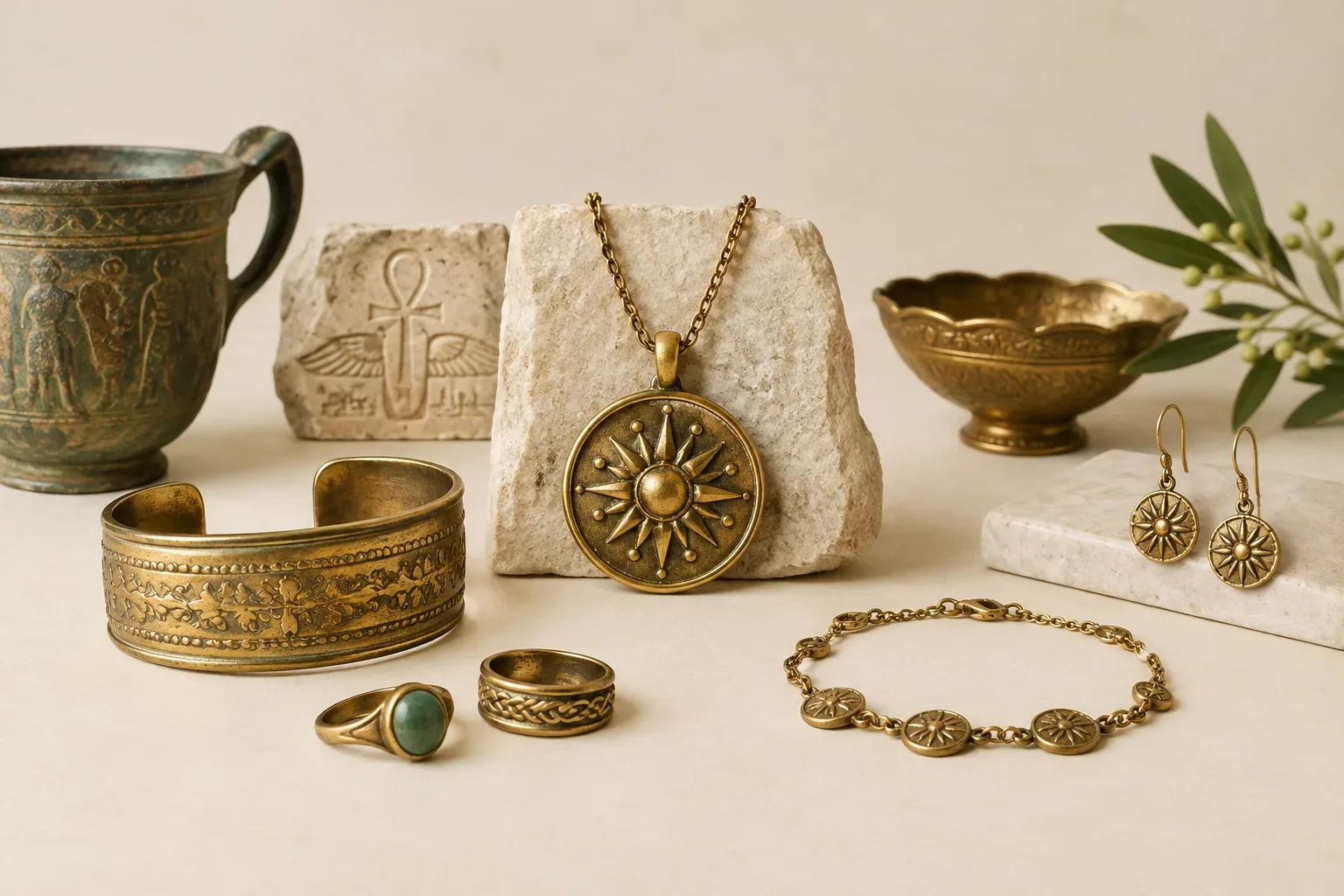
Brass appears in jewellery in several distinct ways: as solid cast or forged components, as sheet worked into engraved or pierced motifs, and as base metal cores for plated or gold-washed finishes. Museums such as the Victoria and Albert Museum show examples across ensembles where brass served either as the visible material or as a structural component beneath a surface finish.
Surface treatments common in both historical and contemporary pieces include deliberate patination to deepen tone, lacquering or clear coatings to prevent further darkening, and plating or gold wash for a precious-metal appearance. Brass is also used in combined pieces with gemstones set into bezels or prong settings; for information on how gemstones have been identified and presented in museum contexts, the Victoria and Albert Museum’s guide to gemstones is a useful reference. Because brass is softer than many precious metals, settings and thin decorative elements require attention to mechanical wear and mounting security.
Practical maintenance: daily care and gentle home cleaning
Daily care aims to slow surface change and prevent mechanical damage. Store brass jewellery separately to avoid scratches, keep pieces dry when possible, and remove them for strenuous activity, swimming, or heavy-duty cleaning tasks. A simple protective habit like wiping pieces with a soft, dry cloth after wear reduces oils and residues that accelerate surface change.
For gentle home cleaning, avoid aggressive abrasives. A soft cloth and mild soap with warm water will remove dirt. Rinse thoroughly and dry with a lint-free cloth. If a brass piece has a clear lacquer or other modern coating, do not use solvents that could compromise that finish. If you do not know whether a piece is plated or lacquered, test a small, inconspicuous area or consult a professional to avoid removing finishes unintentionally.
Warning signs that call for professional help
Stop home treatments and seek a professional jeweller if you see any of the following: a gemstone or set element that is loose or shifting in its setting, visible cracking or separation at joints, missing solder or broken links, or an unusual green or blue corrosion (verdigris) at contact points that may indicate a chemical reaction with skin or other metals. Structural instability can worsen with improper DIY repair.
If you suspect plating, gold wash, or a lacquer finish is present and you need restoration or re-plating, ask a professional. The United States Federal Trade Commission reminds consumers to seek clear information about treatments, plating, or imitation materials at purchase; disclosure matters because repair and restoration choices depend on the original construction and any coatings on the metal. A trained bench jeweller can assess whether polishing, re-lacquering, replating, or mechanical repair (resoldering, replacing clasps or jump rings) is the right course of action.
Choosing, gifting, and commissioning brass jewellery respectfully
When selecting or gifting brass jewellery, consider the recipient’s skin sensitivity, style preferences, and whether they prefer a polished look or a natural aged patina. Brass can develop a warm, darker surface over time that some people value; others prefer to keep a bright finish. Communicate these options when gifting to avoid assumptions about care or intended longevity.
If commissioning a custom piece, discuss surface finishes and expected maintenance with the maker. Ask whether pieces will be lacquered for protection or left to develop patina, and whether any stones are glued versus mechanically set. The Victoria and Albert Museum’s guidance on material contexts can help you understand how craftsmen historically treated surfaces and settings, but contemporary makers will offer specific technical solutions that fit the wearer’s lifestyle.
Finding the right professional and what to expect
Seek a jeweller who can show examples of prior work on base metals and who explains their approach to cleaning, re-coating, and structural repair. A competent bench jeweller will inspect the piece and explain risks and options, including whether surface cleaning will remove intended finishes or whether replating is advisable.
Ask the jeweller how they will secure stones, whether they use adhesives, and what warranties or guarantees apply to mechanical repairs. For any restoration that alters the original finish, request a clear explanation and, if possible, a written estimate. If a piece has historical or museum value, consult a conservator or a specialist in historic jewellery rather than a commercial repair shop, because conservation ethics and methods differ from routine restoration.
When care becomes conservation: historic or sentimental pieces
If a brass piece is historically significant, of museum quality, or holds high sentimental value, treat restoration as a conservation decision and consult a specialist conservator. Museums such as the Victoria and Albert Museum separate conservation from commercial repair; conservators aim to stabilize and document objects while respecting original materials and finishes.
Conservation choices may prioritize preserving patina and signs of use rather than returning an item to a 'like new' state. If you are unsure whether an object has historical importance, consider seeking an appraisal or speaking with a museum department before undertaking irreversible treatments.
Final practical checklist
Prevent mechanical problems by storing jewellery properly, removing it for heavy use, and wiping it after wear. For cleaning, use mild soap and a soft cloth; for uncertain finishes, test a hidden area or consult a professional. Seek immediate help if settings are loose, solder joints are failing, or you find green or blue corrosion at contact points.
When repairing or restoring, ask for clear disclosure of the original materials and treatments; the Federal Trade Commission advises consumers to get accurate information about treatments and imitations at purchase. Choose a jeweller who demonstrates experience with base metals and who explains the trade-offs between polishing, plating, and conserving original finishes.
Frequently asked questions
How can I tell if a piece is solid brass, plated brass, or another metal?
A reliable way is to ask the seller for material disclosure; the Federal Trade Commission recommends that sellers disclose treatments and base materials. Visual clues include uniform coloration for solid brass and wear-through zones on plated items where a different metal shows at edges. When in doubt, a professional jeweller can test the metal without damaging the piece.
Is it safe to polish tarnished brass at home?
Gentle polishing with a soft cloth and mild soap is usually safe for uncoated brass, but vigorous abrasion or strong chemical cleaners can remove intentional finishes like lacquer or gold wash. If you suspect a coating or plating, test an inconspicuous area or consult a professional to avoid unintended damage.
When should I stop home repairs and seek professional help?
Stop home treatments and consult a professional if a stone is loose, solder joints are failing, links or clasps are broken, or if you see green or blue corrosion around contact points. Structural and setting problems can worsen with improper DIY attempts.
Can brass jewellery cause skin discolouration or reactions?
Brass can react with acids, salts, or moisture from skin and produce a greenish residue on the skin known as verdigris in some cases. If someone has sensitive skin or a history of metal reactions, choose pieces with protective coatings, an inner lining, or a different metal, and discuss options with the maker.
How do I choose a repair professional for brass jewellery?
Choose a jeweller experienced with base metals who explains their proposed methods and the risks to finishes. For historically important or museum-quality pieces, seek a conservator. Ask for examples of relevant past work and a written estimate for significant repairs.
Sources and further reading
- Bedazzled: A History of Jewellery — Victoria and Albert Museum
- An A-Z of Gemstones — Victoria and Albert Museum
- Buying Gemstones, Diamonds, and Pearls — Federal Trade Commission