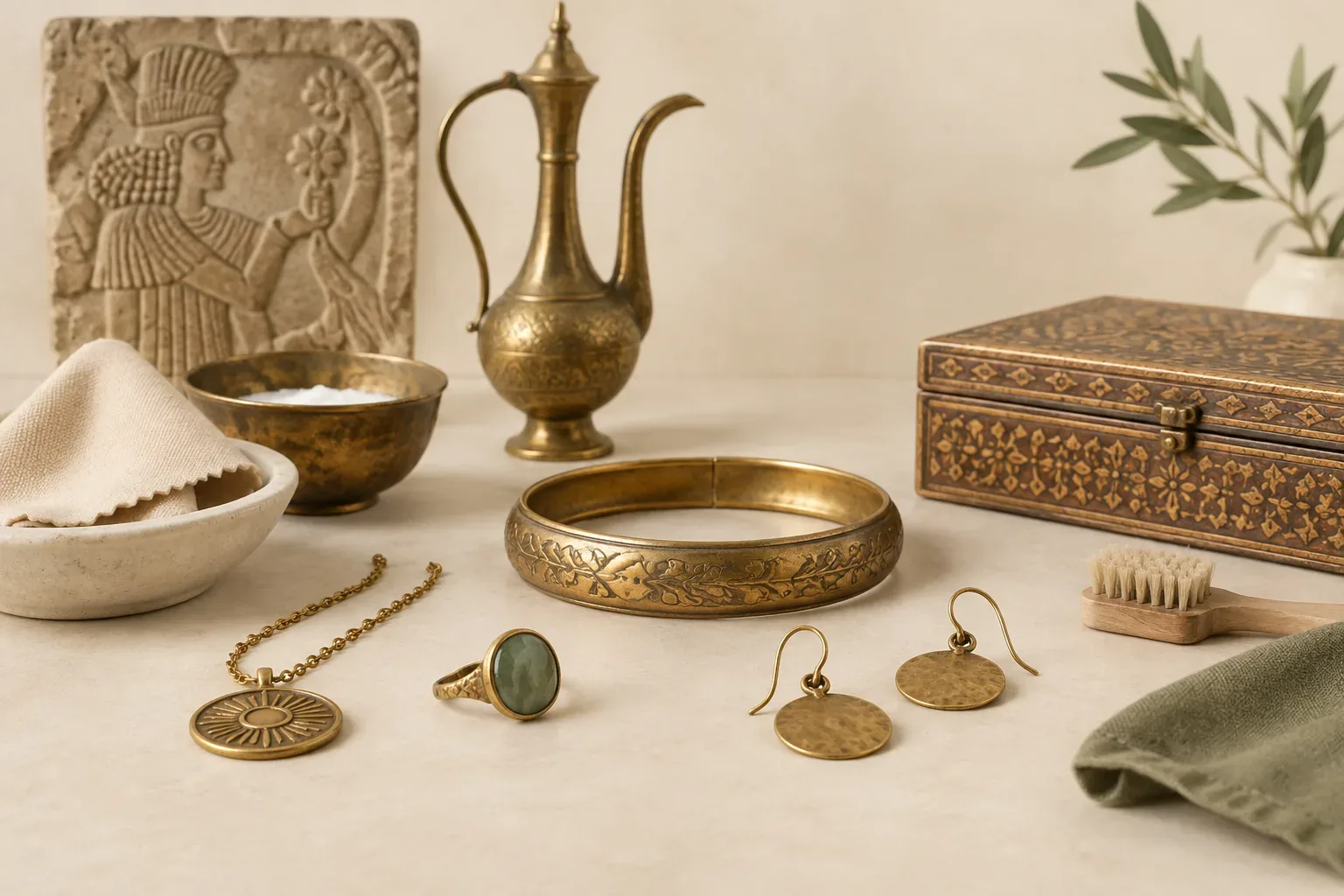
Meaning at a glance
This article explains the documented history and changing contexts of brass and metal jewellery, distinguishes historical evidence from later popular meanings, and gives safe, practical guidance for cleaning, polishing, and storing brass jewellery along with respectful selection and gifting advice.
What the historical record shows
Museum scholarship shows that metal jewellery has been important across many cultures and periods, and that meanings and materials shifted with technology and fashion. The Victoria and Albert Museum frames jewellery as a changing social practice from ancient times through classical antiquity, medieval and early modern periods, and into industrial and contemporary production. These changes affected the choice of metals, the use of inlaid stones, and how jewellery signaled status, identity, and memory.
Collections and museum interpretation also show that gemstones and mounted ornament were handled differently in different places and eras. As the Victoria and Albert Museum notes in its overview of gemstones, specific stones and settings have distinct technical and cultural histories that affect how jewelry was made and worn. Those documented histories help explain why a brass piece today might echo older forms, but they do not prove identical meanings or uses across time and place.
Documented historical meanings versus modern interpretations
Documented historical meanings come from material evidence and recorded contexts: how a society used and displayed metalwork, what documents say about gifts and ritual, and how makers signed or dated pieces. The Victoria and Albert Museum’s historical framing is useful for identifying those demonstrable contexts—who wore what, when, and in what social settings. These are the claims that can be supported by surviving objects, inventories, portraits, and written records.
Modern interpretations—what people today choose to believe about a motif, metal, or stone—are valid as personal or commercial meanings but are not necessarily continuations of historical practice. For example, a contemporary wearer might choose brass because they like its warm tone or because a modern brand markets it as a symbol of 'earthiness.' That preference is a personal or marketing meaning rather than a documented historical fact. When gift-giving or describing a piece, separate proven historical context from recent or personal symbolism so you do not obscure cultural significance or misrepresent provenance.
How brass, motifs, and gemstones appear in jewelry
Brass appears in jewellery for several practical reasons: it is an alloy that can look like gold at lower cost, it is malleable for casting and stamping, and it takes a characteristic warm patina over time. Makers have used brass for costume jewellery, decorative fittings, and components where a golden look was desirable but fine gold was not required. Museums document that different metals and techniques were chosen for economic, aesthetic, and technological reasons across periods (Victoria and Albert Museum).
Motifs and gemstones appear in jewellery as carved, cast, or set elements. The V&A’s A–Z of Gemstones explains that certain stones were chosen for color, durability, or symbolic association in particular eras, and that mounting techniques affect how a stone should be cleaned and stored. In modern brass jewellery you will commonly see applied motifs—filigree, stamped patterns, or attached charms—and occasionally inset stones that may be genuine gems, glass, or simulated materials. Because materials and treatments vary, treat each piece according to its construction rather than assuming all brass jewellery accepts the same care.
Safe cleaning methods (what to try and what to avoid)
Start with the least invasive approach: wipe the piece with a soft, dry microfiber or cotton cloth to remove dust and skin oils. For general soiling, use a gentle detergent solution—mild dish soap in warm water—applied with a soft cloth or soft-bristled brush, then rinse carefully and dry completely with a soft cloth. This method is safe for many construction types and for brass with surface finishes.
Before any more aggressive cleaning, identify finishes and stones. If brass is lacquered, plated, or combined with glued settings or porous gemstones (pearls, opals, turquoise), avoid soaking and avoid polishes that abrade. If a piece has significant value, historical interest, or difficult-to-identify treatments, consult a professional conservator or trusted jeweler rather than trying strong home remedies.
Avoid abrasive metal scrubbers and harsh chemicals such as bleach or concentrated ammonia solutions, which can remove plating, damage delicate settings, and react with other metals. Ultrasonic cleaners can loosen adhesives and crack fragile stones and should be used only when you know the construction and materials are suitable. If you want to reduce visible tarnish with a commercial brass polish, test a small, inconspicuous area first and use the mildest product possible.
Storage: best practices and common mistakes
Store brass jewellery dry and separate. Humidity accelerates tarnish and can loosen adhesives. Use a lined jewellery box with individual compartments or soft pouches so pieces do not rub and scratch one another. Including a small silica gel packet can help control moisture. Anti-tarnish strips or paper designed to absorb sulfur compounds can reduce oxidation in enclosed storage.
Do not store jewellery while it is still damp from cleaning, perspiration, or lotion—the trapped moisture encourages corrosion and can stain stones and settings. Avoid long-term exposure to direct sunlight, household chemicals, and cosmetic products; store pieces away from perfume sprays and household cleaners. If a piece is plated brass or has a deliberate patina you value, avoid polishing aggressively as repeated polishing will remove surface finishes and may change the appearance permanently.
Practical and respectful selection or gifting guidance
Consider provenance, materials, and cultural meaning before buying or gifting. If a motif or style has a clear cultural or religious significance, research that context using reputable museum resources and, where appropriate, ask members of that culture or trusted advisers about respectful use. The Victoria and Albert Museum’s accounts of jewellery history can help identify whether a design is historically rooted or a modern reinterpretation.
For brass pieces, be transparent about what the metal is and how to care for it. The Federal Trade Commission recommends clear disclosure around treatments and imitations when selling gemstones or jewellery. If you gift brass jewellery, include a short care note that explains how to clean and store the piece and mention any special construction—lacquer, plating, or glued stones—so the recipient can avoid damaging it. Consider the recipient’s allergies and lifestyle: if they have metal sensitivity or spend a lot of time in water, choose a different metal or a design with appropriate finishes.
When to consult a professional
Take valuable, antique, or uncertain-construction pieces to a trusted jeweler or a conservator. If corrosion looks like active green or blue verdigris, if stones are loose, or if components are glued rather than mechanically set, professional treatment is safer than DIY cleaning. Professionals can also advise on whether a lacquer finish should be renewed or removed and can give a condition assessment that preserves value and integrity.
When buying or selling, use established resources to verify provenance and material claims. For gemstones and treatments, the Federal Trade Commission provides guidance on disclosure and consumer protection; rely on professional appraisals for high-value items.
Frequently asked questions
How often should I clean my brass jewelry?
Clean brass jewellery only as needed: wipe after wear to remove oils, and do a gentle soap-and-water clean when visibly soiled. Frequent aggressive polishing can remove plating and finishes, so prefer light maintenance.
Can I use vinegar or lemon juice to clean brass?
Acidic home remedies can remove tarnish but may also attack finishes, thin plating, or glued settings. If you try a mild acid, test a hidden area first and avoid soaked treatments on pieces with stones or lacquer.
Is it safe to put brass jewellery in an ultrasonic cleaner?
Ultrasonic cleaners can loosen adhesives and damage some gemstones. Use them only when you are certain the piece has mechanically set stones and durable construction; otherwise consult a jeweler.
How should I store brass jewelry long-term?
Store brass jewelry dry and separated in a lined box or soft pouch, include an anti-tarnish strip or silica gel to control humidity, and keep pieces away from perfumes, cosmetics, and household chemicals.
My brass piece has a greenish deposit (verdigris). What should I do?
Active corrosion or verdigris can indicate chemical reaction. For valuable or sentimental items, consult a professional conservator or jeweler. For inexpensive costume items, careful mechanical cleaning with a soft tool may remove surface deposits, but avoid harsh chemicals.
Will polishing remove the patina I like?
Yes. Polishing removes surface oxidation and can alter the appearance permanently. If you prefer a warm, aged look, avoid polishing and clean only to remove dirt and oils.
Are brass and bronze the same when caring for jewelry?
Brass and bronze are different copper alloys and can behave differently; if you are unsure which alloy you have, treat the piece gently and consult a jeweler for identification before using strong cleaning methods.
What should I tell a gift recipient about caring for a brass piece?
Include a simple care note: avoid water and chemicals, wipe after wear, store dry and separate, and have the piece checked by a jeweler before attempting aggressive cleaning or repair.
Sources and further reading
- Bedazzled: A History of Jewellery — Victoria and Albert Museum
- An A-Z of Gemstones — Victoria and Albert Museum
- Buying Gemstones, Diamonds, and Pearls — Federal Trade Commission