Meaning at a glance
This guide answers the search intent behind 'Black Opal authenticity guide' by defining natural, lab-created, treated and imitation black opal, giving decision criteria and practical trade-offs for buyers, outlining safe care, and stating clearly what a shopper cannot confirm without a qualified jeweler or gemological laboratory.
Direct answer — what this guide gives you
This Black Opal Authenticity Guide defines the common categories a shopper will encounter (natural, lab-created, treated, imitation), lists practical visual and documentation checks you can perform, explains the trade-offs between value and durability, recommends safe care, and states the limits of what you can verify without a qualified jeweler or a gemological laboratory.
Definitions and decision criteria
Natural black opal: a gemstone that formed in nature and displays the play-of-color and body tone that collectors and jewelry buyers prize. Sellers should disclose that the material is natural and whether any treatments have been applied.
Lab-created black opal: a material manufactured in a controlled environment to reproduce opal’s appearance. Although lab-created opals can show play-of-color similar to natural stones, they are not the same material chemically and should be described as lab-created. The Federal Trade Commission requires sellers to distinguish natural from synthetic or lab-created products when selling gemstones, and written disclosures are advisable.
Treated black opal: a natural opal that has undergone laboratory or workshop processes to improve appearance or stability. Treatments can range from dyeing and impregnation to more advanced procedures. The Gemological Institute of America explains that treatments, their detectability, and their effect on durability and care are central consumer questions, and treated stones should be disclosed.
Imitation or simulated opal: materials that imitate the appearance of black opal but are not opal (for example, glass, plastic, or composite materials). Imitations should be sold with clear disclosure. The FTC guidance highlights the need for clear distinctions among natural, lab-created, treated, and imitation materials and for written seller disclosures.
What you can check yourself (visual and documentation cues)
Play-of-color: Natural black opal is valued for a lively, multi-hued play-of-color that appears to move as the stone or light changes. Visual inspection under several light sources can show whether the color effect is complex and layered, but visual inspection alone cannot confirm natural origin.
Body tone and transparency: Black opal typically has a darker body tone that enhances play-of-color. Check how the stone looks against both light and dark backgrounds. These observations are useful for assessing appeal but are not definitive proof of origin or treatment.
Mounting and finishing: Many treated stones, doublets and triplets, or imitations may be mounted in less expensive settings. Conversely, a high-quality setting and accompanying paperwork raise confidence but do not prove natural origin.
Documentation: Ask the seller for written disclosure of whether the stone is natural, lab-created, treated, or an imitation, and for any available laboratory report. The FTC recommends written disclosures and the GIA explains that laboratory testing and reporting are the reliable routes to identify treatments and origin.
What you cannot reliably verify without expert help
You cannot definitively determine whether a black opal is natural, lab-created, or treated using only unaided visual checks or non-destructive at-home tools. Some treatments and synthetic processes are specifically designed to mimic natural appearance and require instrumentation and trained interpretation to detect.
Only a qualified gemologist or an independent gemological laboratory can produce a reliable identification and a treatment report. The GIA’s guidance emphasizes detectability limits for treatments and the value of laboratory testing, and the FTC requires accurate labeling but recognizes the practical need for expert verification in uncertain cases.
Historical evidence and cultural context — scope and limits
The approved sources for this article focus on consumer guidance, treatment disclosure and modern market trends rather than primary cultural or archaeological histories for black opal. Neither the Gemological Institute of America, the Federal Trade Commission, Professional Jeweller, nor Imaginaire Digital provide a comprehensive historical account of black opal use across distinct cultures or time periods.
Because the selected evidence does not supply specific historical claims about which cultures used black opal or when, this guide does not attribute cultural symbolism or ritual use to particular peoples or periods. Where historical cultural meanings exist in other academic or primary sources, they should be cited directly; they are outside the evidence base used here.
To keep historical and modern meanings separate: any cultural or spiritual meanings you hear about black opal in contemporary marketing or personal stories should be treated as modern or personal interpretations unless supported by cited historical sources.
Documented meanings versus modern personal interpretations
Documented meanings: Within the evidence base used for this guide, documentation concerns treatments, disclosure obligations and modern market demand rather than cultural symbolism. The GIA focuses on treatments and care, and the FTC focuses on accurate consumer information. Neither documents traditional cultural meanings for black opal.
Modern personal interpretations: Many buyers and wearers today attach symbolic value to black opal—such as ideas about mystery, protection, or creative energy—but those are contemporary personal or commercial interpretations. They vary by community and individual and are not universal; buyers should treat symbolic claims as aesthetic or emotional choices rather than objective properties of the stone.
How black opal appears in jewelry today
Market reporting shows rising interest in gemstone rings, engagement styles, and sculptural jewelry, with opal and other gemstones appearing more often in rings and necklaces. Professional Jeweller’s trend reporting and Imaginaire Digital’s search insights for 2026 indicate that opal and distinctive gemstone rings are part of broader consumer interest in unique gemstone pieces.
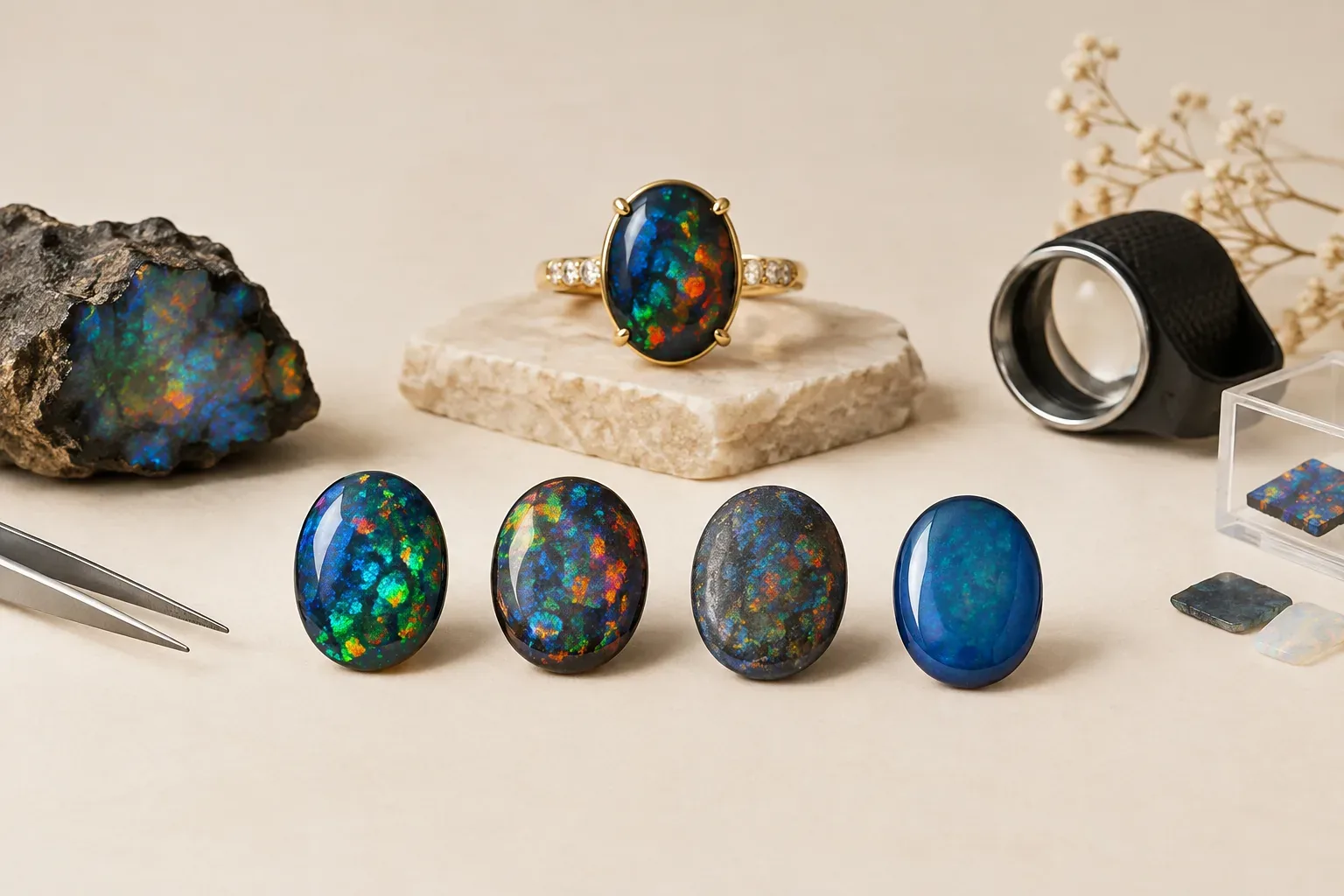
Black opal is commonly set as the center gem in rings, pendants, and statement earrings where its play-of-color can be seen easily. Settings range from protective bezel mounts to prong mounts that maximize visible surface. Buyers should consider both aesthetics and the stone’s need for gentle handling when choosing settings.
Practical selection and gifting guidance
Ask for clear written disclosures. Before purchase, request written confirmation of whether the stone is natural, lab-created, treated, or an imitation and whether any laboratory report accompanies the stone. The FTC advises sellers to avoid ambiguous terms and to provide clear written disclosure.
Request a lab report for mid- to high-value purchases. For stones that significantly exceed typical price points or when the distinction affects value for you, insist on an independent laboratory report identifying whether the opal is natural, treated, or synthetic. This is the reliable way to confirm authenticity and reported treatments.
Consider trade-offs: natural untreated black opal typically carries a premium for its rarity and perceived value, while lab-created stones offer consistent color at lower cost and treated stones can offer dramatic appearance improvements but potentially reduced value or stability. Determine which matters more for your budget and intended use.
Choose appropriate settings and insurance if the piece will be worn often. Because opal can be less durable than many other gemstones, choose settings that protect the stone from knocks if daily wear is intended. Verify that your homeowner’s or jewelry insurance policy covers gemstone jewelry, and obtain an up-to-date appraisal or valuation if needed.
Care and long-term considerations
Handle black opal gently and avoid exposure to harsh chemicals, extreme heat, and prolonged immersion in liquids that could affect treated stones. The GIA highlights that durability and special care vary by gemstone and treatment; always follow care guidance from a trusted jeweler or laboratory report.
Cleaning: Use mild soap, lukewarm water, and a soft cloth for routine cleaning; avoid ultrasonic cleaners and steam unless a qualified jeweler confirms they are safe for that specific stone and setting. If a stone is mounted as a doublet or triplet (layers glued together), aggressive cleaning can compromise the layers.
Storage: Store opal jewelry away from hard gemstones and metals that could scratch it, and consider keeping pieces wrapped separately to minimize abrasion.
Checklist for buyers — quick, actionable steps
Before buying, ask the seller: Is the opal natural, lab-created, treated, or an imitation? Request written disclosure and any lab report. For higher-value purchases, obtain an independent lab report identifying treatments and origin. Avoid destructive at-home tests and do not rely solely on visual inspection to determine authenticity. Choose settings and insurance appropriate to the stone’s intended use and follow care recommendations from authoritative sources such as the Gemological Institute of America. When in doubt, consult a qualified, independent gemologist.
Frequently asked questions
How can I tell if a black opal is natural without a lab report?
You can inspect play-of-color, body tone, and mounting quality and ask the seller for written disclosure, but you cannot reliably confirm natural origin or the presence of certain treatments without a qualified gemologist or a laboratory report.
What documentation should I request when buying a black opal?
Ask for written disclosure stating whether the stone is natural, lab-created, treated, or an imitation, and request any available independent laboratory report that identifies treatments or synthesis. Written documentation is recommended by the Federal Trade Commission.
Are treated black opals less durable?
Durability depends on the specific treatment. The Gemological Institute of America notes that treatments can affect detectability and care needs; always get details about the treatment and follow the care guidance provided.
Should I buy a lab-created black opal?
Lab-created black opals can offer attractive, consistent play-of-color at a lower price. They are a reasonable choice if you value appearance and budget over natural origin, but make sure the seller labels them accurately.
How should I clean and store black opal jewelry?
Use mild soap, lukewarm water and a soft cloth; avoid steam and ultrasonic cleaners unless a qualified jeweler confirms they are safe for that specific piece. Store opal pieces separately to prevent abrasion.
Sources and further reading
- Imaginaire Digital — Imaginaire Digital
- Professional Jeweller / PRYA Jewellery Search Insights — Professional Jeweller / PRYA Jewellery Search Insights
- Gemological Institute of America — Gemological Institute of America
- Federal Trade Commission — Federal Trade Commission