Meaning at a glance
The tiger motif in jewelry has long been used as an animal emblem within many cultures; museum scholarship shows animal motifs and gemstones have shifting meanings tied to context and technique. This article separates documented historical evidence from later popular interpretations, explains how tigers appear as motifs and as the tiger's eye gemstone, and offers practical, culturally respectful guidance for selecting and gifting tiger jewelry today.
Quick answer
Documented sources show that animal motifs — including large cats — appear throughout the history of decorative personal ornaments and that meanings change with time and context. The Victoria and Albert Museum frames animal imagery in jewellery as a shifting social and artistic language rather than a single, universal symbol. Modern associations of tiger jewelry with traits such as strength, courage, or protection are common personal and popular interpretations but are not universally documented across cultures. Practical selection requires attention to materials, craftsmanship, provenance and cultural context.
What the historical record shows (and how the evidence is presented)
Museum research on jewellery emphasises that motifs travel, change, and are reinterpreted across periods and places. The Victoria and Albert Museum’s materials on jewellery history describe how makers and wearers have used animal imagery in different social contexts, from status display to personal ornamentation; they also show that meanings are not fixed but evolve with fashion, technology, and patronage.
That V&A scholarship focuses on the practices, materials and changing social uses of motifs is important when looking specifically at the tiger as a subject. In many regions, big-cat imagery appears within local artistic languages; the V&A’s broader history of jewellery helps us understand these appearances as part of wider currents rather than as a single consistent meaning.
When we turn to gemstones and materials used in tiger-themed jewelry, the Victoria and Albert Museum’s A–Z of Gemstones provides identification and historical context for stones commonly associated with animal motifs, including the chatoyant quartz called tiger's eye. For consumer guidance on material treatments and disclosure, the U.S. Federal Trade Commission provides a practical framework for how sellers should present information about gemstone treatments, imitations, and enhancements.
Documented historical meanings versus modern interpretations
Documented evidence in museum collections and scholarship usually ties meaning to context — who commissioned a piece, who wore it, and where it circulated. V&A materials show that animal imagery could mark lineage, status, alliance, or simply follow fashion and technical developments in metalwork and gem cutting. These are the kinds of historically grounded interpretations supported by the V&A’s work on jewellery history.
Modern meanings assigned to tiger jewellery — for example that a tiger symbolizes individual strength, ferocity, protection, or leadership — are widespread in contemporary marketing and personal use. Those are valid as personal or cultural interpretations today, but they are not necessarily direct continuations of a single historic meaning in every culture. Distinguishing the two helps avoid treating modern symbolism as if it were an uncontested historical fact.
How the tiger motif and related materials appear in jewelry
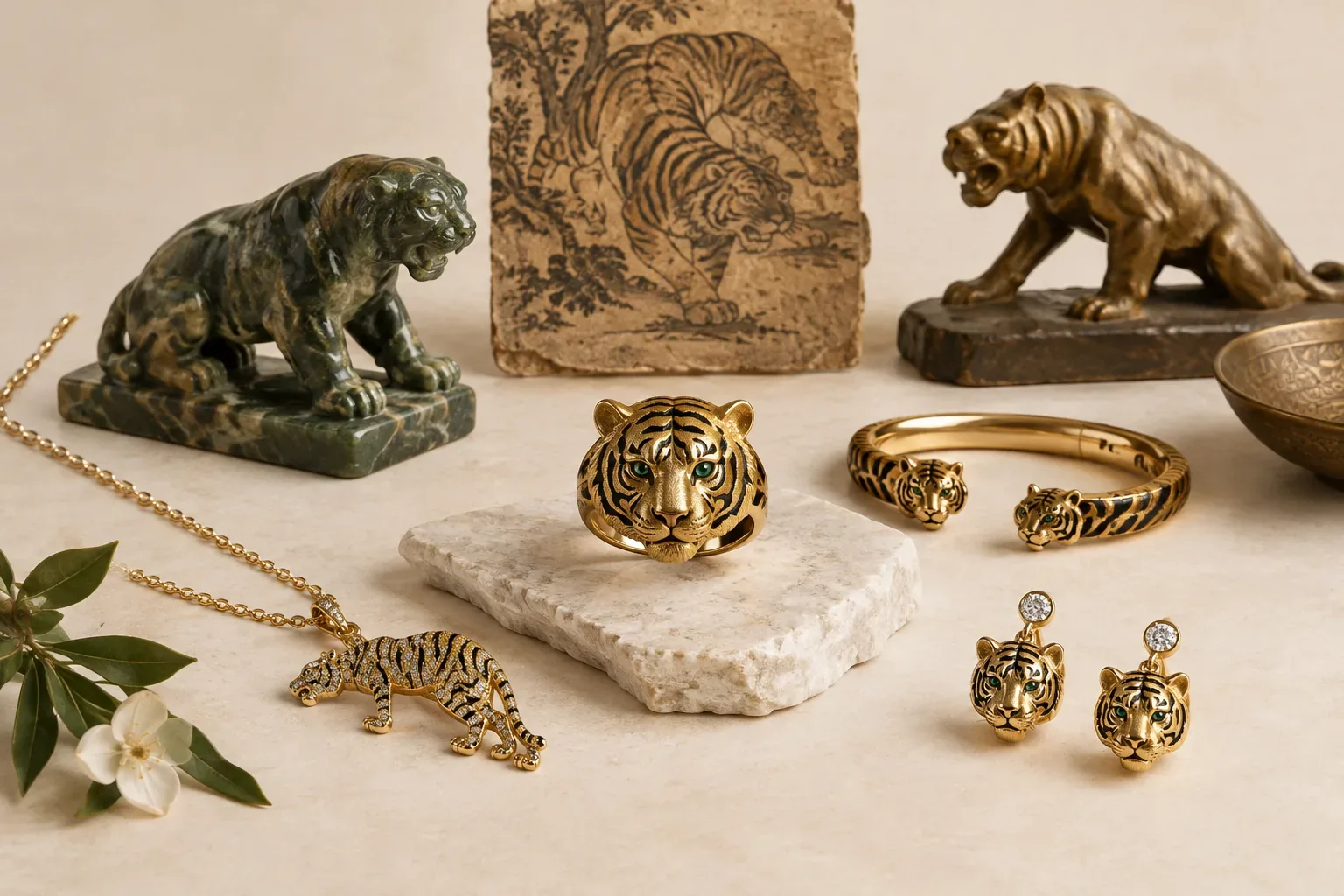
As a motif, the tiger is used in the same technical repertoire that the V&A describes for animal imagery generally: carved or cast figural brooches and pendants, engraved or inlaid surfaces on rings and cuffs, enamelled scenes, and small sculptural elements attached to functional objects. Makers may render a tiger naturalistically, stylise it into a pattern, or use hybridized forms that echo local decorative traditions.
The stone known as tiger's eye is a chatoyant quartz that has been used in jewellery for centuries; the V&A’s A–Z of Gemstones explains how such stones are identified and placed within historical practice. Tiger's eye is often cut en cabochon to display its chatoyancy and is used for beads, signet-style rings, cabochon rings, and intarsia inlaid surfaces. Other gemstones and materials are also used to suggest stripe patterns or to create contrast: onyx, mother-of-pearl, enamel and various gold and silver treatments appear in documented collections of animal-themed jewellery.
Technically, makers have used carving, relief casting, cloisonné and champlevé enamelling, gem setting, and mixed-media construction to portray animal motifs; the V&A highlights these broad techniques across its jewellery collections. In modern manufacture, laser engraving, 3-D modelling and new surface finishes extend these historic methods, but the visual languages of figural animal representation remain continuous with past practices.
Practical and respectful guidance for selecting or gifting tiger jewelry
Start by asking why you or the recipient are drawn to the motif. If the intention is cultural or religious — for example, connecting to family heritage or to a specific local tradition — research that use specifically rather than assuming a general meaning. Use the site’s guidance on researching symbols to check whether a given form or detail has a particular cultural origin or usage.
Choose craftsmanship and materials that match your budget and values. Inspect construction: look for secure settings, consistent metalwork, and clear finishing. When gemstones are involved, ask for disclosure of treatments or imitations. The Federal Trade Commission’s consumer guidance explains how sellers should disclose treatments, synthetics or enhancements; insist on clear information and written confirmation where possible.
Consider provenance and ethical sourcing. If the piece is described as “antique” or “vintage,” request documentation or ask a trusted dealer about its history. For contemporary pieces, ask makers about materials and labor practices if ethical sourcing matters to you or the recipient.
Be culturally respectful. Avoid wearing or gifting a motif that has a specific sacred or ceremonial function in a community unless you understand and have permission to use it in that way. Make the gift with an explanatory note about your intention, or choose a neutral artistic interpretation if you are unsure.
If the jewellery includes tiger's eye or other named stones, learn a little about their care and how they were cut or treated. The V&A’s gemstone entries are useful for basic identification and historical context, and the FTC guidance will help you understand treatment and disclosure issues you should verify with a seller.
Caring for tiger-themed pieces and verifying authenticity
Care depends on materials. Polished cabochons such as tiger's eye are best kept away from harsh chemicals and cleaned with a soft cloth. Enamel and fine metalwork should be stored separately to avoid abrasion. For any valuable piece, ask a jeweller for recommended cleaning and storage.
To verify authenticity, request written information about the metal fineness, gemstone identification, and any treatments. For high-value items, a certificate from a reputable gemological laboratory or an appraisal from a qualified, independent appraiser provides additional assurance. The FTC’s guidance on buying gemstones can help you evaluate seller statements about treatments and synthetics.
Frequently asked questions
What does tiger jewelry traditionally mean?
Traditionally, the meaning of animal motifs — including large cats — varies with place and time. Museum scholarship indicates that animal imagery could denote status, identity, alliance, or follow fashion; it is context-dependent rather than universally fixed (Victoria and Albert Museum). Modern meanings such as strength or protection are contemporary interpretations rather than a single historic fact.
Is it offensive to wear tiger imagery from another culture?
That depends on the specific cultural or religious usage of the motif. If a form has a sacred or ceremonial role, wearing or gifting it without understanding may be disrespectful. Research the motif’s cultural context and, when in doubt, choose a neutral artistic design or ask community representatives for guidance.
What is tiger's eye and is it the same as tiger jewelry?
Tiger's eye is a chatoyant quartz that displays a silky, banded sheen and is often used in jewellery; the Victoria and Albert Museum’s A–Z of Gemstones offers identification and historical context. A tiger motif in jewellery is a depiction of the animal and can be made in metal, enamel, carving or mixed media; the two appear together but are not the same thing.
How can I verify the authenticity of a tiger-themed gemstone?
Ask the seller for written disclosure about any treatments, synthetics or imitations, and request gem identification or a certificate for high-value stones. The Federal Trade Commission provides consumer guidance on how sellers should disclose treatments and imitations to buyers.
What should I consider when gifting tiger jewelry?
Consider the recipient’s cultural background and personal taste, the piece’s provenance and craftsmanship, and whether gemstone treatments and material sourcing are disclosed. Include a note explaining your intention and, if appropriate, choose a design whose meaning you can explain and that respects any cultural significance.
Sources and further reading
- Bedazzled: A History of Jewellery — Victoria and Albert Museum
- An A-Z of Gemstones — Victoria and Albert Museum
- Buying Gemstones, Diamonds, and Pearls — Federal Trade Commission