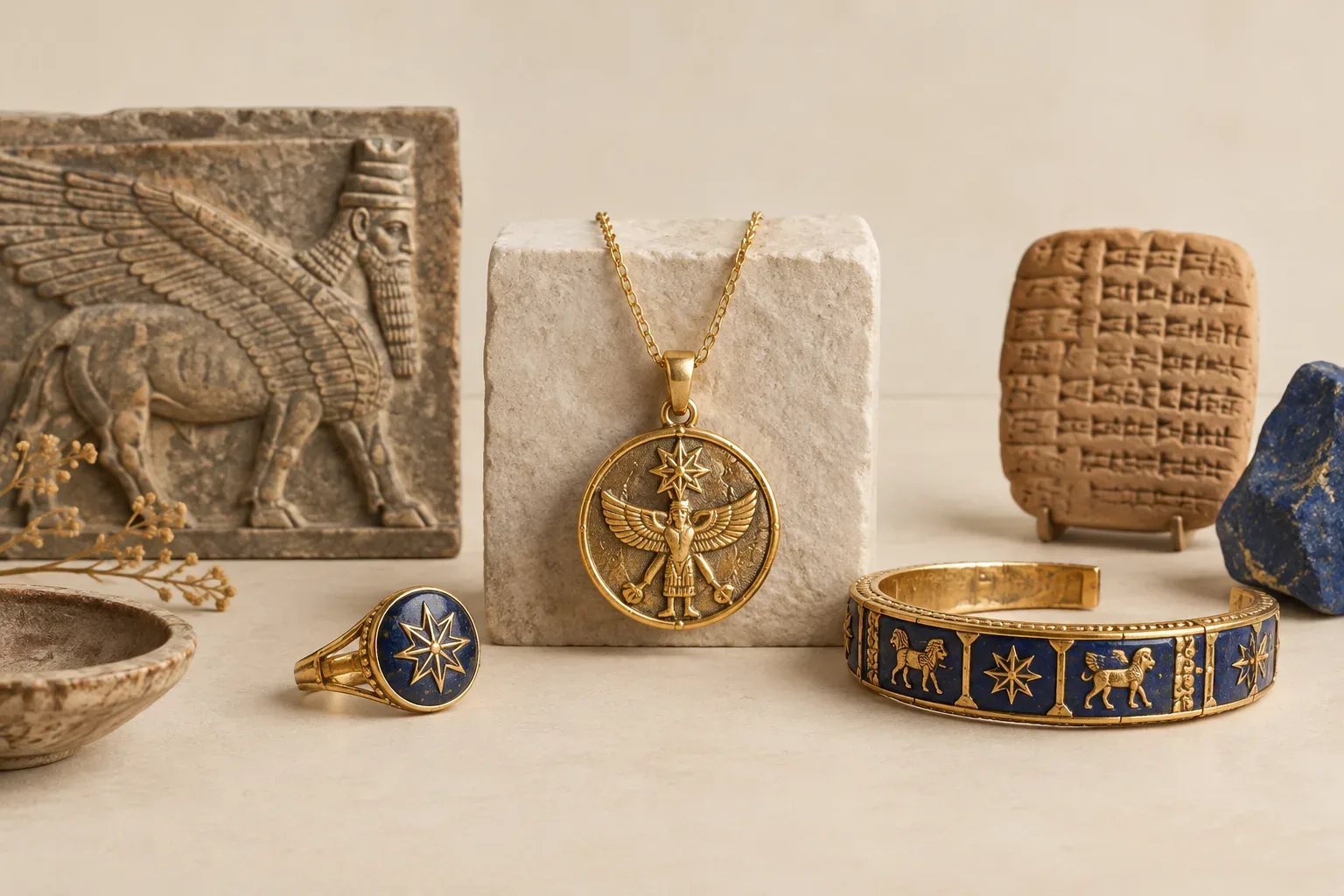
Meaning at a glance
Museum scholarship shows that motifs and materials now called "Babylonian" come from a range of ancient Mesopotamian cultures; documented meanings are limited and often context-specific, while modern uses layer new personal or cultural meanings. This article separates the evidence from modern interpretation and gives guidance for selecting and gifting Babylonian-inspired jewelry with respect and transparency.
Quick answer
Scholarly and museum evidence indicates that the motifs and materials often described as "Babylonian" in jewelry derive from a range of ancient Mesopotamian cultures and changed meaning through time; documented historical meanings are usually tied to specific archaeological contexts and are not universal, while contemporary jewelry makers and wearers add modern symbolic or aesthetic meanings. The best approach is to treat ancient motifs as historically situated visual languages documented in museum collections, separate those documented uses from later popular interpretations, and choose or gift pieces with attention to provenance, material disclosure, and the recipient's cultural or personal preferences.
What the historical evidence shows (which cultures and periods?)
The primary evidence that underlies what people now call "Babylonian" jewelry comes from the ancient Near East broadly referred to as Mesopotamia. Museum scholarship and exhibitions present artifacts and contextual interpretation from multiple, distinct cultures and periods within that region rather than a single monolithic tradition. The Victoria and Albert Museum's overview of jewellery history places the artifacts of Mesopotamia within a long sequence of changing styles and social uses, showing how pieces were produced, worn, and repurposed across time and regions.
When researchers and museums describe jewelry from this part of the world they usually mean objects recovered from archaeological contexts associated with Sumerian, Akkadian, Old Babylonian, Neo-Babylonian, and adjacent Assyrian periods, among others. Each of these cultural and historical phases produced different techniques and favored motifs, and meanings could vary between cities, workshops, and social classes. Modern labels such as "Babylonian" are convenient shorthand for parts of this complex material record but can obscure those distinctions unless the specific archaeological context is given.
Types of evidence and how reliable they are
Museum collections and catalogs provide the most accessible documented evidence. Objects in museum collections are usually accompanied by provenance information, typological description, and curatorial interpretation that explain where an object was found, its material, and the archaeological context when known. Exhibitions and interpretive texts, such as the Victoria and Albert Museum’s history of jewellery, place items within broader social and technical histories and note how use and meaning changed over time.
Archaeological records—excavation reports, stratigraphic contexts, and associated inscriptions—offer stronger evidence for what a symbol or object meant in its original setting, but complete contextual information is not always available, especially for objects that entered collections in the 19th and early 20th centuries. As a result, museum interpretation often combines hard archaeological data with comparative stylistic analysis and careful inference; such assertions are useful but should be read as historically situated judgments rather than absolute statements of universal meaning.
Documented historical meanings versus modern personal interpretations
Where inscriptions or archaeological contexts survive, scholars can make stronger claims about a symbol's original function or meaning. For example, seals and amulets found in ritual or funerary contexts can be reasonably interpreted as serving administrative, protective, or commemorative purposes in their original cultural settings. Museum commentary typically distinguishes these contexts and explains the level of certainty, which is why museum texts are a good first stop for documented meanings.
Modern jewelry markets and contemporary wearers often ascribe broader or different meanings to the same visual elements. Designers and buyers may treat Mesopotamian motifs as emblems of antiquity, exoticism, resilience, or personal spirituality. Those modern meanings are valid as contemporary expressions, but they are not evidence for how people in ancient Babylonia understood those symbols. It is important to keep the two layers—documented historical use and modern reinterpretation—separate when discussing significance.
Common motifs, gemstones, and how they appear in jewelry today
Motifs associated with ancient Mesopotamian art that appear in museum collections and contemporary jewelry include stylized animals, geometric patterns, cylinder-seal imagery, and plant or rosette motifs. Museums present these motifs as part of the visual repertory of the region, and modern jewelers draw on them by adapting shapes, engraving patterns, or reproducing seal-like pendants and signet rings. In contemporary pieces these motifs are often simplified for wearability and combined with modern settings and metals.
Gemstones historically used in the region—such as lapis lazuli, carnelian, and various agates—continue to appear in modern pieces. The Victoria and Albert Museum’s A–Z of Gemstones describes the historical identification and valued properties of many such stones, explaining where certain materials were prized for their color, durability, or perceived qualities. Contemporary makers often use these same materials to evoke an ancient aesthetic or to honor historical craft traditions, but the way stones are cut, treated, or mounted today is different from ancient practice.
Material authenticity, treatments, and disclosure
If authenticity of material matters to you, look for transparent information about provenance and treatments. The Federal Trade Commission advises buyers that gemstones and pearls may be treated, enhanced, or imitated and that sellers should disclose such treatments. Modern lapis, agate, and carnelian can be natural, treated, or lab-created, and the visual similarity between treated or imitation materials and historic stones means buyer disclosure is important for informed choices.
For reproduction or inspired pieces, maker transparency about whether a gem is natural, stabilized, dyed, or synthetic is a reasonable request. If an object is presented as an archaeological original, ask for clear provenance documentation. Reputable dealers, museum shops, and established designers will state whether a piece is a modern interpretation, a hand-crafted reproduction, or an archaeological antiquity.
How to choose and gift Babylonian-inspired jewelry respectfully
Start by clarifying your intention and the recipient’s likely preferences. If you are drawn to a motif because of its historical associations, consider choosing a piece from a museum shop or a designer who cites specific sources and explains the inspiration. If the goal is to honor a cultural or religious tradition, research the symbol's original contexts using museum resources and confirm whether the motif has living cultural significance that might make private wearing inappropriate.
Ask sellers for provenance and treatment information and favor transparency over romanticized claims of "authenticity" when clear provenance is unavailable. If buying a true antiquity, ensure that the seller provides documentation showing legal export and acquisition. For modern designs, choose creators who acknowledge influences and avoid promotional language that asserts unverified ancient meanings. When giving such a piece as a gift, include a short note explaining the historical context and noting the distinction between documented uses and contemporary meanings, so the recipient can appreciate both the history and the modern intention behind the object.
Putting it into practice
If you want a historically informed piece, start with museum resources and reputable makers. Museum publications and exhibition materials help you understand which motifs were common in which periods and why certain materials were valued. If you prefer a contemporary interpretation, choose designers who credit their sources and are open about materials and production methods. Either approach is valid so long as you avoid presenting a modern interpretation as a verified ancient belief and you respect cultural contexts when an object has ongoing significance for living communities.
Finally, consider combining historical interest with modern values: prioritize ethically sourced materials, insist on treatment disclosure as advised by the Federal Trade Commission, and consider commissioning a piece that explicitly celebrates both the ancient inspiration and the recipient’s personal story. That approach keeps the historical and the contemporary meanings transparent and respectful.
Frequently asked questions
Are Babylonian jewelry symbols one single, documented system of meanings?
No. The visual repertoire from ancient Mesopotamia comes from several cultures and historical periods and meanings were context-specific. Museum scholarship treats motifs as elements within a changing material culture, and modern interpretations often add new, personal meanings that are not documented in the archaeological record.
How can I tell if a gemstone in an "ancient-inspired" piece is authentic or treated?
Ask the seller for a written description of the stone and whether it has been treated, stabilized, dyed, or is synthetic. The Federal Trade Commission recommends that sellers disclose treatments. If the piece is presented as an original antiquity, request provenance documentation showing lawful acquisition and export.
Is it disrespectful to wear or gift jewelry inspired by Babylonian motifs?
Not inherently. Respectful practice means researching the motif, choosing makers who acknowledge sources, avoiding claims that assign unverified ancient beliefs, and being sensitive if a symbol has ongoing religious or cultural significance for living communities. When in doubt, include contextual information with your gift.
Where should I look to learn about the historical usage of a specific Mesopotamian motif?
Start with museum catalogs, curatorial descriptions, and reputable exhibition material. The Victoria and Albert Museum’s resources on jewellery history are a helpful starting point because they discuss changing social contexts and provide object-level interpretation.
Can modern artists legally reproduce ancient motifs?
Yes. Ancient motifs in the public domain can be reproduced, but ethical and legal considerations apply if an item is being sold as an original antiquity. Sellers should be transparent about whether a piece is a modern reproduction, a reinterpretation, or an archaeological object with documented provenance.
Sources and further reading
- Bedazzled: A History of Jewellery — Victoria and Albert Museum
- An A-Z of Gemstones — Victoria and Albert Museum
- Buying Gemstones, Diamonds, and Pearls — Federal Trade Commission