Meaning at a glance
This article explains documented history and changing contexts of Babylonian jewelry techniques, separates historical evidence from modern interpretation, describes how motifs and materials appear in surviving pieces, and offers guidance for selecting and gifting historically inspired jewelry.
Quick answer
Documentary and museum evidence shows that what we call "Babylonian" jewelry techniques emerged within broader Mesopotamian metalworking and bead traditions: artisans combined metalworking, beadmaking, inlay and surface finishes to produce personal ornament that signaled status, group identity, and religious associations. Over centuries these practices changed with trade, technology and taste; modern uses of Babylonian-inspired motifs are often personal or aesthetic appropriations rather than direct continuations of ancient ritual meanings. When choosing or gifting pieces that reference Babylonian techniques, prioritize credible provenance, clear disclosure about materials or treatments, and sensitivity to cultural context.
What the historical evidence shows — cultures and periods
Archaeological material from ancient Mesopotamia, including layers and sites associated with early Babylonian cities, reveals a long history of jewellery production and exchange. The Victoria and Albert Museum places these objects within a broad narrative of jewellery history and changing social contexts, noting that personal ornament has long reflected social rank, trade connections and technological know-how rather than a single, unchanging meaning.
Scholars and museums generally treat "Babylonian" jewellery as part of the material cultures of Mesopotamia. That encompasses multiple city-states and periods—early Sumerian and Akkadian developments, later Old Babylonian and Neo-Babylonian phases—each with its own local styles and technical emphases. The V&A's surveys of jewellery history emphasize that techniques and motifs circulated across regions through trade and diplomatic exchange, so a given technique might be present in objects from several related cultures rather than exclusive to one named polity.
Physical evidence for techniques and materials comes from surviving metal and stone objects, beads and inlaid items preserved in graves, temple hoards and excavated settlements. Museums like the Victoria and Albert Museum have documented how these objects reflect both skilled handcraft and long-distance trade in raw materials such as semi-precious stones.
Documented techniques and materials
Museum-backed surveys of jewellery history identify a set of craft practices visible in Mesopotamian assemblages. These include basic metalworking for pins, rings and collars; bead production and stringing; inlay techniques for combining colored stones or glass with metal mounts; and surface finishes achieved by hammering, chasing or simple soldering. The Victoria and Albert Museum presents such techniques in the context of global jewellery development, showing that these methods were widespread and adapted locally over centuries.
Material choices recorded by museums include gold and electrum where available, copper alloys, faience (a glazed ceramic-like material), and semi-precious stones. The V&A's resources on gemstones stress that materials like lapis lazuli, carnelian and carbonate stones were historically valued across the Near East and often transported long distances, which shaped both design and social meaning.
Trade, exchange, and changing contexts
The presence of non-local stones and metals in Mesopotamian jewellery demonstrates active trade networks. Museums note that jewellery materials could travel far from their geological sources, and that designs adapted as new materials and techniques became available. The Victoria and Albert Museum highlights how social meanings attached to jewellery evolved as objects moved between elites, temple institutions and private owners over time.
This mobility means that a technique or motif seen in a Neo-Babylonian necklace may have antecedents in earlier or neighbouring cultures, and its social role could differ by period. Archaeological and museum contexts support an interpretation of jewellery primarily as material culture whose meanings shift with use and context rather than as a fixed symbolic language.
Separating documented historical meanings from modern interpretations
Documentary evidence and archaeological context can support some historical readings—such as jewellery indicating status or acting as votive offerings—but these readings come from burial contexts, inscriptions, or associated temple records rather than the ornament itself. The Victoria and Albert Museum emphasizes that meaning is assigned through context and that the same form can signify different things in different settings.
Modern attributions of spiritual or national symbolism to "Babylonian" motifs are often contemporary reinterpretations. Some designers and wearers today assign protective, mystical or ethnic meanings to ancient motifs; those interpretations reflect modern needs and imaginations rather than a single documented ancient belief. It is more accurate to describe such meanings as modern personal or collective interpretations inspired by ancient forms, not direct continuations of ancient ritual usage.
How Babylonian motifs, stones and techniques appear in jewellery today
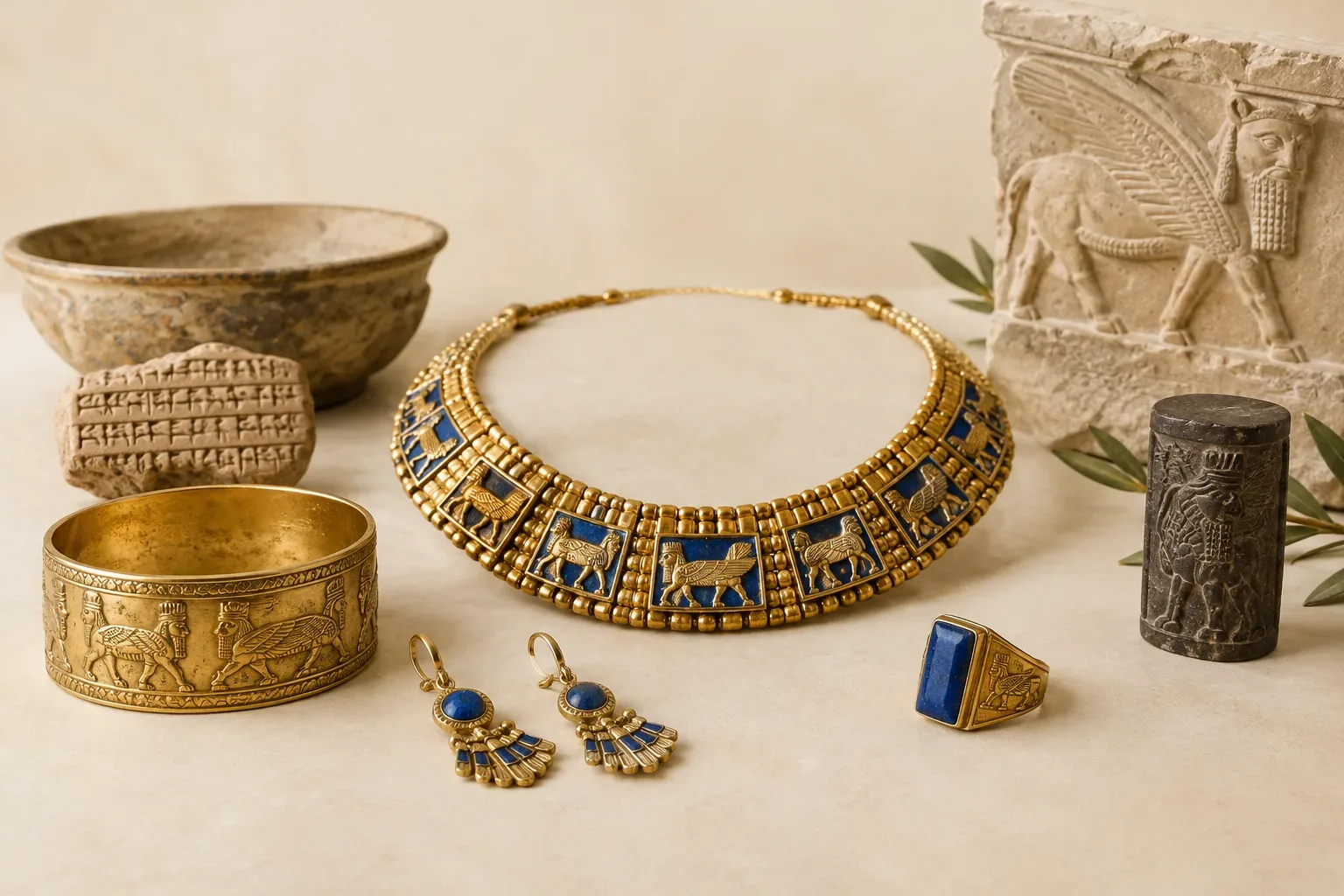
Contemporary jewellery that references Babylonian techniques typically adapts historic elements rather than replicating entire objects. Commonly referenced features include beaded collars or segmented necklaces that recall ancient beadwork, settings that mimic inlay work combining stone and metal, and use of glazed faience-like materials or stylized motifs inspired by reliefs and seals. Museum collections and exhibitions provide models that modern makers reinterpret in metal, glass and stone.
When gemstones enter the picture, designers frequently choose materials associated with the ancient Near East—deep blue stones like lapis, translucent carnelian, and other semi-precious gems—to evoke antiquity. The Victoria and Albert Museum's guide to gemstones explains the historical contexts of many stones and how their colour and finish contributed to ancient ornament aesthetics.
Practical guidance for choosing and gifting Babylonian-inspired jewellery
Verify provenance and materials. Ask sellers for clear information about where a piece was made, whether any archaeological claims are verifiable, and whether stones have been treated. The U.S. Federal Trade Commission's consumer guidance on buying gemstones, diamonds and pearls recommends that buyers seek disclosure of treatments and whether a gem is natural, synthetic or imitation.
Prioritize transparency about replicas and restorations. A tasteful modern piece inspired by Babylonian designs is a valid creative choice, but it should not be marketed as an ancient artifact. Museums and ethical dealers will label reproductions clearly; if an item is described as an archaeological find, request documentation.
Consider context and respect. When gifting jewellery that draws on motifs from ancient cultures, be mindful of the wearer's personal or religious sensitivities. Explain the inspiration and, when possible, include educational context such as a short note about the historical source and what the motif may have represented in different periods. If a motif has a clearly documented sacred function in a living tradition, avoid casual appropriation and prefer neutral design motifs.
Think about materials and care. Some historical materials—faience-style glazes, delicate inlays or soft gold alloys—are fragile in modern wear. Choose a setting and backing suitable for everyday wear if the recipient intends to wear the piece frequently. For valuable gemstones, request certification or a letter describing treatments, and follow recommended care and insurance practices described by consumer protection resources.
How to research and authenticate historically inspired pieces
Begin with reputable institutional resources. Museum catalogues, academic publications and established dealers provide measured context for comparing styles and techniques. The Victoria and Albert Museum's work on jewellery history and gemstones is a helpful place to learn how materials and methods changed across periods and regions.
Ask for documentation from the seller and for laboratory testing when value warrants it. The FTC recommends that consumers obtain clear information about gem treatments and the nature of stones and metals. Independent gemological reports can confirm whether gems are natural, treated or synthetic.
When in doubt about cultural meaning, consult published scholarship rather than marketing language. Marketing often simplifies or romanticizes ancient meanings; museum and scholarly resources will offer a more cautious, evidence-based account of what is documented and what is speculative.
Frequently asked questions
Are authentic Babylonian jewellery pieces available for private purchase?
Genuine ancient Babylonian jewellery is exceptionally rare and normally held in museum collections or reported through archaeological publications. If a private seller claims to offer an ancient Mesopotamian piece, request verifiable provenance and documentation; reputable institutions generally label authentic finds clearly and publish catalogues. Be cautious of unverified claims and seek expert opinion before purchase.
What materials should I look for in historically inspired Babylonian designs?
Historically informed modern pieces often use materials associated with ancient Near Eastern ornament such as gold-tone metals, faience-style glazed elements, lapis-like deep blue stones and carnelian-style reds. The Victoria and Albert Museum's gemstone guide explains historical use of many stones. For high-value stones, request disclosure of treatments and certification as recommended by the Federal Trade Commission.
How can I tell if a gemstone has been treated or is synthetic?
Ask the seller for a gemological report or a written disclosure about treatments. The Federal Trade Commission advises that dealers disclose common treatments and whether a stone is natural, synthetic or an imitation. Independent testing by a qualified laboratory can confirm a gem's nature and treatments when necessary.
Is it culturally insensitive to wear jewellery inspired by ancient Babylonian motifs?
Wearing historically inspired jewellery is not inherently insensitive, but context matters. Avoid claiming ancient ritual meanings that lack evidence, and be cautious about using motifs that have clear, continuing sacred significance to a living community. When gifting, include context about the inspiration and choose neutral designs if you are unsure of the recipient's views.
How should I care for jewellery that uses delicate historical techniques?
Many historically inspired techniques—delicate inlay, glazed surfaces or soft metal finishes—require gentle care. Store pieces separately, avoid exposure to harsh chemicals and remove jewellery before activities that could strain settings. For valuable pieces, arrange regular professional checks and consider insurance for irreplaceable items.
Sources and further reading
- Bedazzled: A History of Jewellery — Victoria and Albert Museum
- An A-Z of Gemstones — Victoria and Albert Museum
- Buying Gemstones, Diamonds, and Pearls — Federal Trade Commission