Meaning at a glance
The documented record — as presented by museum scholarship — shows that jewellery in ancient Babylon and the broader Mesopotamian world was made from durable metals, stones and manufactured materials, served visible social and ritual roles, and has been reinterpreted in later fashions; modern buyers should distinguish historical evidence from later meanings and follow routine checks for materials and treatment disclosure when selecting or gifting pieces.
What the historical record actually shows (and what to attribute to which sources)
When we say “Babylonian jewellery,” we are referring to objects from the ancient city of Babylon and the broader Mesopotamian world. Museum surveys of jewellery history identify the ancient Near East as one of the primary regions where metalwork, stone setting and bead production were long-established techniques. The Victoria and Albert Museum, for example, treats these developments as part of a longue durée in the history of jewellery, emphasizing changing social contexts and craftsmanship over time rather than a single, uniform practice.
That museum-level scholarship documents a range of durable materials and techniques used across these cultures, including worked metals, inlaid stones and manufactured vitreous materials. The V&A’s writing on gemstones and on jewellery history explains how specific stones and materials entered broad historical use and how jewellery functioned differently across classes and ritual contexts. Where excavations, inscriptions or contemporary art explicitly link a piece to a ritual use or a status marker, those links are treated as documented evidence; where such documentation is absent, conclusions are interpretive and presented as such.
Materials and manufacture: what is documented
Museum summaries emphasize three linked aspects of ancient jewellery: available materials, manufacturing technology, and social display. Metals such as gold and other alloys, plus worked stones and man-made glass or faience, appear repeatedly in museum collections and academic treatments as the materials commonly used to create items that survived burial or were recorded in art. The Victoria and Albert Museum’s wider treatments of jewellery history place these materials in a long sequence of changing techniques and tastes.
Gemstones and decorative stones that survive in collections are interpreted in light of both their material properties and the trade networks that brought them into a region. The V&A’s A–Z of Gemstones discusses how museum study helps identify stones and reconstruct their historical contexts, which in turn informs our understanding of which materials were prized or available to different groups. That evidence supports statements about material presence and craftsmanship without making universal claims about meaning for every individual wearer.
Status, ritual and daily wear: where evidence is strong and where it is not
In many ancient societies the archaeological and iconographic records show clear connections between certain kinds of jewellery and social status or religious practice. The museum narrative of jewellery history highlights that in contexts where written records, tomb assemblages or formal portraits survive, researchers can link specific items to elite display, funerary practice or cult activity. The V&A emphasizes changing social meanings across time, demonstrating that jewellery could mark rank, group identity or ritual role in particular documented contexts.
At the same time, it is important not to assume that every piece found in a grave or represented in art had the same meaning across different cities, periods or social groups. Where the direct evidence is limited, later readings of ancient motifs — for example as ‘‘protective’’ amulets or universal symbols — are modern interpretations unless explicitly documented by contemporary inscriptions or clear archaeological context. Distinguishing documented ritual or status use from later popular interpretation is essential when discussing Babylonian jewellery history.
Motifs, gemstones and traditions: how they appear on jewellery
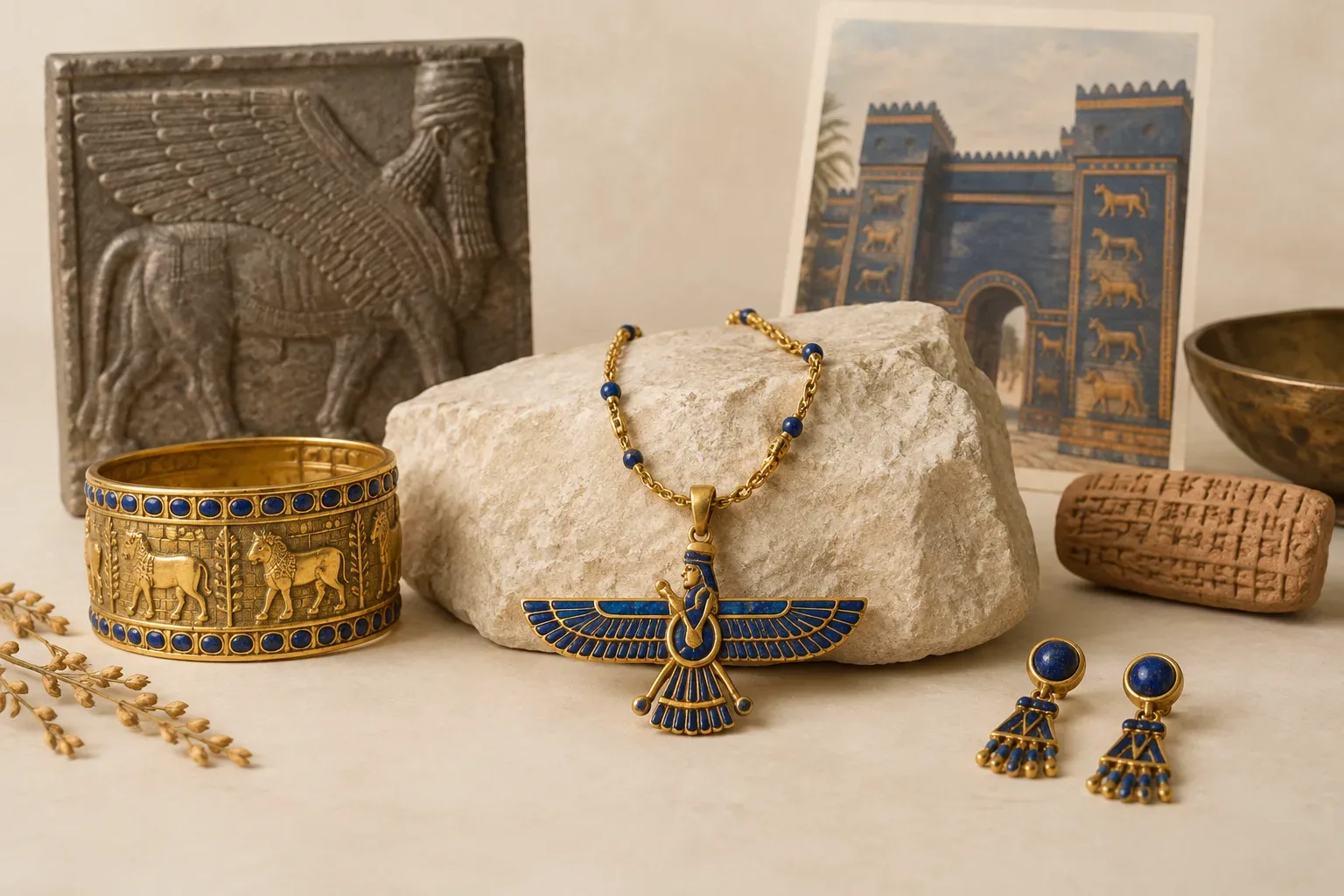
Many motifs and materials familiar from museum displays appear in jewellery as settings, inlaid surfaces, engraved motifs and beadwork. Museum treatments note that craftsmen used metal settings and inlays to show off stones or to create patterned surfaces, and that repeating decorative motifs were achieved in both small personal items and larger ceremonial pieces. The physical ways motifs appear — whether as carved stone inlays, repoussé metalwork or strung beads — are part of the documented craft vocabulary preserved in collections and exhibitions.
When you encounter a ‘‘Babylonian’’ motif in modern jewellery, the design may be a direct visual quotation of archaeological objects, a stylistic reinterpretation, or an entirely modern composition inspired by perceived ancient forms. Museum descriptions of gemstones and jewellery history help identify what elements are genuinely ancient in origin and which are later inventions or modern hybrid designs. That distinction matters for understanding authenticity, historical resonance and personal meaning.
Separating documented historical meanings from modern personal or popular readings
Museum scholarship separates proven historical functions from later symbolic readings. If an item is accompanied by inscriptions or found in a documented ritual deposit, the V&A and similar institutions treat those as documentary evidence that can be cited. By contrast, many ideas about ‘‘Babylonian’’ symbolism circulating in modern books, design catalogs or social media are reinterpretations or contemporary assignments of meaning, not direct continuations of ancient belief systems.
As a guide: when a meaning is tied to a specific archaeological context and discussed in museum literature, it is properly presented as documented. When a meaning is offered without archaeological or textual support and framed as a personal, spiritual, or universal claim, it should be presented as modern interpretation. Maintaining that distinction respects both historical complexity and contemporary users’ freedom to assign personal significance.
Practical selection and gifting guidance
If you are choosing Babylonian-inspired jewellery for yourself or as a gift, start by identifying whether you want an authentically ancient object, a museum-quality replica, or a modern piece inspired by historical motifs. Museum collections and exhibitions provide reference images and descriptions that help validate a maker’s claims about inspiration or reproduction. The Victoria and Albert Museum’s coverage of jewellery history is a useful reference point for assessing how closely a contemporary piece follows documented forms.
Materials and treatment disclosure are critical when purchasing. The U.S. Federal Trade Commission’s guidance on buying gemstones, diamonds and pearls stresses the importance of clear information about whether stones are natural, treated, synthetic, or imitation. Ask sellers for written disclosure about treatments, origin claims and metal content, and request reputable third-party gemstone reports for high-value items when available. Transparent provenance and material information protect both buyer and seller and help preserve the historical meanings that matter to you.
Respectful gifting also involves cultural context. Mention the source of inspiration (for example, ‘‘inspired by Mesopotamian forms as represented in museum collections’’) and avoid claiming cultural continuity where none is documented. If the recipient values historical accuracy, provide context from reputable museum sources and, where possible, link to accessible scholarship so the object’s history is clear without overstating ancient meanings.
Using Babylonian-inspired jewellery responsibly today
Wearing or gifting jewellery inspired by ancient Babylonian forms can be meaningful when done with attention to evidence and respect for cultural specificity. Cite museum scholarship if you describe an object’s historical basis, ask for material and treatment disclosures when buying, and avoid universalizing claims about ancient beliefs or symbolism. That approach honors both the documented past and modern personal creativity.
If you want to learn more about how to research jewellery symbols or choose meaningful pieces, museum resources and practical buying guidance are good next steps. Our internal resources on cultural and historical jewellery, gift guidance, and researching symbols can help you move from appreciation to informed selection.
Frequently asked questions
Was jewellery in ancient Babylon only for elites?
Archaeological and museum evidence shows that jewellery often signaled rank or office in specific contexts, especially in elite burials and official depictions, but smaller and simpler personal ornaments also existed for everyday wear. The Victoria and Albert Museum emphasizes that social meanings changed across time and context, so it is best to evaluate each find by its archaeological and documentary evidence rather than assuming universal exclusivity.
Can a modern piece be both inspired by Babylon and authentic?
Yes, a modern piece can be authentically inspired by Babylonian forms: it can faithfully reproduce documented motifs or techniques while being newly made. If you want an object that closely follows historical practice, look for makers who reference museum collections or published sources. The V&A’s resources are a helpful point of comparison.
How can I verify the materials in a Babylonian-style piece?
Ask the seller for written disclosure about metal content and any treatments or enhancements. For higher-value stones, request a reputable third-party report. The Federal Trade Commission recommends clear disclosure when gems are treated, synthetic, or imitations, and that buyers seek documented information on origin and treatment.
Do motifs used in Babylonian jewellery have fixed symbolic meanings?
Not necessarily. Some motifs have clear contextual associations when supported by inscriptions or archaeological context; others are modern attributions. Museum scholarship separates documented ritual or status uses from later symbolic readings, so avoid assuming a single, fixed ancient meaning unless it is documented.
Is it respectful to wear jewellery inspired by ancient Babylon?
Wearing historically inspired jewellery can be respectful if you acknowledge the source of inspiration, avoid claiming unproven continuity of meaning, and disclose accuracy when gifting. Providing context from museum literature or labeling a piece as ‘‘inspired by’’ rather than ‘‘authentic ancient’’ helps maintain transparency and respect.
Where can I learn more about identifying genuine historical pieces?
Museum publications and exhibitions are reliable starting points for identification and context. The Victoria and Albert Museum’s material on jewellery history and gemstones offers authoritative overviews, and consumer guidance from government sources like the FTC can help with material and treatment verification.
Sources and further reading
- Bedazzled: A History of Jewellery — Victoria and Albert Museum
- An A-Z of Gemstones — Victoria and Albert Museum
- Buying Gemstones, Diamonds, and Pearls — Federal Trade Commission