Meaning at a glance
Astrolabe jewelry meaning rests on a documented history of the astrolabe as a scientific and navigational instrument used across medieval Islamic and European contexts (as described by the Victoria and Albert Museum); modern uses of the motif emphasize curiosity, learning, navigation, and personal journeys but are contemporary interpretations rather than historical facts. When choosing or gifting astrolabe jewelry, consider the recipient's relationship to science and history, craftsmanship and materials, and ask about gemstone treatments and authenticity in line with FTC guidance.
Documented history and cultural contexts
The astrolabe began as an analog instrument for solving problems in astronomy and timekeeping. Museum scholarship from the Victoria and Albert Museum places the instrument within the histories of science and material culture and emphasizes how objects used for measurement and observation also carried decorative and social functions in different periods. The V&A treats the astrolabe primarily as an object of scientific and technical history that was produced, used and sometimes elaborately decorated in medieval Islamic contexts and later in medieval and Renaissance Europe.
In the medieval Islamic world the astrolabe was a sophisticated instrument used by astronomers, navigators and scholars. The V&A highlights how makers and owners sometimes added inscriptions, ornament and fine materials; these embellishments show that the instrument could be both practical and an object of craft. In medieval and Renaissance Europe, the astrolabe similarly served educational, navigational and astronomical purposes, and surviving instruments demonstrate regional variations in style and construction, as recorded by museum collections and catalogues.
Museum documentation therefore supports two clear points: first, the astrolabe was primarily a technical instrument in its documented history; and second, makers often combined functional components with decorative workmanship. The V&A's approach cautions against projecting contemporary symbolic meanings back onto the instrument without evidence from historical records.
Separating documented historical meanings from modern interpretations
The best-documented historical meaning of the astrolabe is technological: it was an instrument for astronomical observation, for calculating time and celestial positions, and for teaching mathematical astronomy. That is the account supported by museum scholarship such as the Victoria and Albert Museum. Religious or mystical meanings attributed to astrolabes in later popular accounts are not primary claims in the V&A’s technical and object-focused documentation and should be treated as secondary or modern layers of interpretation unless supported by specific historical sources.
Modern jewelry designers and wearers often interpret the astrolabe motif as a symbol of navigation through life, intellectual curiosity, or connection to a scientific heritage. These contemporary meanings are valid as personal or cultural symbols today, but they are contemporary meanings rather than documented historical functions. Make a clear distinction when discussing an astrolabe motif: say that historical evidence points to scientific and educational use, and that symbolic associations with guidance, discovery or spirituality are modern attributions made by designers and buyers.
How the astrolabe motif and related gemstones appear in jewelry
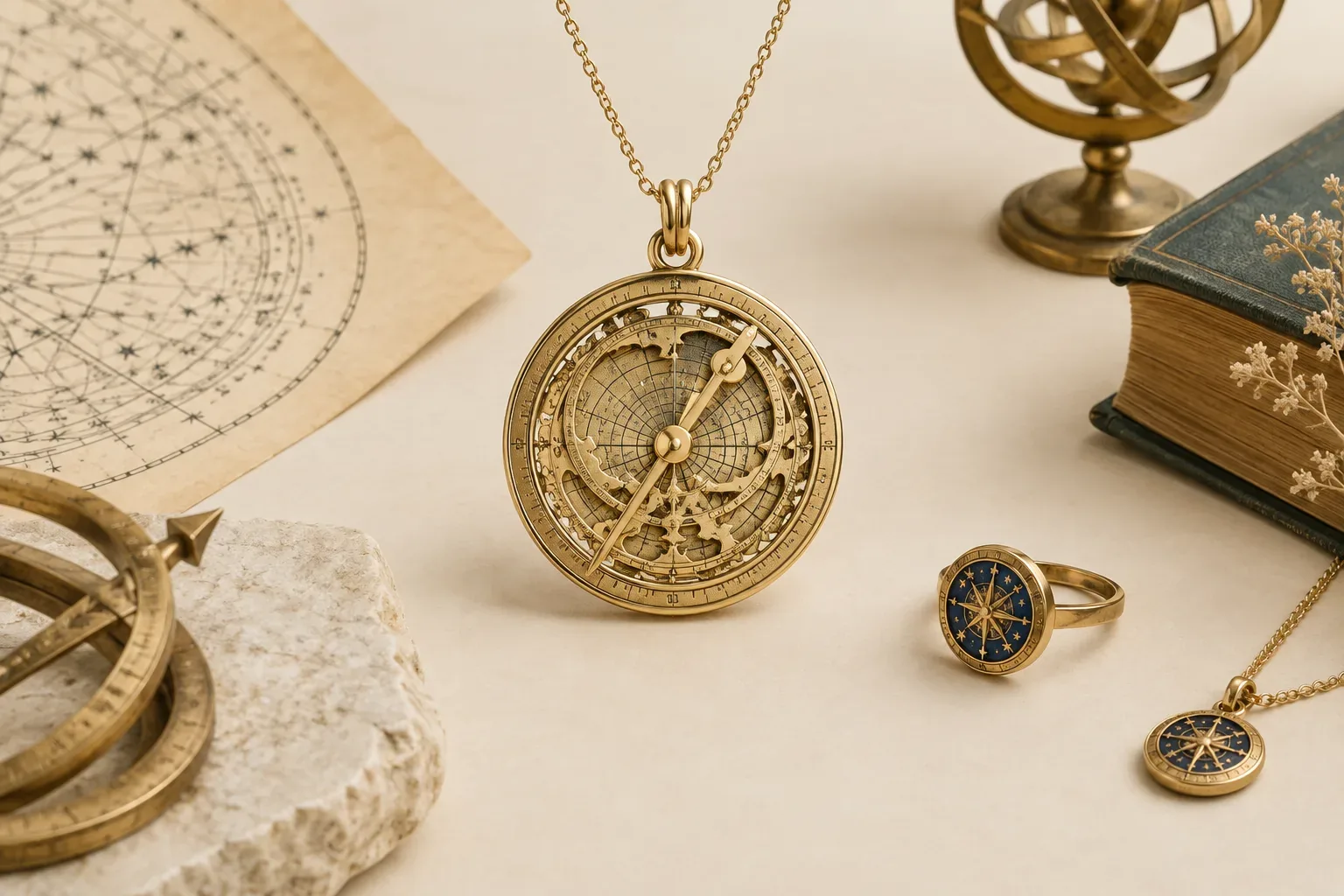
Designers adapt the astrolabe’s circular form, intricate rete (the star-shaped overlay on a full astrolabe), and engraved scales into pendants, charms, brooches and rings. The V&A’s material on jewellery history notes that motifs derived from scientific instruments have long been incorporated into personal adornment, with artisans translating complex objects into wearable symbols while retaining decorative detail. Contemporary pieces may render a stylized rete, an engraved horizon line, or a miniature dial as a purely ornamental pattern rather than a functioning instrument.
Gemstones commonly used with science-inspired motifs follow the general histories of gemstone use described by the Victoria and Albert Museum. Designers may set sapphires, moonstones, garnets or other gems into astrolabe-inspired settings to evoke the sky, stars or night, or they may use enamel, filigree and mixed metals to suggest historical craftsmanship. When gems are present, museum guidance on identification and historical context reminds buyers to consider whether stones are natural, treated, or simulated and how treatments were understood historically versus today.
Practical guidance for choosing or gifting astrolabe jewelry
Start by thinking about the recipient's relationship to the themes associated with an astrolabe: do they have an interest in astronomy, navigation, history, or scientific instruments? Because the instrument has a clear technical past, an astrolabe motif is especially meaningful for people who value inquiry, learning or the history of science. If the gift is intended as a cultural or historical reference, be explicit about that context rather than implying a single, universal symbolic meaning.
Examine craftsmanship and materials. Museum writing on jewellery history highlights how decoration and technique communicate value; look for clean engraving, solid settings, and a maker’s mark or attribution when possible. If the piece contains gemstones, consult authoritative guidance on gemstones such as the Victoria and Albert Museum’s summaries on gem identification and history to understand typical materials and historical associations. For consumer protections regarding disclosure of treatments, imitations or synthetics, follow the Federal Trade Commission’s advice to ask sellers whether stones are treated, lab-grown, or simulated and to request written confirmation.
Respect cultural context. The astrolabe has a medieval history in both Islamic and European contexts. If a piece explicitly references a particular cultural form—by use of calligraphic inscriptions, specific ornamental styles or historical reproductions—check that the maker or vendor represents those references accurately and respectfully. If the recipient has cultural or religious ties related to these regions, a considerate conversation before gifting can prevent unintended offense.
Ask practical questions when buying. Request information about metal purity, gemstone treatments and return policies. If provenance matters, ask whether the piece is a modern design inspired by historical astrolabes or a reproduction of a specific historical instrument. For higher-value purchases, seek independent appraisals or documentation from reputable dealers or museum-standard conservators.
Wearing, care and presentation
Present astrolabe jewelry with a short note explaining the intended meaning or inspiration—this helps receivers understand whether the design references scientific history, personal navigation, or another modern interpretation. Care for jewelry according to its materials: store silver pieces to reduce tarnish, follow heat and chemical precautions for gemstones, and consult a trusted jeweller for cleaning techniques appropriate to enamel or fragile inlays. For guidance on disclosure of treatments and materials when maintaining or reselling pieces, follow FTC recommendations to ensure transparent communication with future buyers.
Final thoughts
An astrolabe motif in jewelry functions today largely as a modern symbol built on a documented technical past. Museum scholarship represented by the Victoria and Albert Museum places the instrument firmly within the histories of astronomy, navigation and crafted instrument-making, and it cautions against assuming spiritual or universal meanings not supported by historical records. Contemporary meanings—curiosity, guidance, a tribute to scientific heritage—are valuable and personal, but they should be presented as modern interpretations when you choose or describe astrolabe-themed jewellery.
Frequently asked questions
Was the astrolabe originally a religious symbol?
No. Museum documentation such as that from the Victoria and Albert Museum identifies the astrolabe primarily as a scientific and navigational instrument used in medieval Islamic and European contexts. Any religious or mystical meanings attributed to the astrolabe in modern descriptions are later interpretations and are not the primary historical function recorded by museum scholarship.
What does astrolabe jewelry usually symbolize today?
Today the astrolabe motif is commonly used to symbolize guidance, intellectual curiosity, the love of astronomy, or a personal journey. These associations are contemporary and symbolic rather than universal historical meanings; individual wearers may attach their own personal significance to the motif.
How can I tell if gemstones in an astrolabe piece are genuine or treated?
Ask the seller for written details about the stones and their treatments. The Federal Trade Commission recommends that sellers disclose whether gems are natural, treated, lab-grown or simulated. If you need higher certainty, request certification from a qualified gemological laboratory or seek an independent appraisal.
Is it appropriate to gift astrolabe jewelry to someone from a culture where the original instruments were used?
It can be appropriate if done respectfully. Because the astrolabe has historical importance in multiple regions, be mindful of specific cultural references—such as inscriptions or stylistic elements— and ensure the piece and its description are accurate. When in doubt, communicate the intent openly and consider whether the recipient would appreciate a scientific-historical reference.
Should an astrolabe pendant be functional to be meaningful?
No. Most astrolabe-inspired jewelry is decorative rather than functional. Historical astrolabes were scientific instruments, but modern recreations and motifs usually translate the visual language of the instrument into wearable form to evoke ideas like navigation and inquiry rather than to perform astronomical calculations.
Sources and further reading
- Bedazzled: A History of Jewellery — Victoria and Albert Museum
- An A-Z of Gemstones — Victoria and Albert Museum
- Buying Gemstones, Diamonds, and Pearls — Federal Trade Commission