Meaning at a glance
This article explains the documented history and shifting contexts of the sundial motif in jewelry, distinguishes museum-backed meanings from later personal or popular interpretations, describes how sundial imagery and related gemstones appear in wearable pieces, and offers practical advice for selecting or gifting sundial jewelry with attention to materials and provenance.
Quick answer
The sundial jewelry meaning is best understood as historically layered: museum records show the motif and related miniature timekeeping devices appearing in European decorative arts and jewelry collections from the Renaissance through the 19th century, typically linked to scientific interest and changing fashions rather than any single universal symbolism. Modern wearers attach personal ideas—time, memory, transience, or curiosity—while contemporary makers may intentionally mix scientific or classical references with sentimental messages. This article separates documented, museum-backed evidence from later interpretations and gives practical guidance for choosing and gifting sundial-themed jewelry.
What the historical evidence shows (periods and contexts)
Museum scholarship and exhibition catalogues emphasize that jewelry and small decorative objects must be read in their social and technological context rather than as fixed symbols. The Victoria and Albert Museum’s overview of jewellery history explains how motifs change meaning as fashions, technologies and social uses change, and how museums interpret objects within those contexts.
In those collections and in associated scholarship, objects that reference timekeeping and scientific instruments most consistently appear in European material culture from the Renaissance into the early modern and Victorian periods. Examples in museum collections include miniature instruments, timepiece decorations and jewelry that draw on classical forms, reflecting both an interest in scientific innovation and an aesthetic fascination with instruments as fashionable objects.
The Victoria and Albert Museum also documents how the nineteenth century expanded the range of motifs used in wearable objects as personal expression and public display, so that scientific or classical motifs could circulate alongside sentimental imagery within the same period. Museum catalogues therefore place many sundial-inspired pieces in the broader currents of early modern and Victorian tastes rather than within a single cultural or religious tradition.
Separating documented historical meanings from modern interpretations
Documented historical meanings are what museums and primary records can support: for sundial-related jewelry, evidence in museum collections points to links with scientific display, classical reference and fashionable ornament. Those links are interpretive conclusions based on object types, inscriptions, provenance and comparable material in museum catalogues, and the Victoria and Albert Museum describes this approach in its exhibitions and articles on jewellery history.
Modern personal or popular interpretations—time as a prompt to mindfulness, the sundial as a symbol of mortality, or a pendant as an emblem of punctuality—are meaningful to wearers but usually not directly attested in historical documentation for every period. These contemporary readings are valid as personal symbolism but should be distinguished from what can be documented about how specific objects were understood when made and first used.
A practical reading therefore holds two layers: the historically documented layer (museum-backed evidence that a motif was fashionable, tied to scientific instruments, or used as an applied decorative form) and the modern interpretive layer (what current owners choose to read into that motif). The Victoria and Albert Museum’s work on jewellery underlines the importance of keeping those layers distinct when discussing meaning.
How the motif, gemstones, and traditions appear in jewelry
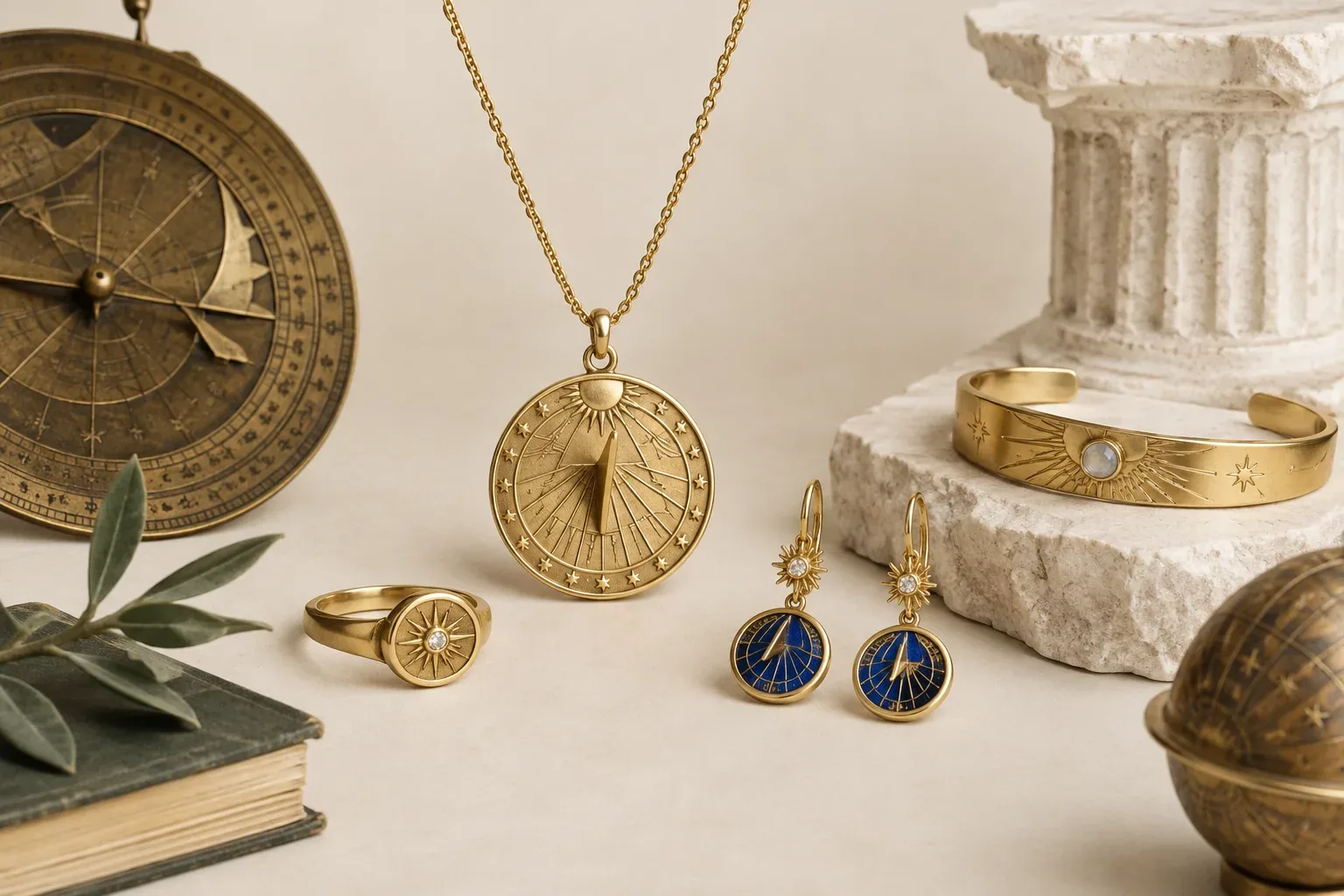
The sundial motif appears in two principal ways in wearable objects: as imagery or engraving of a sundial on a decorative surface, and as a miniature functional or pseudo‑functional instrument incorporated into a pendant, ring or brooch. In historical examples documented by museum collections, makers sometimes referenced instrument forms in miniature, using small gnomons, engraved dial faces or pierced patterns that echo the geometry of sundials. Where an object is a functioning miniature instrument, that practical function is usually noted in museum descriptions.
Gemstones and materials commonly used in pieces that reference instruments or scientific taste vary by period. The Victoria and Albert Museum’s A–Z of Gemstones provides context for how particular stones were used across periods: opaque stones and dark backgrounds (for example, onyx or black enamel) have often been used to set off engraving or to suggest contrast for tiny dials, while clear stones, glass and rock crystal were sometimes used as lenses or covers for practical small instruments. In later decorative treatments, colored gemstones and enamels serve to emphasize the motif artistically rather than functionally.
Enamel work, engraved metal, and gemstone inlay therefore coexist as techniques for making the sundial motif legible on a small scale. Victorian and early modern jewellery makers frequently relied on enamel and fine metalwork to reproduce instrument details that were visually evocative even when not strictly functional. Museum records emphasize technique and context—how an object was made and displayed—when documenting such pieces.
Choosing or gifting sundial jewelry: practical and respectful guidance
Consider context and the recipient. If you give a sundial-motif piece as a gift, think about whether the recipient prefers historically grounded objects, symbolic jewellery, or contemporary designs. A historically styled miniature instrument or a reproduction will suit a wearer interested in history or horology; a stylised sun-and-dial motif set with modern stones will suit someone who wants a symbolic token without functional pretense.
Ask sellers or makers about provenance and function. When buying an antique or historically styled piece, request clear information about whether the object is a genuine period item, a later reproduction, or a modern design inspired by historical forms. Museum collections and reputable dealers typically provide documentation or catalogue references; the Victoria and Albert Museum’s approach to jewellery history shows how provenance and documented context matter to meaning.
Verify gemstone and treatment disclosures. The Federal Trade Commission advises buyers to seek clear disclosure about gemstone treatments, imitations and enhancements when purchasing gems, diamonds, and pearls. Ask the seller for written information on treatments and whether stones are natural, laboratory-grown, heated, dyed or otherwise modified, and for any certifications that accompany higher-value pieces.
Choose materials and scale with wearability in mind. Small, detailed motifs can be delicate. If you want a piece to be worn daily, select robust metals (for example, gold alloys appropriate for daily wear) and consider settings that protect any decorative gnomon or projecting element. For heirloom pieces or true antiques, consult a conservator or jeweller about how to wear or display the object without risking damage.
Respect personal meanings and cultural sensitivities. Because modern wearers often project private meanings—remembrance, fleeting time, or personal transformation—discuss the intended symbolism if the gift is for someone close. If you are commissioning a bespoke piece, communicate whether the motif should read strictly as a historical reference or as a contemporary symbol.
Buying, care, and authenticity checks
Work with reputable sources. Museums, well-documented dealers, and established makers provide better provenance and clearer descriptions. The Victoria and Albert Museum’s public material on jewellery history illustrates how documentation and cataloguing illuminate an object’s original use and later reception.
Ask for condition reports and any conservation history for antiques. Specialists can advise on whether a projecting element such as a gnomon is original, replaced, or removed for safety and how that affects both function and value.
Follow FTC guidance on consumer protections. The Federal Trade Commission’s advice on buying gemstones recommends asking about treatments and lab reports when appropriate and keeping written records of any claims made at purchase. That guidance helps you avoid surprises about what you are buying and ensures the recipient knows the object’s material truth.
Final thoughts
Sundial jewelry meaning is not a single settled thing. Museum evidence situates many examples within European decorative and scientific tastes from the Renaissance through the nineteenth century, while modern makers and wearers freely adopt and adapt the motif to express personal ideas about time, remembrance or curiosity. Distinguishing what museums can document from what modern users interpret preserves historical accuracy while leaving room for meaningful personal use.
If you are choosing or giving a sundial-motif piece, combine respect for documented provenance with clear practical checks—material disclosure, condition, and suitability for wear—to make a gift that is both thoughtful and responsible.
Frequently asked questions
Does sundial jewelry ever function as a real sundial?
Some historical objects in museum collections reproduce miniature instrument forms and may have functional elements; museums will note if an item is a working instrument. Many wearable pieces that recall sundials are decorative rather than functional, so always check provenance and object descriptions if function matters to you.
What did sundial imagery historically mean?
Museum documentation suggests sundial imagery in jewelry and small objects was most often associated with scientific interest, classical reference or fashionable ornament in the periods where examples survive; more precise meanings depend on the object’s inscription, provenance and the wider cultural context recorded by curators and catalogues.
Is a sundial motif appropriate for mourning or memorial jewelry?
Wearing sundial imagery as a reminder of time’s passage is a modern interpretive practice some people adopt. While museums record a variety of mourning and memento motifs in the nineteenth century, each case should be assessed on its own evidence: consult museum catalogues or a specialist to see whether a specific object was intended as mourning jewellery.
How can I be sure a gemstone in a sundial-themed piece is genuine?
Ask the seller for written disclosure of treatments, imitations or laboratory-grown origins. The Federal Trade Commission recommends obtaining documentation for significant purchases and keeping records of any claims made about the stone’s nature and treatments.
Should I wear an antique sundial pendant daily?
Antique and delicate pieces may be better worn only occasionally. For daily wear choose robust settings and materials; consult a jeweller or conservator about whether an antique piece can safely be worn and how to protect fragile elements.
Sources and further reading
- Bedazzled: A History of Jewellery — Victoria and Albert Museum
- An A-Z of Gemstones — Victoria and Albert Museum
- Buying Gemstones, Diamonds, and Pearls — Federal Trade Commission