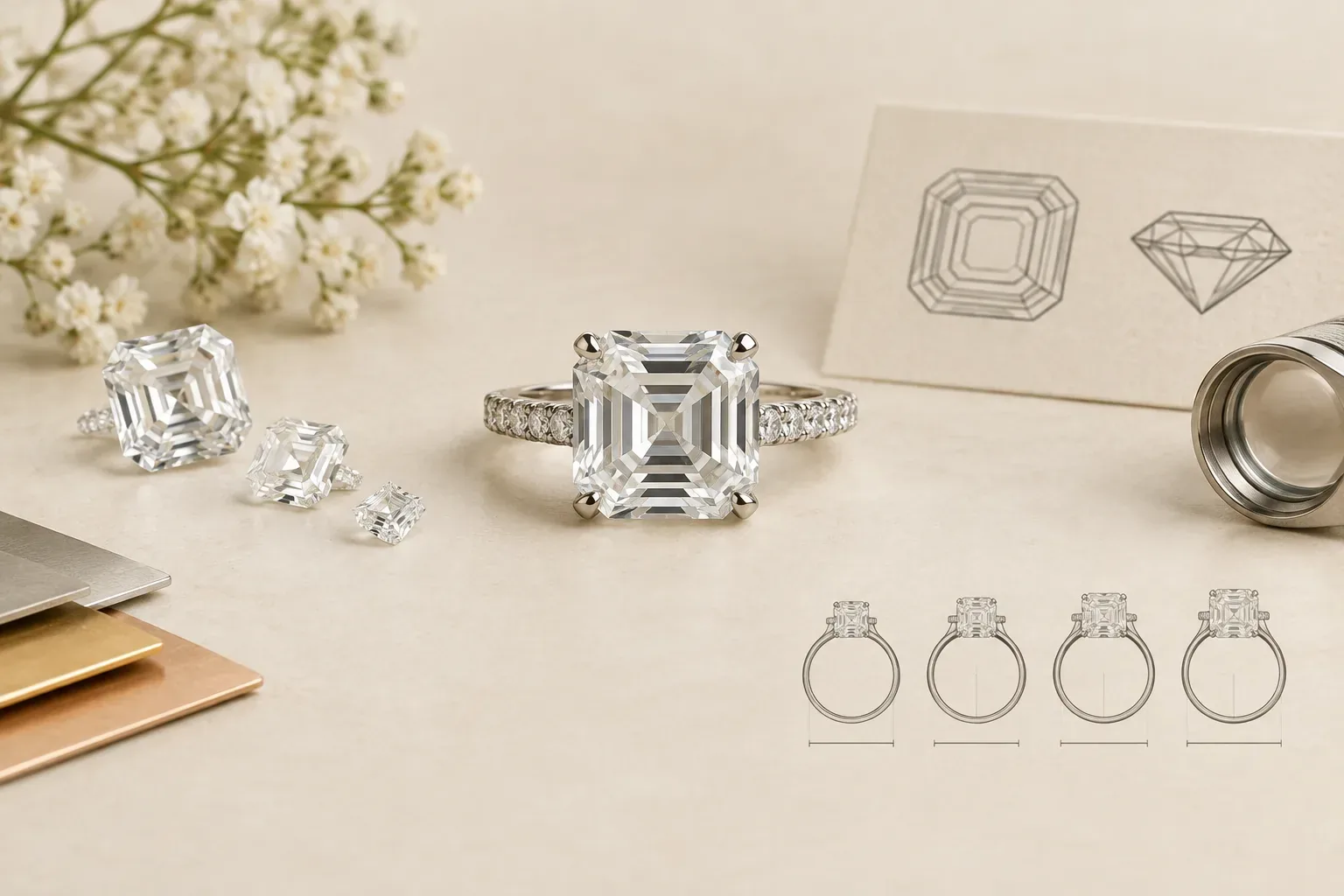
Meaning at a glance
Asscher cut engagement ring styling balances the square, step-cut face of the stone and its visible table with band width and setting to control perceived size, finger coverage and wearability; choose mountings and metal that change visual proportion, ask for written disclosures and lab reports to verify origin or treatments, and follow routine care to protect pavé and channel details.
Quick answer
Answer the search intent: style an Asscher cut engagement ring by matching the stone’s square, step-cut profile to band width and setting so the ring’s table and outline sit in proportion to the wearer’s finger; use settings such as low-solitaire, halo, or raised cathedral to change perceived coverage, and rely on written seller disclosures and a gemological report to verify origin or treatments because certain verifications require a qualified jeweler or laboratory.
What to expect from an Asscher cut in jewelry
In jewellery descriptions the Asscher cut is presented as a square step-cut with trimmed corners that produces a distinctive, often octagonal, face. That face emphasizes clean planes rather than the many small facets of a brilliant cut. The result is a strong geometric outline that reads as architectural on the finger and tends to focus the eye on table size, facet symmetry and clarity rather than on scintillation alone.
Because of that geometry, Asscher cut stones are used in a variety of mountings. Jewelers place them in single-stone solitaires when a crisp, vintage-modern look is desired, in halo settings when a larger visual footprint is wanted without increasing carat weight, and in three-stone or channel-set rings to continue the step-cut aesthetic along the band. Pavé and micro-pavé accents are also common where sparkle around the square center softens the step-cut’s planar look.
Proportion and finger coverage: principles that guide styling
Finger coverage means the portion of the top of the finger that visually appears occupied by the ring when worn. For Asscher cuts, that perceived coverage depends on the stone’s face dimensions, the visible table, the size of the trimmed corners, and the band or accent design that frames it. To keep the profile balanced on narrow fingers choose narrower shanks and smaller outer frames; on broader or longer fingers a wider band, larger stone, or halo can achieve balanced coverage.
Proportion works on two axes: vertical height (how much the ring looks tall from the side) and horizontal span (how much of the finger’s width the ring’s top covers). Low-profile settings reduce vertical projection and make the ring feel more practical for daily wear, while elevated settings increase presence and perceived size at the cost of snag risk. Horizontally, a halo or wider gallery increases the ring’s apparent diameter, while thin, tapered bands focus attention on the stone itself and make the face feel larger relative to the finger.
Practical trade-offs to consider
An Asscher cut’s step facets highlight clarity and color more than a brilliant-cut diamond. That means visible inclusions or a warmer body color will be more noticeable at a similar carat and color grade than they might be in a brilliant cut. The styling trade-off is this: choosing a larger table and simpler setting showcases the cut’s architectural beauty but makes internal characteristics more noticeable; choosing a halo or heavier side stones increases perceived size and can hide minor inclusions but changes the ring’s visual language.
Another trade-off is daily wear versus drama. A low-solitaire or bezel that hugs the girdle is practical for an active wearer and keeps the Asscher’s geometry clean. Conversely, an elevated setting or extensive accent work increases presence, takes more real estate on the finger, and often requires more maintenance to keep small stones secure.
Selection and gifting guidance—practical and respectful
Begin by observing how the recipient wears jewelry: do they prefer low, minimalist bands or larger, decorative rings? If you can view existing rings, note band width and how much of the finger top they cover. Match the Asscher’s visual footprint to that preference rather than assuming bigger is better. Jewelers Mutual’s 2026 trends highlight a demand for versatility and modern stacking, so consider how an Asscher ring will sit with other pieces if the recipient stacks rings or wears mixed-metal sets.
If you are purchasing without the wearer present, opt for settings with a modest return or resizing policy and ask for a clear, written description of the ring’s dimensions. The Federal Trade Commission emphasizes that consumers need written disclosures about origin and treatments. Request a gemological report when available and document any assurances the seller provides about origin, treatment, or lab-grown status in writing before finalizing the purchase.
What a shopper can—and cannot—verify without a lab or qualified jeweler
You can visually check symmetry, polish and how the ring sits on a finger using high-resolution photos or an in-person inspection, and you can compare band width to finger width to judge coverage. However, determining whether a diamond is natural or lab-grown, whether a stone has been clarity-enhanced or irradiated, and the precise color and clarity grades requires specialized equipment and specialist training. The Gemological Institute of America advises that treatments, detectability and durability questions are technical and often need laboratory testing to answer reliably.
The Federal Trade Commission advises that sellers provide clear, written disclosure of whether a gemstone is natural, lab-grown, treated, cultured or imitation. A lab report from an accredited laboratory is the most reliable consumer-friendly way to confirm those facts; without a report you should consider the seller’s return policy and be prepared to get an independent appraisal or lab confirmation after purchase.
Care, maintenance and longevity
Asscher cut centers set with pavé or channel shoulders need routine attention because settings that hold multiple small stones can loosen with wear. Jewelers Mutual’s 2026 guidance for jewellery care and trends emphasizes craftsmanship and routine maintenance as important for longevity. Remove the ring for heavy manual work, gardening and cleaning with harsh chemicals, and have settings checked annually by a qualified jeweler to confirm prongs and channels are secure.
For gemstones other than diamond, follow durability guidance and disclosure information. The Gemological Institute of America’s resources on gem treatments and durability explain that certain gemstones and treatments change how a stone should be cleaned and how durable it will be under daily wear. When in doubt, follow the care recommendations provided with the purchase and schedule professional cleanings and checks.
Documented historical meanings versus modern interpretation
None of the approved sources in this collection provide a documented, culture-specific historical meaning for the Asscher cut itself, so there is no authoritative historical symbolism for the cut documented among these sources. Modern interpretations are primarily stylistic and personal rather than historical facts. Imaginaire Digital’s 2026 search data shows strong consumer interest in a range of engagement-ring styles, indicating that contemporary buyers often choose cuts like the Asscher for aesthetic or trend reasons rather than for a single, documented traditional meaning.
Today, people attach personal or family meanings to ring styles in many cultures, but those meanings are modern and individual. When you present an Asscher cut as a gift, clarify whether the symbolism is a personal message you are giving rather than a claim of long-documented cultural symbolism.
A practical checklist before you buy
Ask for high-resolution photos from multiple angles and, when possible, request to see the ring in person to judge how the stone’s table and trimmed corners affect perceived size and coverage. Obtain written disclosures about whether the stone is natural, lab-grown or treated, and ask for a gemological report when available. Confirm sizing and a realistic return or resizing policy so the ring can be adjusted if the fit or perceived coverage is not right after gifting.
Decide which trade-offs matter most to you: do you prioritize a clean, architectural look with a plain solitaire; the visual enlargement of a halo; or the sparkle of pavé shoulders? Balance that choice with practical details like the wearer’s daily activities, preferred ring profile and maintenance willingness. When possible, have a local qualified jeweler evaluate the setting and any accent stones before final purchase if authenticity or craftsmanship is a primary concern.
Closing guidance
Styling an Asscher cut engagement ring is about proportioning a strong geometric center to the wearer’s finger and lifestyle. Use band width, setting height and accents to control perceived coverage and presence. Rely on written seller disclosures and accredited gemological reports for questions about origin and treatments, and perform routine maintenance to protect detailed settings. If you need help translating how a specific Asscher will look on a particular finger, a local jeweler can provide in-hand comparisons and measurements that online photos alone cannot fully replicate.
Frequently asked questions
How do I judge if an Asscher cut will cover a finger well?
Judge coverage by comparing the stone’s face width and its visible table to the wearer’s finger width; thinner bands and smaller frames reduce coverage while halos and wider shanks increase it. Viewing high-resolution photos or seeing the ring in person is the most reliable way to assess coverage before purchase.
Will a halo make an Asscher cut look bigger?
Yes. A halo of small stones around an Asscher center increases the ring’s apparent diameter and makes the center look larger without increasing carat weight, but it also changes the ring’s aesthetic and adds settings that will need occasional maintenance.
Can I tell if an Asscher diamond is lab-grown or treated by looking?
No. Visual inspection alone cannot reliably determine whether a diamond is lab-grown or whether a stone has had treatments. The Federal Trade Commission recommends written disclosures from sellers and the Gemological Institute of America advises using accredited laboratory reports for those verifications.
Is an Asscher cut harder to maintain than a brilliant cut?
Maintenance depends more on the setting than the cut. Step-cut surfaces like the Asscher’s show inclusions and dirt more clearly, so routine cleaning and checks of prongs and pavé settings are important. Jewelers Mutual recommends regular professional inspections for rings with many small accent stones.
Should I choose a low or high setting for daily wear?
If the wearer is active or wears gloves frequently, a lower-profile setting or bezel reduces snag risk and is more practical. A higher setting increases presence and perceived size but requires more care to avoid knocks and catches.
What paperwork should I ask for when buying an Asscher cut engagement ring?
Request written disclosure about whether the stone is natural, lab-grown or treated, any available gemological report from an accredited lab, detailed photos, and the seller’s return, resizing and warranty policy before you purchase, as recommended by the Federal Trade Commission.
Sources and further reading
- Imaginaire Digital — Imaginaire Digital
- Jewelers Mutual — Jewelers Mutual
- Gemological Institute of America — Gemological Institute of America
- Federal Trade Commission — Federal Trade Commission