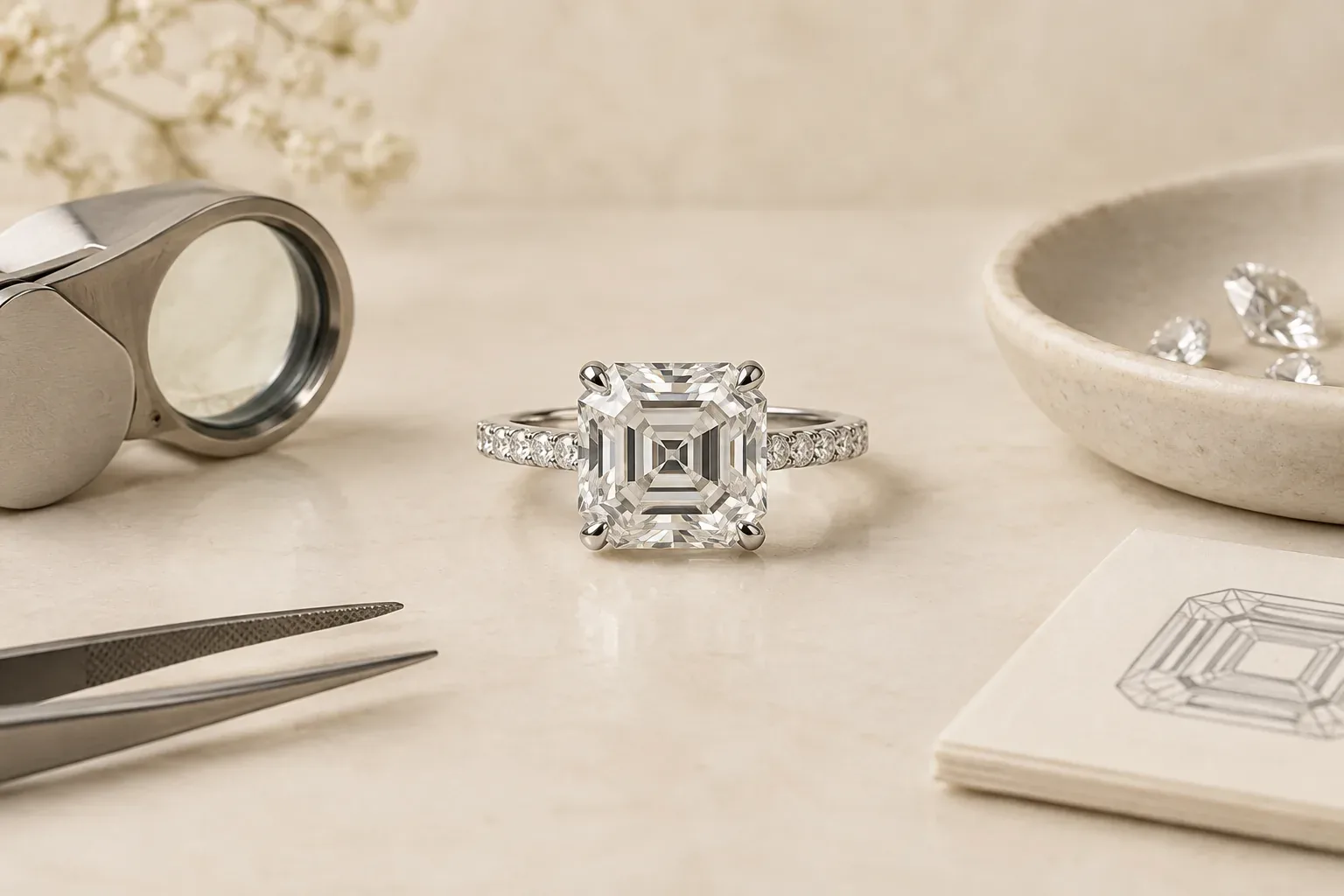
Meaning at a glance
Before buying an Asscher cut engagement ring, ask for a qualified lab report, written disclosure about origin and treatments, clear details on cut quality and setting protection, warranty/return terms, and care guidance; prioritize what matters most to you (clarity versus size, protection versus profile) and understand that confirming origin or treatments beyond seller documentation requires a gemological laboratory or qualified appraiser.
Direct answer — the quick checklist thesis
Concise answer: ask for a reputable gemological report, written disclosures about whether the stone is natural, lab-grown or treated, specific cut-quality measurements and images, the setting’s protection for stepped corners, retailer return/repair policies, care instructions, and insurance or appraisal options; accept that definitive verification of origin and certain treatments requires a qualified jeweler or an independent gemological laboratory.
This article expands each item into the practical questions and trade-offs you should weigh when shopping for an Asscher cut engagement ring.
What the evidence base covers (and what it does not)
The sources available for this checklist focus on consumer protections, gemstone treatment disclosure, and contemporary market trends. The Federal Trade Commission explains the consumer need for clear written distinctions among natural, lab-created, treated and imitation materials. The Gemological Institute of America (GIA) highlights how treatments, disclosure, detectability and durability raise specific consumer questions. Industry commentary from Jewelers Mutual emphasizes current buyer priorities such as craftsmanship, versatility and durability, while Imaginaire Digital reports strong search demand for engagement-related styles in 2026.
These sources do not provide a complete historical provenance for the Asscher cut nor authoritative claims about century-old symbolic meanings. Where historical claims or cultural attributions appear in marketing or informal writing, treat them as modern interpretation unless they are specifically documented by independent historical research.
Documented history versus modern interpretation
Documented history: among the approved sources there is no primary documentation of the Asscher cut’s origin or historical symbolic meaning. Because the FTC and GIA material are about disclosure and treatments, and trade bodies report contemporary trends, they do not establish historical cultural claims.
Modern interpretation: retailers, designers and buyers commonly associate the Asscher and other step cuts with vintage or Art Deco styling and an emphasis on geometric elegance. Those associations are modern interpretive frames used for styling and marketing. Treat such stylistic links as subjective and not universal symbolic facts.
How the Asscher-style choice appears in jewelry and why it matters
In jewellery practice an Asscher-style (step-cut square with an emphasis on clarity and symmetry) is often chosen for a structured, architectural look that highlights facet lines and clarity more than scintillation. That style decision changes which characteristics you should prioritize: clarity and cut symmetry typically matter more for step-cuts than for brilliant cuts, while a setting that protects the stone’s corners becomes an important practical consideration.
The marketplace context in 2026 favors craftsmanship, versatility and gender-neutral styling, which affects how Asscher-style stones are set and marketed. Expect variations—from solitaire and halo settings to mixed-metal designs—that reflect current buyer priorities for durability and everyday wearability, as reported by Jewelers Mutual and Imaginaire Digital.
The evidence-led checklist: questions to ask a seller
Certification and lab reports: request a full gemological report from a recognized lab (for example GIA or AGS). A report should describe whether the stone is natural, lab-grown, or treated and give documented measurements and grades. The FTC underscores the need for written disclosures; do not accept only verbal assurances.
Origin and treatments: ask explicitly whether the diamond or gemstone has been treated (clarity enhancement, irradiation, high-temperature annealing, etc.) or is lab-grown. The GIA explains that treatments affect detectability, durability and care needs. If the seller states ‘no treatment,’ ask for that in writing and for the lab report that supports it.
Cut-quality details you can request: ask for proportions or measurable data the seller can provide—symmetry notes, table and depth percentages, girdle condition, and images from multiple angles. For step-style stones, ask how symmetry and facet alignment were evaluated, and request magnified photos or videos.
Clarity and color considerations: because step cuts emphasize inclusions and facet lines, ask how clarity and color will appear face-up at your intended carat and setting. Request photographs of the actual stone in the proposed setting when possible.
Setting protection: ask how the setting protects the stone’s corners and edges; inquire about prong thickness, bezel options and whether the setting is recommended for daily wear. A protective setting reduces risk but may change the ring profile and ease of resizing.
Lifestyle and wearability: explain the recipient’s daily activities and ask whether the proposed ring is suitable for that lifestyle. Jewelers Mutual’s guidance on contemporary priorities suggests discussing durability and versatility up front.
Warranty, returns and repair policy: get written details on returns, resizing limits, routine maintenance, stone loss coverage, and any conflict or ethical sourcing assurances the seller provides. Clear written policies are important consumer protections.
Insurance and appraisal: ask whether the seller provides an independent appraisal for insurance and whether their prices and appraisals reflect current market norms. Jewelers Mutual offers resources on insuring and maintaining jewelry.
Resale and upgrades: if resale or future upgrades are a concern, ask for historical market behavior for the specific cut and whether the seller offers upgrade programs or buy-back options.
Documentation and photos: always request clear photos of the actual stone in the setting, a copy of the laboratory report, a written description of any treatments, and a sales contract or receipt that lists these elements.
Practical trade-offs to weigh
Prioritize clarity or carat: with step cuts, shoppers frequently trade carat weight for higher clarity because inclusions are more visible. Decide whether face-up size or inclusion masking matters more to you, and allocate budget accordingly.
Cut quality versus sparkle: step cuts produce a different type of light performance than brilliant cuts. If maximum scintillation is a priority, compare an Asscher-style to alternative cuts on similar budgets to see which meets your aesthetic goals.
Protection versus profile: protective settings (bezels, lower-profile halos, thicker prongs) safeguard corners but can alter how the ring sits or looks. If frequent hand use is expected, favor protective settings even if that slightly changes the ring’s silhouette.
Cost considerations: certification, insurance and appraisals add to total cost but provide legal and financial protections. Accepting unverified claims to save money increases risk.
What you can and cannot verify without a lab or qualified appraiser
What you can reasonably check yourself or with a jeweler’s loupe: visual symmetry, surface chips or nicks, visible inclusions at 10x magnification, how the stone sits in its intended setting, and the seller’s paperwork presence and consistency.
What requires a qualified jeweler or gemological laboratory: whether a diamond or gem is natural versus lab-grown in all cases, identification of specific treatments (some are subtle and need instruments), exact grading (certified clarity, color and cut grades), and verifiable origin claims. The GIA and the FTC both make clear that detectability and disclosure issues mean consumers must rely on accredited labs for final verification.
Care, cleaning and longevity
Cleaning and routine care: follow the seller’s written care instructions and consider industry guidance. GIA material on treatments and durability recommends tailored care when treatments are present; if a stone is treated, it may need gentler cleaning or professional inspection more often.
Avoidance of harsh chemicals and impacts: remove rings during heavy manual work, exercise and cleaning with household chemicals. Jewelers Mutual recommends regular inspections and maintenance to avoid prong wear and stone loss.
Professional maintenance: plan on an annual check with a qualified jeweler to examine prongs, settings and mounting tightness. Keep documentation of maintenance and any repairs.
Insurance and documentation: insure the ring promptly with an appropriate policy and keep the original lab report and receipts in a safe place. An independent appraisal is often necessary for replacement coverage.
Practical and respectful gifting guidance
Know preferences before you buy: if you can, learn the recipient’s metal and style preferences, finger size range, and any lifestyle constraints. If a surprise is essential, choose a seller with a fair return and resizing policy.
Sizing and resizing: ask the jeweler about how easily the chosen setting can be resized and whether resizing affects warranty. Some settings and metals have resizing limits.
Cultural sensitivity and symbolism: do not assume a single symbolic meaning for a cut. If you plan symbolic messaging (for example, linking a vintage style to a family story), state that interpretation as a personal gesture rather than a universal fact.
Presentation and follow-up: include the lab report and care guidance with the gift, and discuss insurance and appraisal options as part of the aftercare service you provide.
Final steps before you commit
Before purchase, verify that documentation (lab report, written treatment disclosure, sales contract, return/warranty policy) is complete and matches the stone you are buying. Confirm whether any advertised claims—natural, untreated, or origin—are supported by the lab report and are in writing.
If any key claim cannot be documented, get a commitment in writing or consider an independent pre-purchase evaluation by a qualified appraiser or gemological lab. Remember that some verifications are not possible without lab instruments.
Frequently asked questions
Do I need a lab report for an Asscher cut engagement ring?
Yes. Request a full gemological report from a reputable lab (for example GIA or AGS). The Federal Trade Commission emphasizes written disclosure about whether a gemstone is natural, lab-grown or treated, and the GIA highlights that treatments and detectability affect durability and care.
Can I tell if a stone is treated or lab-grown by looking at it?
Not reliably. Some inclusions and features are visible with magnification, but identification of many treatments and whether a stone is lab-grown usually requires instruments and a qualified gemological laboratory, as noted by the GIA.
What should I prioritize for a step-cut like an Asscher style?
For step cuts, clarity and symmetry often take priority because facet lines and inclusions are more apparent. Decide whether face-up size or inclusion concealment is more important and budget accordingly.
How should I care for an Asscher cut engagement ring?
Follow the seller’s written care guidance. Avoid harsh chemicals and heavy impacts, have the setting checked annually, and insure the ring. If the stone has known treatments, follow any specific care restrictions recommended in the lab report or by GIA guidance on treated gems.
What protections should I get in writing?
Get the lab report, any treatment disclosures, the full sales contract listing the stone and setting details, the return and warranty policy, and any resizing or repair terms in writing. The FTC stresses the importance of clear written disclosures.
Sources and further reading
- Imaginaire Digital — Imaginaire Digital
- Jewelers Mutual — Jewelers Mutual
- Gemological Institute of America — Gemological Institute of America
- Federal Trade Commission — Federal Trade Commission