Meaning at a glance
This guide explains how to measure ankle circumference and choose anklet lengths and fits, clarifies documented historical contexts for ankle ornaments using museum sources, separates historical meanings from modern personal interpretations, describes how motifs and gemstones appear in anklet design, and offers respectful selection and gifting guidance.
Direct answer — what this anklet size and fit guide does
Measure your ankle circumference at the narrowest point above the ankle bone, add 1.5–3.0 cm (about 0.5–1.25 in) for a snug fit or 3.0–8.0 cm (about 1.25–3.25 in) for a looser drape, and choose adjustable clasps or extension chains when in doubt. This article explains the measurement steps, common length ranges, fit choices and safety considerations, and places those practical decisions next to documented historical evidence and modern personal meanings so you can choose respectfully and confidently.
Historical evidence and cultural contexts
Museums document that ankle ornaments and other jewellery have appeared in many cultures and periods and that their social meanings have shifted over time. The Victoria and Albert Museum describes how jewellery’s forms and uses change according to materials, technique and social context, and its collections and exhibitions illustrate these changing roles across regions and centuries.
Specific contexts vary. For example, museum collections often include ankle ornaments from South Asia, the Middle East and ancient Mediterranean cultures, where anklets could be worn for adornment, ceremony or social display. The Victoria and Albert Museum’s historical overviews explain these variations in function and form rather than endorsing a single, universal meaning for ankle jewellery.
Separating documented historical meanings from modern interpretations
Documented historical meanings come from artifacts, inventories and museum catalogues that record how objects were made, who owned them, and how they were used. The V&A’s historical perspective shows that jewellery—including ankle ornaments—has been used for status display, ritual, personal adornment and as craft expression in different times and places. Those recorded uses are evidence of past practice, not fixed prescriptions for today.
Modern interpretations—such as associating a particular anklet style with a single personality trait, relationship status, or uniform cultural meaning—are contemporary readings layered on top of historical practice. Personal or popular meanings are valid for the wearer but should not be presented as direct continuations of a specific historical or religious practice unless supported by clear documentary evidence.
How motifs, gemstones and traditions appear in anklet jewellery
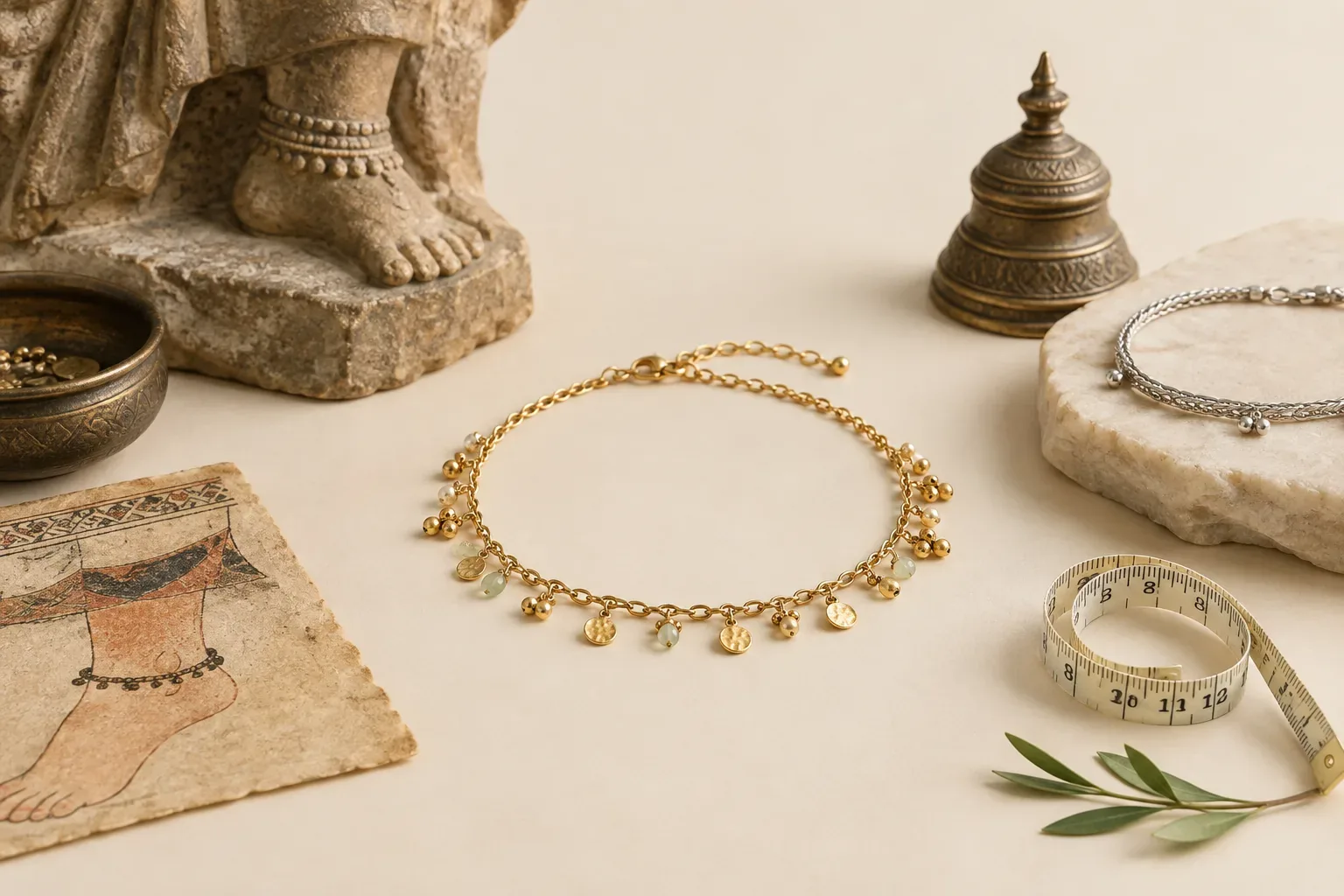
Motifs in anklets can be as simple as a plain chain or as elaborate as repeated charms, bells, filigree panels or engraved plates. Traditional motifs from particular regions—such as florals, geometric patterns or miniature coin discs—are commonly adapted into anklet design as repeating elements or focal pendants. These design choices communicate style and sometimes regional influence without carrying a single fixed meaning.
Gemstones appear in anklets as single set stones, beaded strings, or small inlaid cabochons. The Victoria and Albert Museum’s A–Z of Gemstones explains historical uses and the visual and technical reasons for choosing particular gems. When gemstones are included in anklets, makers balance size, hardness and setting technique so the stones withstand the movement and occasional knocks an anklet experiences.
Materials, treatments and authenticity
Metals commonly used for anklets include gold, silver and base-metal alloys plated with precious metals. Thicker chains and closed-link constructions resist snagging better than very fine open links. Where gemstones are present, the Victoria and Albert Museum provides context on historical gem use and qualities to expect in authentic stones.
Contemporary buying guidance from the U.S. Federal Trade Commission stresses the importance of disclosure for treated, synthetic and imitated gemstones. If gemstone authenticity, treatments or plating are important to you or the recipient, ask the seller for clear information and, for higher-value pieces, independent certification or a written disclosure consistent with consumer-protection guidance.
How to measure your ankle for the right anklet fit
Use a flexible measuring tape to measure at the narrowest part above your ankle bone while standing and with your weight evenly on both feet. If you do not have a tape, wrap a strip of paper or string snugly around that point, mark where it meets, then measure the length of the paper or string with a ruler. Record the measured circumference in centimeters or inches.
Decide how you want the anklet to sit. For a fitted, understated look that stays close to the ankle, add 1.5–3.0 cm (0.5–1.25 in) to the measured circumference. For a comfortable, slightly draped look that swings with movement, add 3.0–5.0 cm (1.25–2.0 in). For a clearly loose or layered look with room for additional charms, add 5.0–8.0 cm (2.0–3.25 in). These ranges are practical starting points; individual preference and design will influence the final choice.
Common anklet length ranges and fit examples
Because ankles vary, many makers list anklet lengths rather than sizes. Typical adult anklet lengths range roughly from 20 cm (8 in) to 30 cm (12 in) depending on style and fit. For example, if your ankle measurement is 22 cm (8.5 in), a 24 cm (9.5 in) anklet will sit fairly snugly, a 26 cm (10 in) anklet will drape lightly, and a 28–30 cm (11–12 in) anklet will hang more noticeably and allow for charms.
Children’s anklets and petite adult styles should be measured separately and account for growth or seasonal swelling. Adjustable chains with extension links are especially useful for younger wearers or for pieces intended to be layered with other ankle jewellery.
Clasp types, adjustments and safety considerations
Clasp choices affect usability and security. Lobster clasps and spring rings are common secure options; hook clasps and S‑hooks are easier to fasten but may open under tension. Extension chains provide 2–6 cm of length variation and make sizing more forgiving. For layered sets, consider uniform clasp positions so layers sit predictably.
Safety considerations matter. Avoid anklets that are too tight; restricted circulation and skin irritation can occur. Remove anklets during swimming in chlorinated pools or sea water if combined metals or plated finishes are a concern. For active or occupational contexts where an anklet could snag or pose a hazard, choose low-profile designs or remove the piece during the activity.
Selecting and gifting anklets respectfully
When selecting or gifting an anklet, consider the recipient’s daily activities, metal sensitivities and personal style. If the piece contains cultural motifs or religious symbols, educate yourself about their meaning before presenting the item. Museum resources show that motifs have specific historical contexts; if you are unsure, choose neutral decorative designs or ask the recipient whether they would welcome a culturally specific motif.
If the anklet includes gemstones or claims of authenticity, request written information about treatments, synthetics or plating from the seller. The FTC recommends transparency about gemstone treatments and imitations, and having clear information helps the recipient make informed care and wearing choices. For gifts, consider an adjustable length or an extension chain to provide flexibility in fit.
Care, maintenance and local repair
Care for anklets according to their materials: silver benefits from gentle polishing; gold requires less frequent attention but still needs occasional cleaning; plated pieces will show wear over time and may require re‑plating. For gemstone-set anklets, inspect settings periodically to ensure stones are secure; the movement that characterizes ankle jewellery can loosen small settings.
For repair, seek a jeweller experienced with small chains and delicate links. Museums and conservation literature emphasize that specialist repair preserves both physical integrity and design intent; for precious or sentimental pieces, professional repair is preferable to DIY fixes that may further stress the metal or stones.
Final thoughts
Choosing the right anklet fit combines precise measurement and an understanding of how the piece will be worn. Use the measuring steps and length additions here as a practical guide, prefer adjustable options if you are unsure, and respect the documented historical and cultural contexts behind motifs when those elements are present.
Museums such as the Victoria and Albert Museum document that jewellery meanings change across time and place, which means that a historically informed choice is not the same as a single prescriptive rule. Be transparent about materials and treatments, follow consumer guidance where authenticity matters, and select a design that suits the wearer’s lifestyle and values.
Frequently asked questions
How exactly do I measure my ankle for an anklet?
Use a flexible tape measure at the narrowest part above your ankle bone while standing. If you do not have a tape, wrap a piece of string or paper around that point, mark where it overlaps, then measure the length of the string or paper with a ruler.
What length anklet should I choose for a snug fit?
For a snug fit add about 1.5–3.0 cm (0.5–1.25 in) to your ankle measurement. This keeps the anklet close without constricting movement.
How much extra length gives a draped, swinging look?
Add approximately 3.0–5.0 cm (1.25–2.0 in) for a light drape and 5.0–8.0 cm (2.0–3.25 in) for a noticeably loose or layered appearance, depending on personal preference and the anklet’s design.
Are extension chains a good idea?
Yes. Extension chains (typically 2–6 cm) make fit more flexible and are helpful if you are unsure of the exact size or if you plan to gift the anklet.
What clasp types are best for anklets?
Lobster clasps and spring-ring clasps are secure for everyday wear. Hook or S‑hooks are easier to fasten but may be less secure under stress. Choose the clasp that balances security and ease for the wearer.
How do I know if the gemstones in an anklet are real or treated?
Ask the seller for written information about treatments, synthetic origins or imitations. The U.S. Federal Trade Commission recommends transparency and disclosure for gemstone treatments and imitations; for higher-value pieces, request certification or evaluation from a qualified lab.
Are there cultural etiquette considerations when gifting an anklet?
Yes. Some motifs or symbols have specific cultural or religious significance. Before gifting a piece that uses identifiable cultural symbols, learn about their meaning or ask the recipient. If in doubt, choose a neutral decorative design or discuss preferences beforehand.
Can anklets cause skin problems?
They can if they are too tight or if the wearer has metal allergies. Leave room for normal swelling, remove anklets during vigorous activity or prolonged immersion in water if metals are mixed, and choose hypoallergenic metals like solid gold or surgical-grade stainless steel for sensitive skin.
Sources and further reading
- Bedazzled: A History of Jewellery — Victoria and Albert Museum
- An A-Z of Gemstones — Victoria and Albert Museum
- Buying Gemstones, Diamonds, and Pearls — Federal Trade Commission