Meaning at a glance
This anklet buying guide explains documented historical contexts, distinguishes them from modern personal meanings, describes common motifs and gemstone uses in anklets, and gives practical advice on quality, materials, price factors, and respectful gifting.
What the historical evidence shows (and which cultures are documented)
Museum collections and scholarship cited by the Victoria and Albert Museum record anklets across several regions and periods rather than a single origin. The V&A traces ankle ornaments in contexts including ancient societies, South Asian dress traditions, and later European fashions, and it frames these objects as part of shifting social and aesthetic practices rather than fixed universal meanings.
Because museum interpretation focuses on objects, the V&A emphasizes material, workmanship, and context—how an anklet was made, where it was found or worn, and how it appeared in dress—rather than simple, monolithic meanings. Use those object-based records to understand that anklets’ significance varies by time and place: the same form can mark status in one context, bridal dress in another, or simply personal ornamentation in a third.
Documented historical meanings versus modern personal interpretations
Documented historical meanings come from how objects appear in archaeological, museum, and dress-history records. The V&A’s approach shows that curators and historians infer social uses—such as status display, ceremonial dress, or regional costume—based on where and how anklets are found and recorded. These documented uses are evidence-based descriptions tied to particular cultures and periods.
Modern personal interpretations are different: contemporary wearers commonly assign private meanings—romance, freedom, fashion identity, or homage to a cultural style—that are not the same as historical, community-specific uses. While modern meanings can be meaningful to the wearer, they should not be presented as historically universal. When you encounter claims that a particular anklet motif always signifies a single idea, treat that as personal or popular interpretation unless supported by museum or scholarly evidence such as that published by the V&A.
How motifs, gemstones, and traditions appear in anklet design
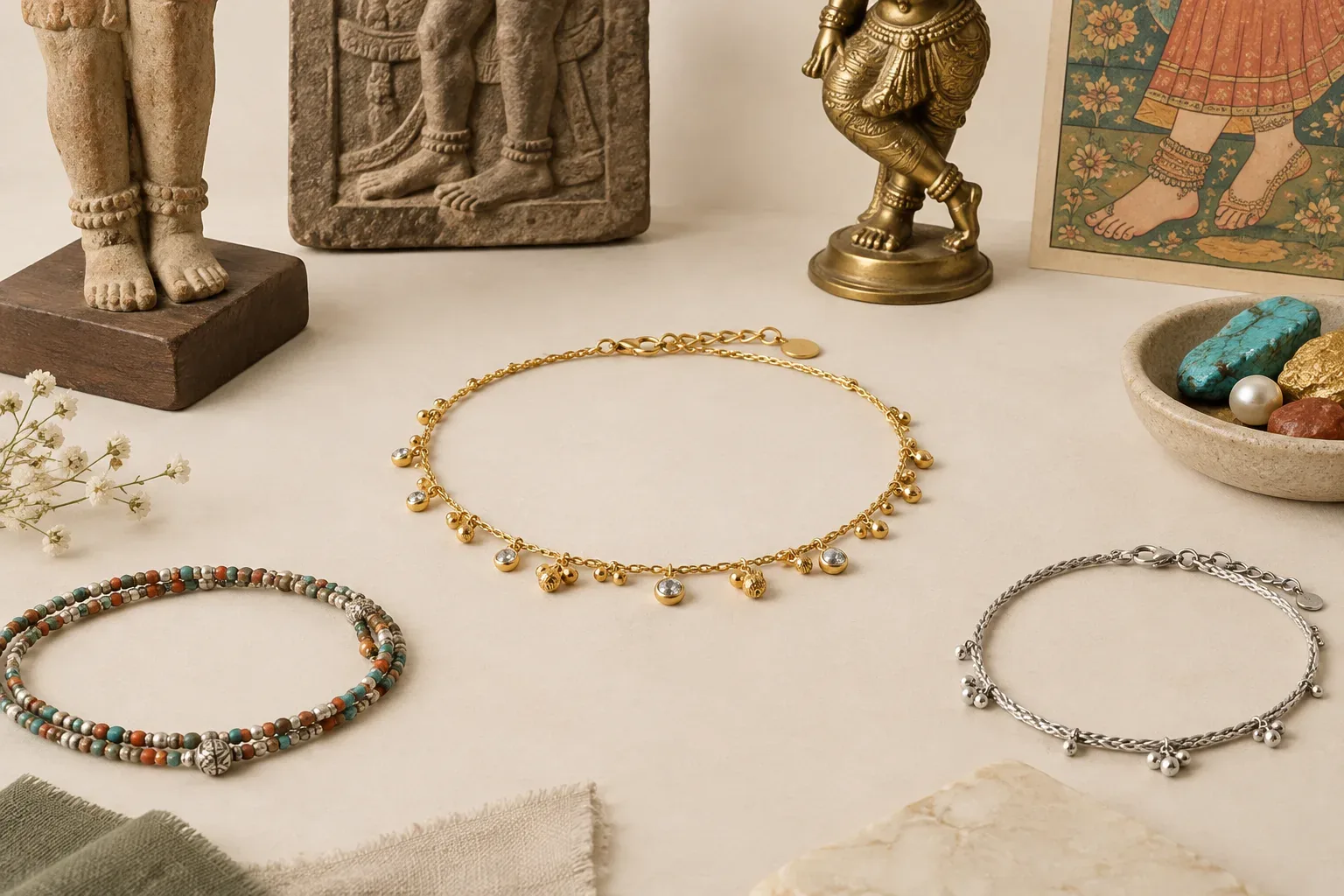
Anklets appear in many forms: simple flat chains, wirework, beads strung on thread, coin or charm chains, small bells (a motif associated with sound in several regional styles), and inset gemstones. Museum descriptions, including the V&A’s A–Z of Gemstones, show that choice of motif and stone is both aesthetic and technical—certain gemstones were historically chosen for color and durability, and some motifs recur in regional jewellery-making traditions.
Gemstones in anklets are usually small cabochons or pavé settings because the scale is reduced compared with rings or necklaces. The V&A’s gemstone material guidance explains that different stones have different hardness and wear characteristics, which influence where they are used on jewelry and how they are set. Bells, filigree, and coin charms reflect local metalworking skills and cultural dress codes recorded in museum collections; they can also alter the way an anklet is worn or perceived in social settings.
Quality, materials, and price: what to ask and what matters
Metal: Solid gold and sterling silver will cost more but last longer than plated or filled metals. Look for hallmarks or assay marks on precious metals as evidence of purity. Ask the seller for metal content information and, if possible, a hallmark certificate or assay report; museum records spotlight craftsmanship and material as central to historical value, and the same care in assessing materials serves modern buyers.
Construction and workmanship: A heavier chain or thicker wire and solid soldered links resist stretching and breakage. Check closures and soldered joints for neat, secure work. The way an anklet is made—hand‑forged links, machine-formed chain, or beaded construction—affects durability and price.
Gemstones: Size, type, cut, and treatment affect cost. Consult the Victoria and Albert Museum’s guidance on gemstones for how different materials behave and are historically used in jewelry. The FTC requires sellers to disclose any treatments, synthetics, or imitations. Ask explicitly whether gems are natural, lab-grown, heat-treated, dyed, or assembled, because treatment status materially changes both appearance and price.
Plating and coatings: Gold- or rhodium-plated jewelry can look like solid metal at first but will wear. Enquire about plating thickness and base metal, particularly if you expect daily wear near water or skin.
Fit and comfort: Anklets see friction and movement. A comfortable anklet allows toe and heel movement without binding and should account for ankle swelling with activity. Adjustable lengths, extender chains, or multiple closure loops help achieve an appropriate fit.
Price drivers: Metal purity, gemstone type and size, workmanship, brand reputation, and disclosure of treatments all influence price. Because treatment and imitation affect value, the FTC’s buying guidance is relevant to price questions: full disclosure protects you from overpaying for treated or imitation gems marketed like natural stones.
Practical selection and respectful gifting guidance
Be culturally informed and respectful. Use museum sources such as the V&A to learn whether a particular motif, technique, or form appears as part of a living cultural dress tradition or a historical context. If a design has religious or community-specific meaning, favour a modest, informed approach: ask the recipient, choose a neutral design, or include a note acknowledging the piece’s origins and your intention.
When gifting, consider lifestyle and durability. Ask about the recipient’s daily activities and whether they will expose the anklet to water, heavy wear, or occupations that could snag chains. Choose simpler, sturdier constructions for everyday wear and more delicate pieces for occasional or ceremonial use.
Request written disclosures and receipts. For gemstones and precious metals, get a written statement about metal content and gemstone treatments; this protects both buyer and recipient and follows the consumer-protection emphasis in FTC guidance.
If you want a piece that references a cultural style without misusing sacred symbols, select motifs that are decorative rather than explicitly religious, and credit the source when you give the gift. When in doubt, a conversation with the recipient or a knowledgeable jeweller or curator will reduce the risk of unintentional disrespect.
Final practical tips
Try anklets on with the shoes and clothing the wearer will typically use to be sure of length and look. Inspect clasps and links closely and, for gemstones, ask for treatment disclosures. Keep documentation for future care, resale, or reassessment of value.
If you want to learn more about historical context and gemstones, start with museum resources such as the Victoria and Albert Museum’s materials on jewellery history and gemstones and refer to consumer-protection guidance from the FTC when evaluating gemstone claims and price justifications.
Frequently asked questions
How do I size an anklet correctly?
Measure the ankle while standing and add space for movement—typically an extra 1 to 2 centimetres depending on desired fit and activity. Try the anklet on with the shoes or clothing the wearer will normally use. When in doubt, choose an adjustable chain or a design with multiple closure loops.
What metals are best for anklets?
Solid precious metals such as 14K–18K gold and sterling silver are durable choices for frequent wear; plated items cost less but will wear over time. Look for hallmarks or written metal-content disclosure and ask about base metals under any plating.
How do gemstone treatments affect value?
Treatments such as heating, dyeing, fracture-filling, or the use of synthetics materially affect a stone’s appearance and market value. The U.S. Federal Trade Commission advises that sellers disclose such treatments, so ask for written disclosure before purchase.
Can I wear an anklet while swimming?
It depends on materials: solid gold and sterling silver resist corrosion but can be affected by chlorine and salt over time; plated items will lose finish more quickly. Consider removing delicate or plated anklets before swimming to extend their lifespan.
How much should I expect to pay for an anklet?
Price varies widely depending on metal purity, gemstone type and treatment, craftsmanship, and brand. Rather than a single price point, compare pieces by material content, documented gemstone disclosures, and construction quality; documented disclosures (for example, per FTC guidance) help ensure you are paying for what you are told you are buying.
Are there cultural taboos about giving anklets as gifts?
Some motifs or styles have cultural or religious significance. Museum sources such as the Victoria and Albert Museum recommend researching specific forms before using them in a cultural or ceremonial way. If you are unsure, select a neutral decorative design or consult the recipient.
How should I care for an anklet?
Store anklets flat or hanging to prevent tangles. Clean according to metal and gemstone type—gentle soap and water for many pieces, and specialist care for porouser stones. Remove anklets before heavy activity to reduce stress on links and settings.
Can anklets be resized or repaired?
Many anklets can be adjusted by adding or removing links or by attaching an extender; repairs to broken chains and clasp replacement are common. For intricate historic or high-value pieces, seek a jeweller experienced with fine or antique jewellery.
Sources and further reading
- Bedazzled: A History of Jewellery — Victoria and Albert Museum
- An A-Z of Gemstones — Victoria and Albert Museum
- Buying Gemstones, Diamonds, and Pearls — Federal Trade Commission