Meaning at a glance
Use a focused checklist that inspects metal and join quality, clasp and fastener strength, finish and edge treatment, weight and balance for comfort, gemstone setting security, and appropriate documentation about materials and treatments; situate those choices alongside documented historical uses of anklets and respectful cultural considerations.
Direct answer — the checklist in one line
A reliable anklet should be securely joined (solid links or high-quality solder), use an appropriate clasp or fastener rated for ankle wear, have smooth edges and a comfortable weight distribution, present secure settings for any stones or charms, and come with transparent information about metal content and gemstone treatment; verify these points in person and ask for written disclosure when needed.
What the historical record shows (and how I’m citing it)
Historical evidence for anklets and related ankle ornaments appears in multiple regions and periods and is best read through museum documentation and object-based studies. The Victoria and Albert Museum describes the broad social history of jewellery—how personal ornaments change function, form, and meaning across time and place—so their work is the basis for the general statements below about when and where anklets were used.
The V&A’s research and collections show that ankle ornaments appear in ancient and pre-modern societies in South Asia, the Middle East, and parts of Africa and Europe, where they could be decorative, musical (small bells or chaînette attachments), or status-related depending on context. The museum’s historical overview emphasizes changing social contexts rather than a single, static meaning for anklets across cultures.
Separating documented historical meanings from modern interpretations
Documented historical meanings come from the study of objects and records. For example, the V&A’s materials indicate that anklets in South Asia have long been part of regional dress traditions and can be associated with social customs; the objects themselves, their materials, and recorded contexts give evidence for those uses. These are the kinds of claims supported by museum collections and scholarship.
Modern personal interpretations—such as seeing an anklet as a symbol of a particular personality trait, romantic availability, or a generalized spiritual meaning—are frequently individual or informed by recent popular culture rather than by direct historical evidence. Where contemporary wearers assign new symbolic value, that is a valid personal meaning but it should not be presented as a documented historical fact unless there is clear provenance or scholarly citation to support it.
How motifs, gemstones, and traditions show up in anklet design
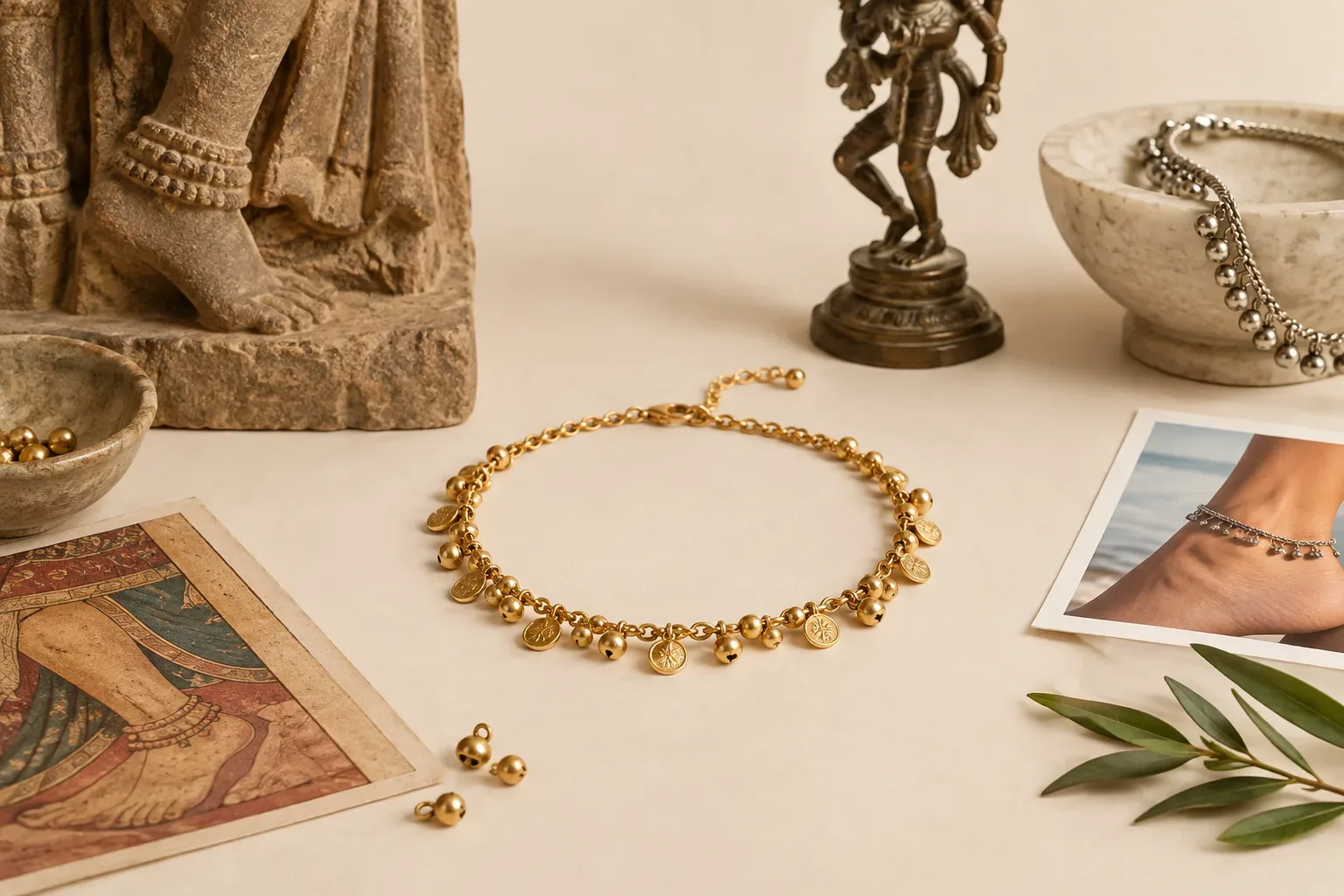
Motifs appear as small charms, engraved plates, pierced links, or cast pendants attached to anklet chains. Traditional motifs—floral patterns, geometric medallions, tiny bells—can be integrated as fixed elements or as dangling parts that add motion and sound. Museum descriptions at the Victoria and Albert Museum illustrate how motifs were adapted to local tastes and technical capabilities in different regions.
Gemstones may be set into anklet components as single accent stones, cabochons in bezels, or as small pavé elements. The V&A’s guide to gemstones explains the variety of gem materials historically used in jewelry and offers a framework for identifying stones by cut, setting, and surface appearance. For contemporary buyers, the Federal Trade Commission advises asking sellers about treatments, synthetic alternatives, and imitation stones because appearance alone does not reveal whether a gem is natural, treated, or lab-grown.
Construction checklist: what to inspect and why
Start with metal and link construction. For ankles the stress from movement and occasional catches is higher than for a wrist. Prefer solid links, fully soldered jump rings, or welded chain links rather than thin, twisted or open rings. A well-soldered or welded join is less likely to separate at stress points.
Examine the clasp and fastener. A robust lobster clasp, box clasp with safety catch, or a screw link designed for ankle wear is preferable. Small spring-ring clasps that are marginal for wristwear often fail more quickly when exposed to ankle movement and moisture.
Check end connections and jump rings. End links and any attachments should be proportionate to the chain gauge; thin jump rings attached to large charms create single-point stress that can open. Ensure that attachment rings are closed and, when appropriate, soldered.
Assess plating and metal composition. Solid precious metals (sterling silver, 9–18k gold) are more durable under repeated abrasion than thin plating on base metals. If plating is present, examine the thickness visually and by asking the seller; expect plating to wear faster in areas of friction.
Comfort checklist: what affects wearability
Consider weight and balance. An anklet should not pull the ankle downward; heavy pendants or too many charms can create pressure and rubbing. Try the piece with the shoes or clothing you plan to wear to spot rows of rubbing or snagging.
Look at edge finishing and surface quality. Smooth, rounded edges on links, clasps, and charms reduce chafing. Any internal edges of hollow elements or screw fittings should be filed and finished so they do not abrade skin or clothing.
Assess noise and mobility. If an anklet has bells or many dangling elements, test whether the sound level suits your needs. For daily wear, consider fewer or fixed motifs; for occasional or ceremonial wear, a more decorative, sonorous anklet may be acceptable.
Check for allergenic materials. If you have sensitive skin, request details about nickel content or base metals under plating. The FTC recommends asking sellers for material disclosures, and if you are uncertain, choose verified nickel-free or hypoallergenic metals.
Durability checklist: settings, treatments, and maintenance
Inspect gemstone settings. Secure settings for ankle use are typically bezels, channel settings, or well-anchored prongs with secondary security. Small stones set into thin mounts are prone to loss if the mount is fragile or the prongs are exposed to catching.
Confirm whether gems are treated or imitation. The Federal Trade Commission advises buyers to ask whether gemstones have been heat-treated, dyed, filled, lab-grown, or simulated. Sellers must disclose certain treatments or imitations; request written confirmation if a stone’s origin or treatment matters to you.
Assess hollow versus solid components. Hollow chains or beads are lighter but dent and crack more easily. Solid construction will resist repeated knocks from footwear and the incidental impacts ankles receive.
Consider finish longevity. High-polish surfaces show wear and scratches sooner than satin or brushed finishes, while rhodium plating on white gold may require periodic re-plating. Ask about expected maintenance cycles and any warranties available.
Testing and documentation to request before purchase
Physically test the anklet by moving, bending, and fastening it several times. Look for early signs of stress at the clasp, end links, or jump rings. If possible, wear it for a short period under similar conditions to those you expect in regular use.
Request written details on metal content and gemstone treatments. Ask for hallmarking or assay marks for precious metals, and for any lab reports or treatment disclosures for gemstones. The FTC guidance is a good standard: sellers should be able to tell you if a gem is natural, treated, lab-grown, or a simulant.
Ask about repairability and service. Learn whether the jeweler will repair damaged links, replace clasps, or re-set lost stones and what costs or guarantees apply. Durable anklets are ones you can have serviced without replacing the entire piece.
Respectful selection and gifting guidance
When selecting or gifting an anklet that draws on a specific cultural design or motif, learn its origins. The Victoria and Albert Museum’s historical material shows how the same form can carry different meanings in different societies; if a motif is traditionally associated with a community or ritual, treat it with care and, when appropriate, consult someone from that community.
Consider occasion, fit, and practicality. If the anklet might be worn daily, choose robust construction, comfortable weight, and hypoallergenic materials. For ceremonial gifts, you can choose more decorative or traditional styles, but still prioritize secure settings and a good fit.
Size thoughtfully and provide adjustability. Ankles vary more than wrists; a small range of adjustable links, an extender, or a clasp that allows fine adjustment makes the gift more wearable. Include a thoughtful note about cleaning and care to help the recipient maintain the piece.
Avoid presumptions about symbolism. If you are unsure whether a symbol is sacred or sensitive, ask or choose a neutral decorative motif. Personal meanings you attach as a giver are valuable, but do not assert a historical or religious meaning unless it is documented and you can cite that source.
Care, repair, and long-term considerations
Routine checks will extend an anklet’s life: inspect clasps and links every few months, clean according to metal and gemstone care recommendations, and remove the anklet for activities likely to snag or expose it to harsh chemicals.
For plated items expect periodic replating; for precious solid metals, basic polishing and the occasional professional tightening of settings keeps the piece wearable. If you plan a long-term heirloom, prioritize solid metals and secure settings at purchase.
Frequently asked questions
How should an anklet fit?
An anklet should fit comfortably without pulling or sliding far down the foot; allow a small amount of movement so it does not constrict when you sit or walk, and prefer adjustable links or extenders to accommodate different shoes and activities.
Are certain metals better for anklets?
Solid precious metals like sterling silver or appropriate gold alloys resist wear better than thinly plated base metals; if you are sensitive to nickel, request nickel-free or hypoallergenic materials and ask for hallmark or alloy information.
How can I tell if a gemstone is treated or imitation?
Ask the seller for written disclosure about treatments and origin; the Federal Trade Commission advises that sellers should state if a gem has been heat-treated, dyed, filled, lab-grown, or is a simulant, and reputable sellers can provide lab reports for notable stones.
Is it disrespectful to wear anklet motifs from another culture?
It depends on the motif and context; museum research shows anklets have culturally specific meanings in some traditions. If a motif is linked to sacred practice or community identity, consult reliable sources or people from that culture and consider choosing a neutral design if you are unsure.
How do I maintain an anklet?
Inspect clasps and links regularly, clean according to the metal and any gemstones (avoid harsh chemicals for softer stones), remove anklets for sports or heavy work, and have a jeweler tighten settings or replate finishes as needed.
Sources and further reading
- Bedazzled: A History of Jewellery — Victoria and Albert Museum
- An A-Z of Gemstones — Victoria and Albert Museum
- Buying Gemstones, Diamonds, and Pearls — Federal Trade Commission