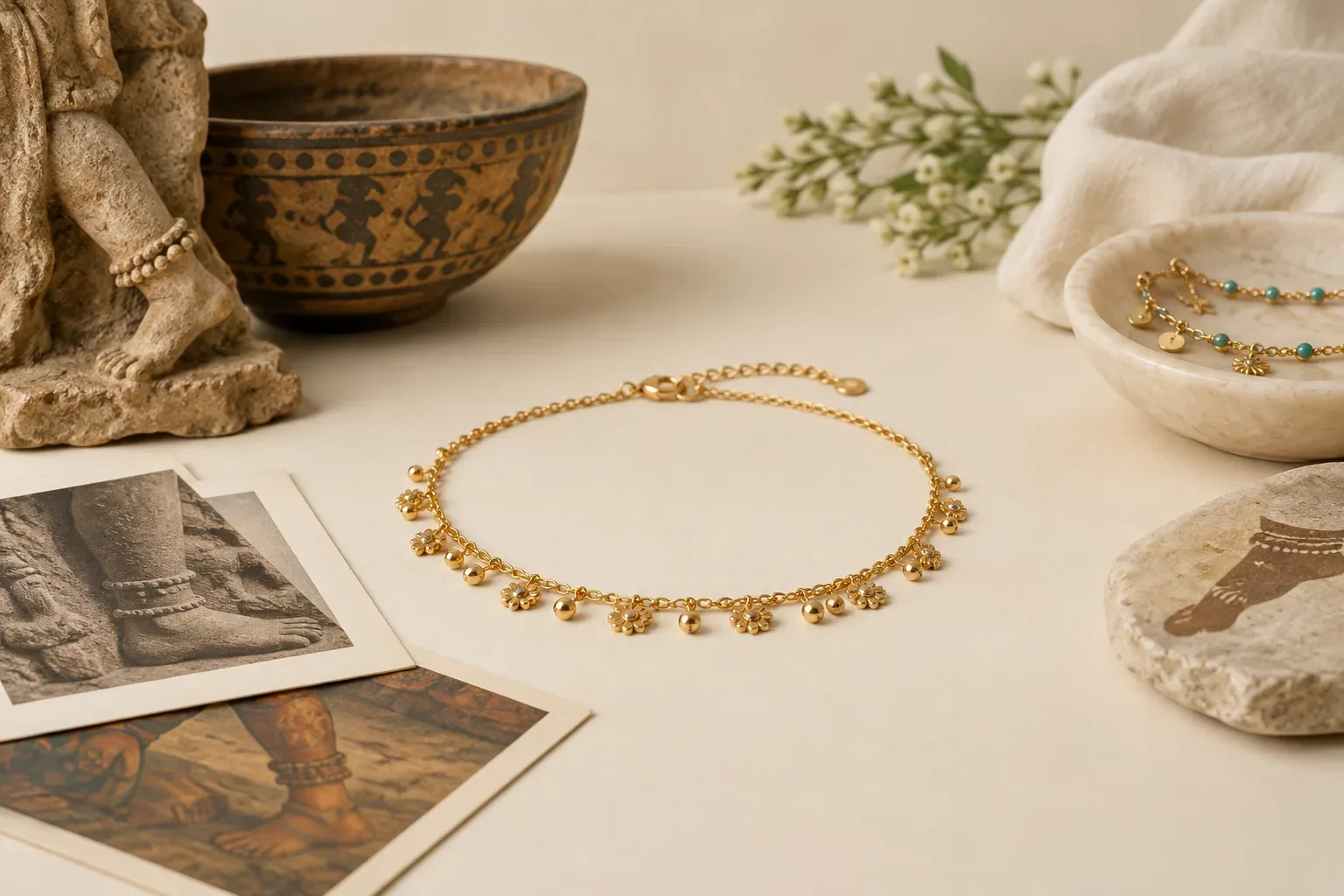
Meaning at a glance
Explain the documented history and changing contexts of ankle ornaments; separate museum-documented cultural practices from modern personal interpretations; describe how motifs and gemstones appear in anklet designs; and give practical guidance for selecting, buying, and gifting anklets online, including photo and policy checks and red flags.
Quick answer
An anklet online shopping guide should combine documented history and cultural sensitivity with practical buying checks: learn where and how ankle ornaments appear in museum and collection records, treat historical meanings as context rather than universal claims, evaluate product photos for scale and construction, insist on clear metal and gemstone disclosure, and avoid sellers who hide treatment, sizing, or return policies.
What the historical record actually shows
Museum collections and historical surveys collected and interpreted by institutions such as the Victoria and Albert Museum document ankle ornaments across several cultures and periods rather than presenting a single global meaning. Examples preserved in museum holdings and discussed in museum catalogues show ankle bracelets, chains and related ankle ornaments in ancient Egyptian contexts, in the Indian subcontinent, and in various European decorative traditions; these objects appear in archaeological finds, dress collections, and decorative arts exhibitions that trace jewellery’s changing social roles over time (Victoria and Albert Museum).
Those sources emphasize that ankle ornaments have shifted function and symbolism over centuries. In some periods they were primarily decorative items made from precious metals and gemstones; in others they are part of regional dress ensembles recorded by ethnographers and collectors. The V&A’s broader work on jewellery history underlines that jewellery meanings are contextual and change with fashion, status systems, religious practice, or economic conditions rather than carrying one stable meaning across all cultures (Victoria and Albert Museum).
Documented cultural or religious uses versus modern interpretations
When deciding what an anklet ‘means’, distinguish documented, context-specific uses recorded by museums and collectors from later or popular interpretations. Ethnographic records and museum collections can document, for example, that an ankle ornament was part of a woman’s marriage ensemble in a specific region or that ankle jewellery appeared in burial assemblages in a particular archaeological culture; these are claims about particular times and places, not universal rules. The V&A and similar institutions focus on these contextual, documented meanings rather than asserting a single symbolic definition (Victoria and Albert Museum).
Modern personal or fashion meanings—such as an anklet signalling a bohemian style, a beach aesthetic, or contemporary romantic connotations—are social interpretations that arise in recent decades and vary by community. Those contemporary meanings are valid in their social contexts but should not be conflated with the historically documented functions recorded in museum catalogues. Treat historical evidence as context and modern meanings as living social practice with variation and change.
How motifs, gemstones, and traditions appear in anklet designs
Anklets use the same formal vocabulary as other types of jewellery: chains, beads, charms, repoussé elements, and settings for stones. Motifs such as bells, tiny coins, floral or geometric charms, and link patterns are common because they move and catch the eye at the ankle; museums show such decorative choices across regions and periods as part of broader decorative traditions (Victoria and Albert Museum).
Gemstones may appear set as single stones, as strings of beads, or as small accents in clasp or charm settings. For guidance on identification and the historical use of particular gemstones in jewellery, consult comprehensive resources like the Victoria and Albert Museum’s catalogue of gemstones, which explains traditional gemstone use and helps distinguish commonly used materials from imitations or treated stones (Victoria and Albert Museum).
Materials for anklets range from plain metal chains and glass or seed beads to gold, silver, pearls, and faceted gemstones. Some anklets are intentionally simple and lightweight for daily wear, while others are crafted from heavier, decorated components for ceremonial use. The construction details—how a stone is set, whether a chain is soldered or simply clasped, and whether components are joined by jump rings or solid links—affect durability and appearance and should be visible in product photos.
Photos and product information: what to expect and what to demand
High-quality listings show multiple clear photographs: close-ups of the clasp and joinery, a clear view of any hallmark or metal stamp, a full-length image of the anklet on a model or a ring of known diameter to show scale, and a macro shot of any gemstones or beadwork. Photos should be sharp enough that you can see solder joints, clasps, and any wear or finishing details.
Product descriptions should state metal type and purity or plating thickness, list gemstone types and whether stones are natural, synthetic, or treated, provide measurements (length, width, weight), and describe the fastening type and adjustability. The U.S. Federal Trade Commission advises that sellers disclose treatments, imitations, and material substitutions for gemstones, diamonds, and pearls; insist on this information when shopping online (Federal Trade Commission).
Policies and red flags
A reliable seller provides a clear return policy, contact information, a stated shipping and customs policy, and documented material disclosures. Red flags include listings that use generic stock images only, omit measurements or metal content, refuse to answer questions about gemstone treatment, or have no returns and no verifiable contact details. Extremely low prices for jewellery advertised as solid precious metal or as high-quality gemstones are another common warning sign.
If a seller claims stones are “natural” or “untreated,” ask for certification or provenance information. If a listing mentions treatments or substitutions only in small print or in a separate FAQ that is hard to find, press for an explicit description in the product page. The FTC guidance on buying gemstones, diamonds, and pearls stresses transparent disclosure as a buyer protection; absence of such disclosure is a material concern (Federal Trade Commission).
Selection and gifting: practical and respectful considerations
Sizing is crucial. Anklet lengths vary by style and ankle circumference. When possible, measure the recipient’s ankle or choose a design with clear size ranges and adjustable links. If you cannot measure, select a model with a generous adjustment range or a return policy that allows resizing or exchange.
Consider metal allergies and lifestyle. Choose hypoallergenic metals like solid gold or sterling silver for those with sensitivities, and avoid plated or base-metal alloys unless the recipient prefers costume jewellery. Think about how the anklet will be worn: seaside or pool use calls for corrosion-resistant metals and secure clasps; everyday wear benefits from solid links and closed jump rings rather than fragile dangling beads.
Be culturally respectful when buying or gifting anklets that resemble traditional or ceremonial objects. If the item is described as a ritual or caste-specific piece in a given culture, research that context through reliable museum resources or ask an informed seller. When in doubt, ask the recipient whether they would welcome a traditionally styled anklet and choose contemporary reinterpretations if you want the look without potential cultural misapplication. For guidance on researching symbols and traditions used in jewellery, consult related resources on study and respectful interpretation.
Caring for anklets and conserving value
Care instructions should match materials: gold and silver require different polishing approaches than beads or pearls. Sellers should provide care guidance and note water and chemical sensitivities. For gemstone-set anklets, ask how stones are secured and whether settings are soldered or simply pegged in place.
For any purchase intended as a collectible or heirloom, keep receipts, certification, and photographs in a safe place, and ask about insurance or appraisal options. Documentation is also useful if you later decide to resell or authenticate the piece.
Final checklist
Before you buy, confirm the following on the listing or with the seller: clear photos showing scale and construction, explicit metal and gemstone disclosures, a stated return policy, and verifiable contact information. If any of these elements is missing or if the seller declines to answer basic questions, consider it a red flag and look elsewhere.
Shopping for anklets online can connect you to a wide range of historical styles and modern designs. Use museum resources to understand documented historical contexts, insist on clear buying disclosures in line with consumer-protection guidance, and choose with both practical needs and cultural respect in mind.
Frequently asked questions
How should I measure for an anklet online?
Measure the ankle at the point where the anklet will sit, using a soft tape measure or a strip of paper and a ruler, then add the desired allowance for a loose or fitted look. If you cannot measure the person, choose an adjustable design with a clear size range and a return policy that covers exchanges.
What questions should I ask a seller about gemstones?
Ask whether stones are natural, synthetic, or treated; request information on any known treatments or enhancements; ask for certification if the seller claims high-value gemstones; and ask for close-up photographs showing the setting. The Federal Trade Commission recommends transparent disclosure of treatments and imitations.
How can I tell if an anklet is solid precious metal or plated?
Look for explicit metal content listed in the product description, hallmarks or stamps in close-up photos, and a statement about whether the piece is solid, vermeil, or plated. If a listing lacks these details, ask the seller directly and treat ambiguous claims with caution.
Are there cultural sensitivities I should consider before gifting an anklet?
Yes. Some anklets may resemble pieces with ceremonial, religious, or regional significance. Research the specific form and ask whether the recipient would appreciate a traditionally styled piece. Use museum resources to understand documented contexts and avoid gifting items that replicate clearly ceremonial or culturally restricted objects without the recipient’s consent.
What are common red flags in anklet listings?
Common red flags include only stock photos with no close-ups, missing measurements or metal information, no return policy or contact details, refusal to disclose gemstone treatments, and prices that seem implausibly low for the described materials.
Sources and further reading
- Bedazzled: A History of Jewellery — Victoria and Albert Museum
- An A-Z of Gemstones — Victoria and Albert Museum
- Buying Gemstones, Diamonds, and Pearls — Federal Trade Commission