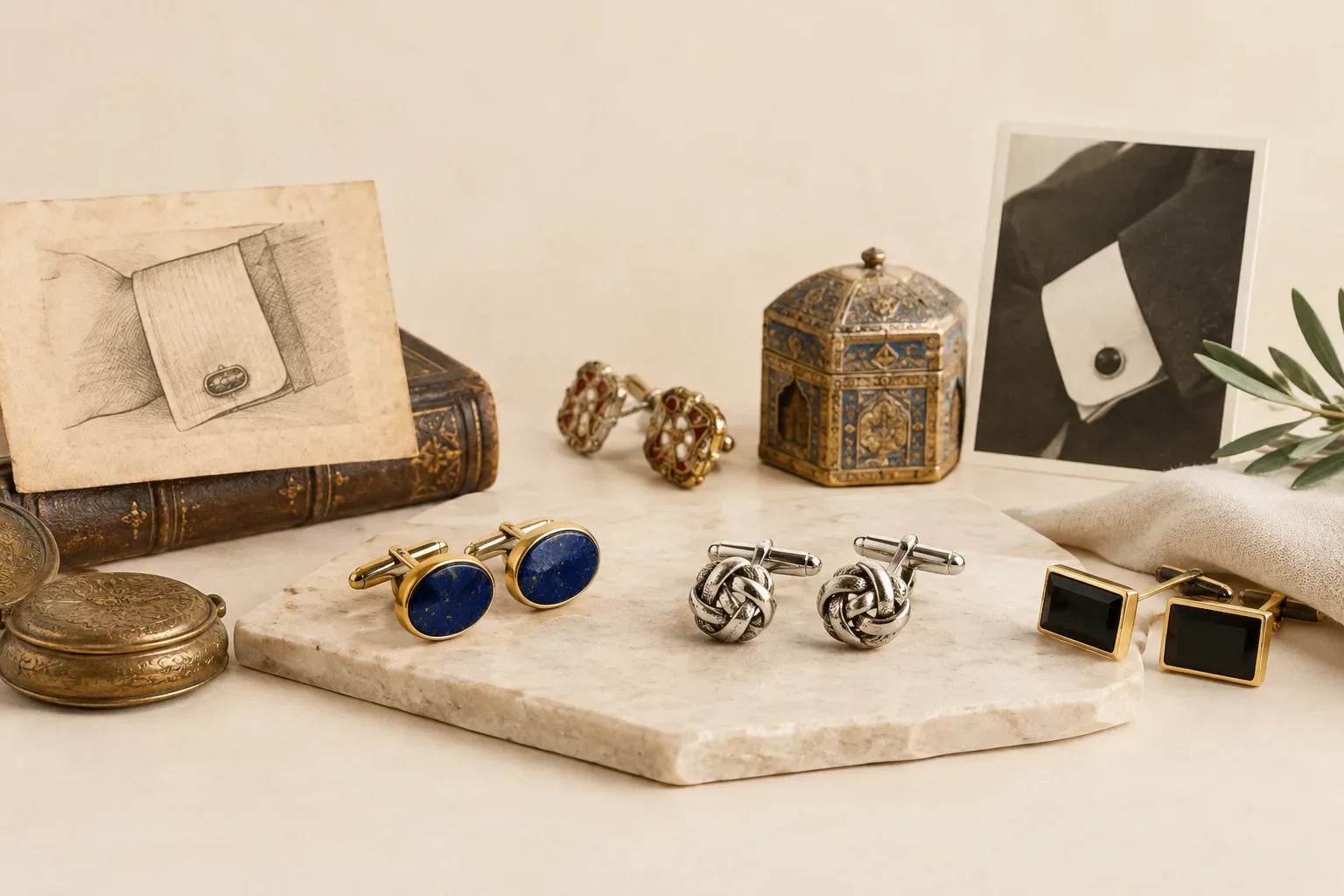
Meaning at a glance
This cufflinks online shopping guide explains the documented history and changing contexts of cufflinks as recorded by museum scholarship, distinguishes historical meanings from contemporary personal interpretations, describes how motifs and gemstones appear on cufflinks, and gives practical advice for assessing photos, checking seller policies, and spotting red flags when buying or gifting cufflinks online.
What the historical evidence actually says
When you research cufflinks through museum collections and catalogues, the available evidence treats them as part of the broader history of jewelry and dress rather than as a single universal symbol. The Victoria and Albert Museum describes how jewellery—and by extension small dress accessories—reflect changing social practices, technologies, and fashions rather than one fixed meaning. Use museum documentation to understand how cufflinks functioned in particular periods and places as markers of dress, craft, and status rather than as a single cultural message.
That documentation is descriptive: museums catalogue materials, techniques, maker’s marks, and the ways items were used with particular garments. The V&A’s historical overview emphasizes changes in social context and production methods over time; it does not offer a universal symbolic dictionary that applies across cultures. When an item in a collection is labeled as ‘mourning,’ ‘sentimental,’ or ‘status’ jewellery, that label reflects the object’s documented role in a specific setting and time as interpreted by curators and scholars.
Separating documented historical meanings from modern interpretations
Documented historical meanings come from evidence such as contemporary inventories, correspondence, maker’s records, and the object’s context in museum collections. When the Victoria and Albert Museum assigns a function or social reading to a cufflink or accessory, it ties that reading to provenance, costume history, or documented use. For example, a particular pair of cufflinks may be recorded as part of a gentleman’s evening dress and catalogued as a sign of dress practice, not as an eternal symbol.
Modern personal interpretations—what someone today chooses to read into a motif, gemstone, or inscription—are legitimate but separate. A contemporary buyer may value an engraved monogram, a birthstone, or a particular motif for sentimental reasons. Those interpretations are personal choices for wearing and gifting; they are not the same thing as historically documented meanings and should not be presented as universal cultural facts.
How motifs, gemstones, and traditions appear on cufflinks
Design motifs appear on cufflinks in several technical ways: engraving, guilloché and enamel work, setting of faceted or cabochon stones, intaglio or relief carving, and applied metalwork. Museum records emphasize identification of technique and material to place a piece in a historical or manufacturing context; for example, an enamel technique or maker’s mark helps curators date or attribute an object, while gemstones and their settings help identify taste and expense.
Gemstones and materials are discussed in depth in museum resource guides. The Victoria and Albert Museum’s A–Z of Gemstones explains how particular stones have been used, the variety of cuts and settings, and the visual and cultural roles of gems in jewellery. When stones appear on cufflinks today, they range from inexpensive glass imitations and synthetic stones to natural gemstones set in precious metals. Distinguishing natural stones from imitations and identifying treatments requires either clear seller disclosure or professional testing.
Photos: what you should expect and why they matter
High-quality photos are the single most important tool for evaluating cufflinks online. Expect multiple images: a sharp main image, close-ups of the face and any gemstones, a profile shot showing depth and setting, a photo of any maker’s mark or hallmark, and a picture showing scale (for example, near a coin or ruler) so you can judge size.
Lighting should be neutral and reveal true color and surface condition. If gemstones are present, ask for a photo under both natural light and a neutral artificial light so you can see color shifts. For engraved or enameled surfaces, request a close-up that shows wear or repairs. If the seller refuses additional photos or provides only a low-resolution image, treat that as a reason for caution.
Policies to check before you buy
Read the seller’s return policy and authenticity guarantees closely. A reliable seller will state their return window, the condition required for returns, and whether they accept returns on used items. Confirm whether the seller guarantees materials and stone identification and what documentation—such as a lab report or an in-house appraisal—will accompany the cufflinks.
For information about disclosures regarding treatments and imitations, consult regulatory guidance: the U.S. Federal Trade Commission requires clear disclosure of material treatments and of imitations. Sellers should state whether a gemstone is natural, synthetic, treated, or an imitation; if a seller omits these details, ask explicitly. If a seller cites a professional appraisal or gemological report, request a copy before purchase.
Red flags: what should make you pause
Vague or minimal photos, missing maker’s marks or hallmarks in the photos, unusually low prices without explanation, absence of clear material or treatment disclosures, and no or very restrictive return policy are all legitimate red flags. A seller who refuses to answer specific questions about materials, treatment, or condition is another warning sign.
Be cautious with promises that a piece will ‘be worth a lot’ without documentation, and be skeptical of claims that a stone is ‘natural’ or ‘untreated’ unless the seller provides a lab report or a reputable appraisal. Likewise, a listing that omits provenance or condition details for an evidently worn piece should prompt more due diligence.
Practical selection and respectful gifting guidance
When choosing cufflinks as a gift, consider the recipient’s typical dress and lifestyle. Match the scale and material to their wardrobe: subtle metal tones for everyday or office wear, and more ornate or gemstone-set designs for evening or formal dress. Personalization—monograms, initials or a discreet motif—can be meaningful but check the cultural or family context first; what is meaningful to one person may be inappropriate or unintentionally provocative in another context.
Size and mechanism matter for comfort and durability. Ask for measurements of the cufflink face and the length of any post or swivel bar. If the recipient wears traditional or cultural dress, research whether specific symbols or motifs have established meanings in that community; if you are unsure, err on the side of simplicity or consult the recipient directly. When in doubt about gemstone durability or cleaning requirements, choose harder stones and established metal alloys, and include care instructions with the gift.
After purchase: verification and care
Once you receive the cufflinks, compare them carefully to the listing photos and written description. Check for the stated hallmarks, test the fastening mechanism, and inspect gemstones for chips or obvious replacements. If a seller claimed a gemological certificate, confirm that the certificate number or details match the stones in hand. If anything differs substantially from the listing, contact the seller immediately and refer to the stated return policy.
Care instructions depend on metal and stone. For general guidance on gemstone identification and sensitivity, consult museum resources like the V&A’s A–Z of Gemstones to learn about relative hardness and common treatments. For disputes about undisclosed treatments or imitations, regulatory guidance from the Federal Trade Commission outlines the expectation of truthful disclosure by sellers.
Final takeaways
Treat historical documentation and personal symbolism as separate: use museum resources to understand documented context, but accept that present-day wearers will attach their own meanings. Rely on clear, multiple photos, full material and treatment disclosures, solid return and authenticity policies, and obvious hallmarks to feel secure buying cufflinks online. When privacy, cultural sensitivity, or personalization is important, ask questions before purchasing and choose conservative designs if you are unsure.
Frequently asked questions
What photos should a seller provide for cufflinks?
Ask for a main image, close-ups of the face and any gemstones, a profile shot showing depth and setting, a photo of any hallmark or maker’s mark, and a scale photo showing the cufflinks next to a coin or ruler so you can judge size.
How can I verify a gemstone’s authenticity from an online listing?
Ask the seller to disclose whether the stone is natural, synthetic, treated, or an imitation and request any lab report or appraisal cited in the listing; regulatory guidance expects such disclosures, and a reputable seller will provide documentation or allow third-party testing.
Which seller policies are most important when buying cufflinks online?
Check the return window and conditions, guarantees of authenticity or material, disclosure of treatments or imitations, and whether the seller provides documentation such as a gemological report or appraisal.
What are the main red flags that indicate I should not buy?
Minimal or low-resolution photos, missing hallmarks in images, vague material descriptions, no disclosure about gemstone treatments or imitations, unusually low price without explanation, and a seller who refuses specific questions are all reasons to pause.
How should I choose cufflinks as a respectful gift?
Consider the recipient’s typical dress and lifestyle, choose an appropriate scale and metal tone, avoid unfamiliar cultural symbols without research, and when in doubt select a simple, elegant design or ask the recipient about preferences.
Sources and further reading
- Bedazzled: A History of Jewellery — Victoria and Albert Museum
- An A-Z of Gemstones — Victoria and Albert Museum
- Buying Gemstones, Diamonds, and Pearls — Federal Trade Commission