Meaning at a glance
Explain the documented history and changing contexts of the anglo-saxon jewelry techniques motif, separate cultural or religious evidence from later popular interpretations, and give practical guidance for choosing and wearing the motif in modern jewelry.
What the historical evidence shows (which cultures and periods are meant)
When we speak of Anglo-Saxon jewelry techniques we mean objects made in Anglo-Saxon England, the early medieval culture commonly dated by historians to roughly the fifth through the eleventh centuries. The primary evidence for techniques and use comes from archaeological finds—burial assemblages, hoards, and stray finds—and from the technical study of surviving objects. The Victoria and Albert Museum (V&A) outlines how the study of jewellery as an art form and social practice helps historians trace changing contexts and skills over time, showing that these objects were both personal adornment and markers of social position.
Documented techniques and materials
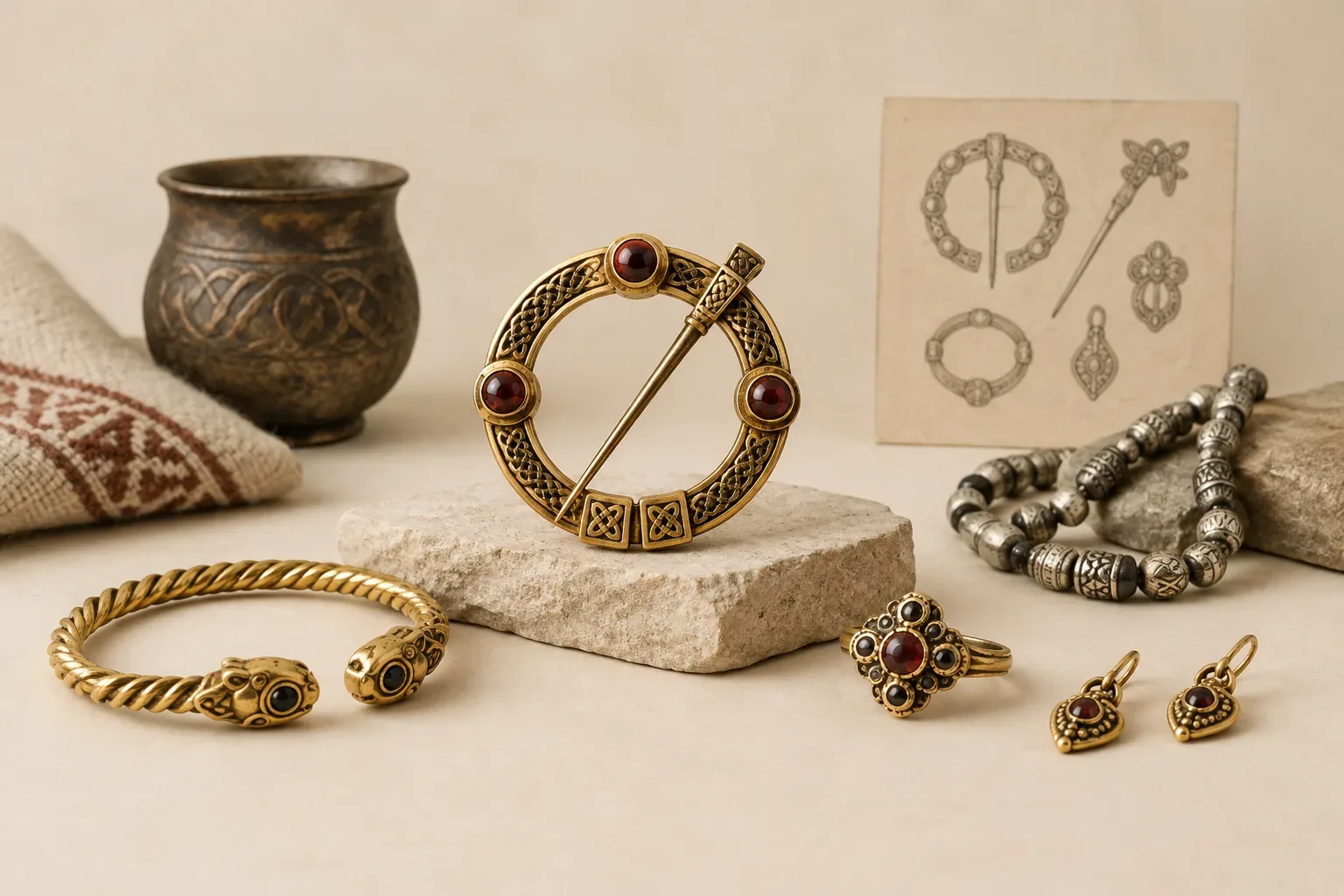
Museum studies identify a set of repeatable metalworking practices in Anglo-Saxon pieces. Cloisonné inlay—thin metal partitions filled with garnet or glass tesserae—was a frequent method for creating bright, jewel-like surfaces. Fine wire work and thread-like decoration known as filigree, and the application of tiny gold or silver granules called granulation, also appear on high-status pieces. Casting and hammering techniques were used to form shapes and mounts, while careful soldering and riveting attached inlays and fittings. The V&A’s accounts of jewellery history explain these techniques as part of a technological repertoire that produced durable and visually complex objects.
Trade, materials, and design influences
Anglo-Saxon jewellery does not exist in isolation: the objects reveal the results of long-distance trade and cultural exchange. Museum overviews of jewellery history show that materials such as gold, silver, cut gemstones, and decorative glass reached Anglo-Saxon workshops through broad networks, and that stylistic influences flowed between Insular (British and Irish), continental, and Scandinavian traditions. Design elements—interlace, animal forms, stylized humans, and abstract geometries—reflect a mixing of local artistic language with imported materials and motifs, producing the distinctive hybrid look seen in many excavated pieces.
How motifs, gemstones, and traditions appear on jewellery
Motifs appear in the form of brooch plates, pendant frames, sword fittings, and smaller personal ornaments. Interlace patterns and zoomorphic motifs are often executed in low-relief metalwork or created with cloisonné fields that hold garnet or glass. Gemstones in Anglo-Saxon contexts are most commonly seen as inlay elements rather than free-set stones, producing large fields of color in brooch centres or panelled mounts. Museum writing on gemstones and jewellery describes how craftsmen used shape, colour contrasts, and reflective surfaces to create visual impact in dimly lit rooms and ceremonial contexts, and how particular techniques emphasize line, rhythm, and texture rather than purely gemstone display.
Documented historical meanings versus modern interpretations
Archaeological and museological evidence supports a number of historically documented functions: jewellery could signify rank or office, mark group or regional identity, serve as wealth storage, and form part of burial rites. The V&A notes that jewellery’s meanings changed over time and that context—such as a grave assemblage or a hoard—helps scholars infer social uses. By contrast, many modern attributions—claims that a specific motif guarantees protection, spiritual power, or a single, fixed meaning—are contemporary readings rather than universally attested functions. Modern jewellery designers and wearers often reassign personal or cultural meanings to Anglo-Saxon forms; such reinterpretations are valid as personal expression but should be distinguished from the documented archaeological record.
Practical guidance for selection, gifting, and respectful use
If you are choosing or gifting jewellery inspired by Anglo-Saxon techniques, decide first whether you want an original archaeological object, a museum-quality reproduction, or a modern piece that uses historical motifs. Originals require specialist authentication, conservation awareness, and often legal provenance documentation; many museums and dealers publish provenance details and condition reports. For reproductions and modern designs, ask suppliers about the materials and methods used: whether gems are natural, treated, or simulated; whether metal is solid or plated; and whether the maker uses traditional techniques or modern substitutes. The U.S. Federal Trade Commission advises buyers to seek clear disclosure about gemstone treatments, substitutes, and imitations, and reputable sellers should provide that information.
Ethical, conservation, and cultural-sensitivity considerations
Treat historic objects with conservation in mind: archaeological jewellery is often fragile and should be handled minimally and stored in stable conditions. For gifted pieces inspired by Anglo-Saxon art, consider cultural sensitivity: designs drawn from past cultures can be worn respectfully when you avoid making inaccurate historical claims or asserting modern spiritual authority that the evidence does not support. If purchasing an archaeological piece, insist on documented provenance to avoid inadvertently supporting illicit trade. For modern makers, prioritise ethical sourcing—asking whether gems are responsibly sourced and whether treatments are disclosed—reflects both care for makers and respect for cultural heritage.
How to learn more and next steps
Start with public, research-led resources to understand both technique and context. Museum overviews of jewellery history provide accessible introductions to how objects were made and used, while specialised gemstone guides explain identification and historical usage. If you are considering a purchase, consult resources about buying gemstones and pearls for reliable consumer advice on disclosure and authentication. For symbolic research, combine museum scholarship with careful reading of archaeological reports rather than relying on popularized or commercial interpretations.
Conclusion
Anglo-Saxon jewellery techniques represent a rich craft tradition documented by archaeological finds and museum scholarship. The objects tell us about skill, trade, and social meanings in early medieval England, while many modern uses of the motifs are reinterpretations that express contemporary taste and identity. Clear provenance, honest disclosure about materials and treatments, and awareness of the difference between historical evidence and modern symbolism will help you choose, gift, or wear pieces with informed respect.
Frequently asked questions
Are Anglo-Saxon jewellery techniques still practised today?
Yes. Modern metalsmiths and jewellers reproduce and adapt historical techniques—such as cloisonné-style inlay, filigree, and granulation—using both traditional hand methods and contemporary tools. These are modern re-creations inspired by historical practice; the Victoria and Albert Museum’s material on jewellery history helps explain how historic and contemporary practices relate.
How can I tell if a piece is an original Anglo-Saxon object?
Authentication requires specialist assessment of style, manufacture, wear, and proven provenance. Originals typically come with detailed find reports, conservation records, and dealer or museum documentation. If you are considering a purchase, ask for provenance, condition reports, and any laboratory analysis; reputable sources should provide such information.
Do specific Anglo-Saxon motifs have fixed meanings?
No single, universal meaning can be assigned to most motifs. Archaeological context shows jewellery often indicated status, identity, or was included in burial rites, but assigning a single symbolic meaning across all finds is not supported by the evidence. Modern symbolic attributions are personal or cultural reinterpretations rather than universally documented historic beliefs.
What should I ask sellers about gemstones and treatments?
Follow consumer guidance and request full disclosure: ask whether gemstones are natural, treated, synthetic, or imitations, and whether metal is solid or plated. The U.S. Federal Trade Commission recommends that sellers disclose treatments and imitations; trustworthy vendors will provide clear information and certificates where appropriate.
Is it cultural appropriation to wear Anglo-Saxon–inspired jewellery?
Wearing historical motifs is not automatically appropriation, but it becomes problematic if accompanied by misleading claims, commercialization of sacred objects, or disrespect to source communities. A respectful approach is to acknowledge the objects’ historic origins, avoid asserting modern spiritual authority unsupported by evidence, and prefer ethically made reproductions when originals are fragile or restricted.
How should I care for antique Anglo-Saxon jewellery?
Antique and archaeological jewellery is often fragile. Minimise handling, avoid amateur cleaning, and store pieces in stable, low-humidity conditions. Seek professional conservation advice for cleaning or repair. For modern reproductions, follow maker care instructions for the specific materials used.
Sources and further reading
- Bedazzled: A History of Jewellery — Victoria and Albert Museum
- An A-Z of Gemstones — Victoria and Albert Museum
- Buying Gemstones, Diamonds, and Pearls — Federal Trade Commission