Meaning at a glance
Explain the documented history and changing contexts of Anglo‑Saxon jewelry, clearly separate cultural or religious evidence from later popular interpretations, and give practical guidance for choosing, verifying, and respectfully wearing or gifting Anglo‑Saxon revival pieces.
Quick answer
If you want an anglo-saxon jewelry buying guide: prioritize pieces that are honestly represented (clearly labeled as original, reproduction, or revival), research the historical sources for the motifs and materials, and choose sellers who disclose treatments, provenance, and legal status. The Victoria and Albert Museum’s work on jewellery history and gemstones is a helpful factual baseline, and the U.S. Federal Trade Commission provides practical rules about gemstone treatments and disclosure that you can use when evaluating any purchase.
What the historical evidence shows (and which cultures or periods we mean)
When I use “Anglo‑Saxon” here I mean the material culture associated with early medieval England as studied by historians and museums, and I use the term “revival” to describe later periods when designers and collectors took inspiration from those early medieval forms. The Victoria and Albert Museum frames jewellery across many eras to show how style and meaning change with social context, and it is a primary reference for understanding how past forms reappear in later design.
Museum catalogues and public displays such as those described by the Victoria and Albert Museum demonstrate that jewellery from early medieval England uses particular techniques, materials, and motifs that were meaningful in their own time and place. Revival pieces produced centuries later reuse those formal elements in new ways. The V&A emphasizes that meanings attached to objects change with time and audience; an object that signaled rank or identity in the past may be reinvented as a romantic or fashion item by later makers.
Documented historical functions and meanings versus modern interpretations
Documented historical evidence, interpreted and presented by institutions such as the Victoria and Albert Museum, shows that jewellery in the early medieval period functioned as visible markers of status, identity, and wealth, and was often made with durable precious materials and secure techniques. Museums interpret these uses on the basis of archaeological context, burial assemblages, and contemporaneous material comparisons; those lines of evidence support social and economic explanations rather than single universal symbolic formulas.
Modern and popular interpretations sometimes read later meanings back onto the past. For example, contemporary sellers or wearers may ascribe spiritual, nationalistic, or uniform symbolic significance to particular motifs. Those attributions can be meaningful to the giver or wearer today, but they are not necessarily documented for the original makers. The V&A’s approach to jewellery history stresses that the cultural meanings of items shift across time, and the buyer should treat modern spiritual or identity readings as contemporary personal meanings rather than established historical facts.
How Anglo‑Saxon motifs, gemstones, and traditions appear in modern jewelry
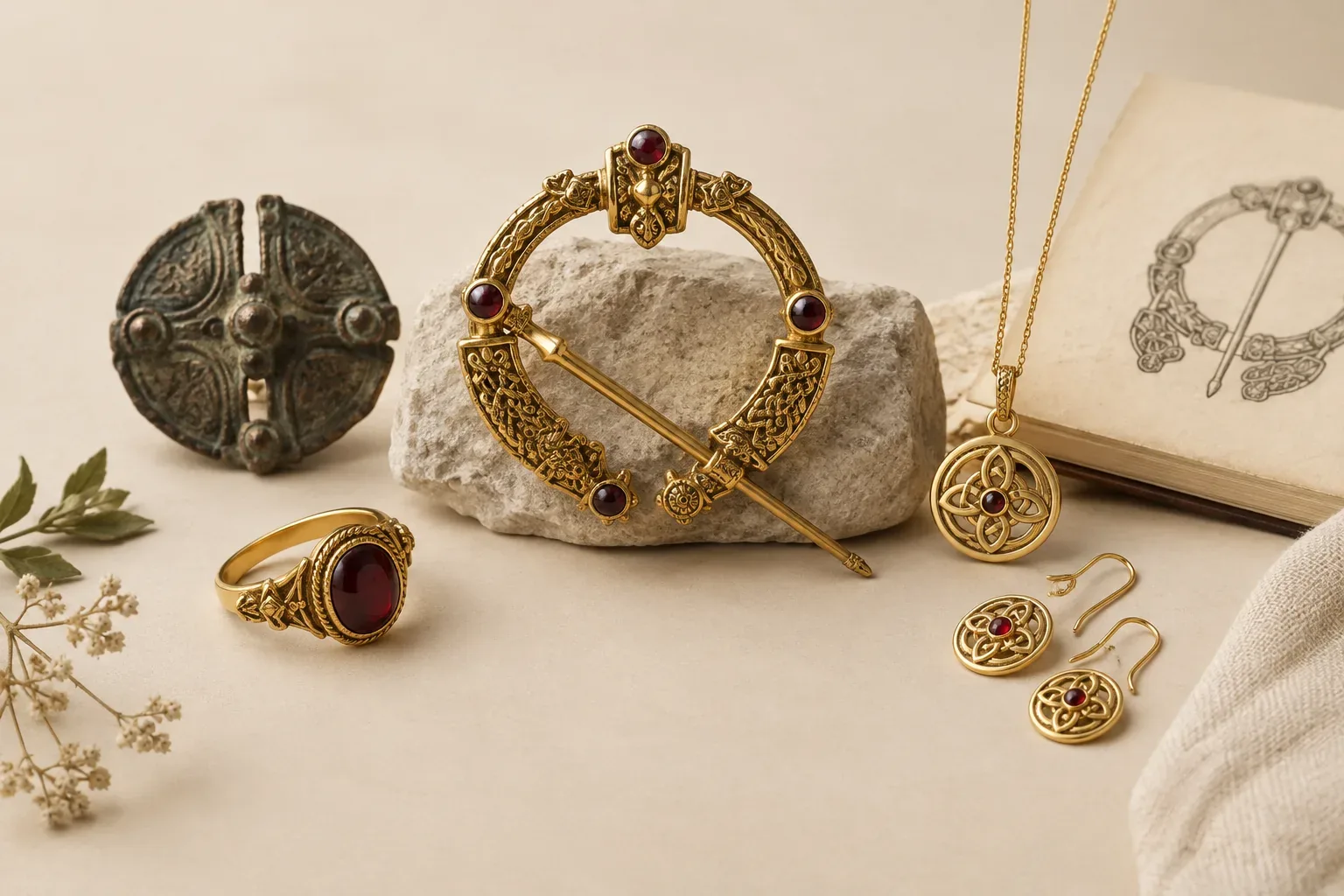
Revival and inspired pieces typically borrow visual motifs and techniques rather than being literal continuations. You will see historic interlace patterns, stylized animal forms, cloisonné‑like enamel work, and settings that recall early metalwork shapes adapted into modern chains, rings, and pendants. Reproductions may mimic the look of period soldering, granulation, and inlay without using identical methods or materials.
Gemstones commonly associated with historical early medieval pieces appear in revival work too. Museum resources that survey gemstones explain how particular stones were used for color and durability and how modern treatments and imitations have changed what comes to market. The Victoria and Albert Museum’s resources on gemstones are useful for recognizing historically common materials and how they are visually represented in later jewellery.
Contemporary makers also use new techniques and modern alloys to achieve the historic look at lower cost. This matters for buyers because an object’s look does not prove ancient age or historic method. Treating a piece as 'in the Anglo‑Saxon style' should be clearly stated by the seller when the piece is a modern creation.
Practical and respectful selection guidance
Decide first whether you want an authentic archaeological object, a historically informed reproduction, or a modern piece inspired by Anglo‑Saxon forms. These are different categories with different ethical and legal implications. Museum and dealer descriptions should make this distinction clear; if a listing does not, ask directly. An archaeological find will usually come with provenance paperwork and often has legal restrictions on sale. A reproduction or inspired piece should be marketed as such.
Ask your seller for provenance and documentation. For archaeological items, provenance helps verify legal export and ownership history. For gemstones, the Federal Trade Commission’s guidance on buying gemstones recommends that buyers ask whether gems have been treated, whether materials are natural or synthetic, and for any lab reports that apply. Sellers should disclose enhancements and imitations; if they do not, treat the claim of authenticity with caution.
Prefer transparent sellers: museums, reputable auction houses, and established dealers typically disclose background research, conservation history, and legal status. For revival pieces, seek makers who describe the inspiration and the materials used, and who do not overstate historical accuracy. If you are buying online, look for clear photographs of hallmarks, construction details, and closeups of stones and backs; these help specialists and conservators assess technique and age.
Avoid purchasing items that might be illicitly excavated or exported. Museums and ethical dealers follow strict acquisition policies; the V&A’s public work on jewellery history includes commentary on context and collecting that can help you learn to spot responsible practice. If you are uncertain, consult a specialist or a museum department rather than proceeding with a purchase you suspect may be problematic.
When gifting, be explicit about what the piece is and what it is not. If the item is a modern creation inspired by Anglo‑Saxon work, say so. If you intend the piece to carry a particular contemporary meaning, explain that meaning to the recipient rather than presenting it as an ancient, universally held symbol. This approach respects both historical truth and the recipient’s space to make their own meaning.
How to wear and display Anglo‑Saxon revival pieces respectfully
Wearing historically inspired jewellery is a valid form of appreciation. Respectful practice means acknowledging inspiration and avoiding claims that an object is an authentic cultural or religious artifact unless it genuinely is. For publicly exhibited or historically accurate pieces, hang provenance or maker statements nearby if you display them at home so visitors are not misled.
If a motif has adopted contemporary cultural or spiritual significance within living communities, seek guidance from those communities before using the motif in ways that might be sensitive. Museums such as the Victoria and Albert Museum emphasize interpretation and provenance; use these tools to guide how you present historic or revival items in conversation or social media.
Closing note
An anglo-saxon jewelry buying guide should center transparency, respect for historical context, and careful questioning of provenance and claims. Museums and regulatory guidance offer concrete steps you can take: learn the background, ask the right questions, and choose pieces that match both your aesthetic preferences and your ethical standards.
Frequently asked questions
How can I tell if an Anglo‑Saxon piece is genuinely ancient?
Genuine archaeological pieces should come with clear provenance, documentation of legal export and sale where applicable, and often specialist condition reports. Museums and reputable auction houses provide this paperwork. If a seller cannot document provenance or uses vague language, treat claims of antiquity with caution and seek an independent assessment.
Is it okay to buy reproductions or inspired pieces?
Yes. Reproductions and modern interpretations allow you to enjoy historic forms without contributing to the market for illicit antiquities. Buy pieces that are honestly labeled as reproductions or inspired by a period and seek makers who describe their materials and methods.
What should I ask about gemstones and treatments?
Follow the Federal Trade Commission’s guidance: ask whether a gemstone is natural, synthetic, or treated; ask what kinds of enhancements it has had; and request any available lab reports. Sellers are expected to disclose common treatments and any imitations used in the piece.
Are there legal or ethical concerns when buying archaeological jewellery?
Yes. Many countries regulate excavation and export of antiquities; buying objects without clear legal provenance can support looting. Prefer items with documented legal histories or choose modern reproductions to avoid participating in an illicit market.
How should I explain the meaning of a revival piece when gifting it?
Be transparent about whether the item is an ancient object, a reproduction, or a modern piece inspired by historic forms. If the gift carries a personal meaning for you, state that clearly rather than presenting the meaning as an ancient or universal fact.
Sources and further reading
- Bedazzled: A History of Jewellery — Victoria and Albert Museum
- An A-Z of Gemstones — Victoria and Albert Museum
- Buying Gemstones, Diamonds, and Pearls — Federal Trade Commission