Meaning at a glance
This article explains the documented history and changing contexts of anglo-saxon jewelry symbols, separates evidence from later popular interpretation, and gives practical guidance for choosing and wearing related motifs today.
Quick answer
Explain the documented history and changing contexts of the anglo-saxon jewelry symbols motif, separate cultural or religious evidence from later popular interpretations, and give practical guidance for choosing and wearing the motif in modern jewelry.
What the museum evidence shows (and what it does not)
Surviving objects and museum research provide the reliable basis for understanding Anglo-Saxon jewellery, but they rarely record a single, universal symbolic meaning for a motif. The Victoria and Albert Museum frames jewellery as historically mobile in meaning, shaped by social context, status, and changing tastes rather than fixed symbolic dictionaries. Archaeological finds, museum collections, and curatorial interpretation therefore show forms and materials in use, and they situate those objects within social and artistic contexts rather than always providing a definitive statement of belief or symbolism.
Across early medieval objects held in collections, museum catalogues and exhibitions commonly point to recurring artistic elements: complex metalworking, repeated decorative themes, and the use of inlaid stones or glass. The Victoria and Albert Museum presents these features as evidence of technique, trade connections, and social display. That evidence tells us what makers made, what materials they used, and where objects circulated; it does not, by itself, provide a single authoritative translation of every motif as a spiritual creed or a single cultural meaning.
Identifying cultures and periods precisely
When discussing Anglo-Saxon jewellery symbols it is important to separate the archaeological and curatorial contexts in which an object was made or used from later Victorian, revival, or contemporary reuse of those forms. Museum descriptions typically locate objects by find-spot, archaeological layer, stylistic features and comparison with dated material; curators then place those objects in a cultural and chronological frame. Institutions such as the Victoria and Albert Museum present Anglo-Saxon items within the broader history of early medieval Britain and later receptions.
Because terminology and chronology vary between disciplines, favour the museum or catalogue context for the object you are studying. If a label or catalogue entry identifies an item as 'Anglo-Saxon' or 'early medieval', that identification is a claim based on archaeological and stylistic evidence. Later uses of the same motifs in Victorian jewellery, 20th-century revival pieces, or contemporary designer work belong to different historical moments and should be understood on their own terms.
Documented historical meanings versus modern interpretations
Museum evidence can support well-attested functions — for example, brooches and pins clearly served as fasteners and status markers — and it may record inscriptions or scenes that give specific information for particular objects. But many symbolic attributions popularly attached to Anglo-Saxon motifs are modern reconstructions. The Victoria and Albert Museum emphasises jewellery’s shifting social meanings; curators and historians avoid claiming universal spiritual messages for motifs unless inscriptions or contemporary written sources support such readings.
Modern popular interpretations often layer new meanings onto Anglo-Saxon designs: this is a normal part of cultural reuse. A motif that originally functioned as decoration or a workshop trademark can be reimagined today as a symbol of ancestry, pagan spirituality, or national identity. Such contemporary meanings have value for people who choose them, but they are not equivalent to documented meanings from the object's original context. Treat museum-backed attributions and modern personal interpretations as distinct kinds of truth: one grounded in physical evidence and historical method, the other in present-day identity and taste.
How Anglo-Saxon motifs, gemstones, and traditions appear in jewellery
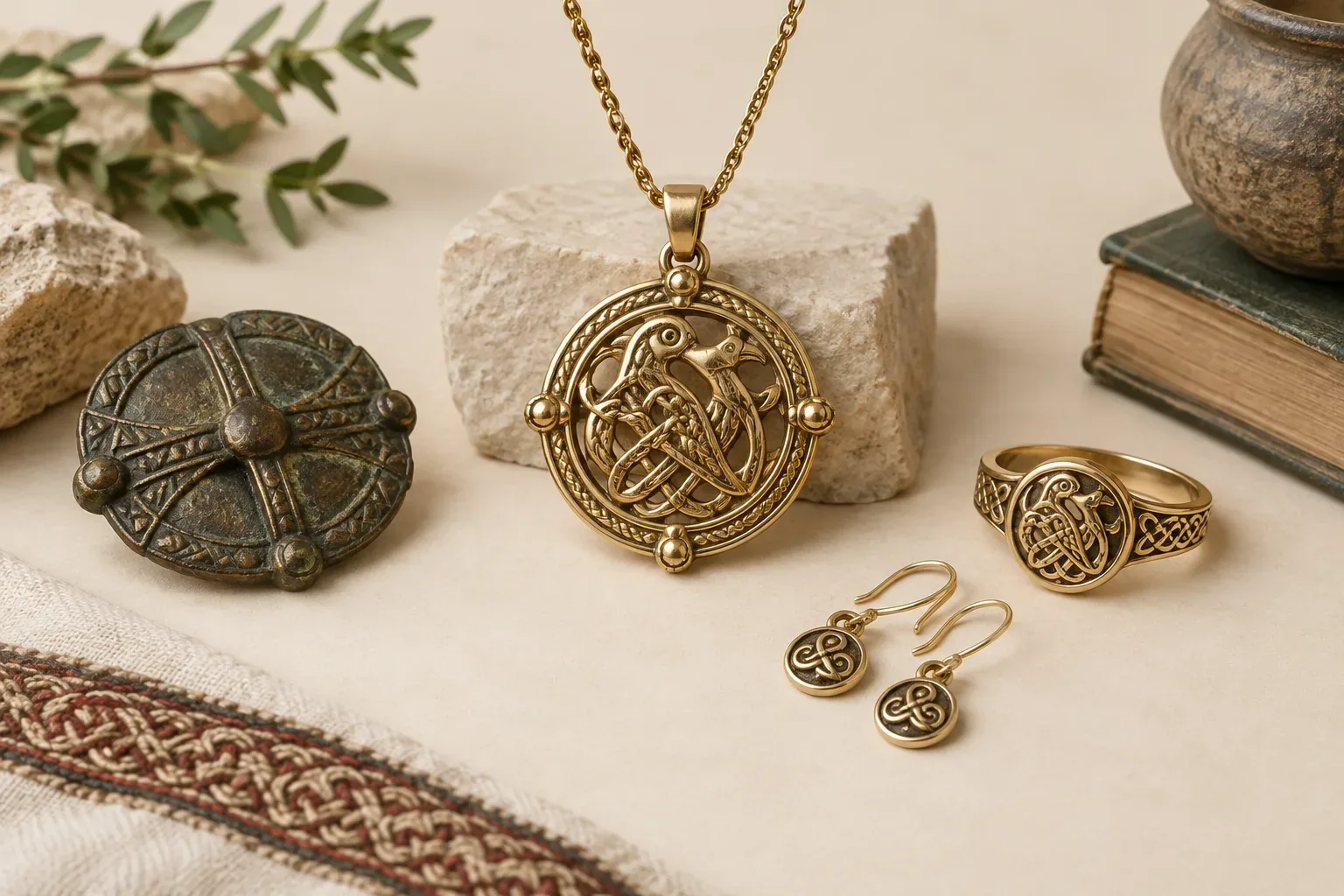
In museum collections, objects associated with Anglo-Saxon contexts include metalwork items such as brooches, pendants, clasps and fittings, often decorated with repeated geometric or animal-like designs. Curatorial descriptions at institutions like the Victoria and Albert Museum show how these decorative vocabularies appear across object categories and how makers combined metalworking techniques with inlaid materials to achieve contrast and colour in small objects.
Gemstones and inlays appear in historic pieces, but their identification and treatment matter. The Victoria and Albert Museum’s guidance on gemstones explains the variety of materials used historically and how gem materials can carry social value. For modern buyers, the Federal Trade Commission’s consumer guidance advises asking about treatments, imitations, and disclosure of enhancements when gemstones are represented as natural or untreated. In reproduction or inspired jewellery, makers commonly adopt Anglo-Saxon visual cues — interlace patterns, zoomorphic shapes, or runic letterforms — and pair them with contemporary metals and stones to evoke an historic look while using modern methods.
Practical and respectful guidance for selecting or gifting Anglo-Saxon motifs
Decide what kind of meaning you want the piece to carry. If your priority is historical connection, look for reputable museum reproductions, academically informed makers, or pieces with clear provenance. If your priority is personal meaning, be explicit that the object is a contemporary expression inspired by historic forms rather than a claim of direct continuity with a past belief system. The Victoria and Albert Museum’s approach to objects warns against conflating original use and modern sentiment without acknowledging the distinction.
Ask sellers about materials and treatments. The Federal Trade Commission recommends that consumers ask whether a stone is natural, treated, synthetic, or imitation and to request written disclosure when needed. If you care about ethical sourcing or the authenticity of a claimed archaeological provenance, ask for documentation and proof of lawful export and sale. Avoid purchasing items marketed as 'authentic Anglo-Saxon' without clear, verifiable provenance from a recognized institution or dealer.
Be culturally and historically respectful when gifting. Avoid using a motif to assert a political or identity claim on behalf of a culture without understanding its provenance and the different meanings it may carry for others. Explain to the recipient whether the jewellery is a modern design inspired by historical forms, a modern reinterpretation with personal symbolism, or a documented antique with verifiable provenance. If you are commissioning work, seek designers who are knowledgeable about the historical vocabulary and who will be transparent about what is original and what is newly invented.
Putting motifs to work: wearing and caring for inspired pieces
Choose jewellery that fits the wearer’s daily life and the formality of the occasion. Heavier metalwork and larger reproductions may be best reserved for occasional wear, while delicate modern reinterpretations can be designed for everyday use. If the piece incorporates genuine stones, follow standard care recommendations for those materials and consult the maker about cleaning and repair.
When authenticity or value is important, obtain a written statement from the seller about materials and treatments as the FTC advises, and keep any receipts and certificates with the piece. This preserves the object’s history in case you later decide to sell, donate, or pass it on as an inherited item. If you are uncertain about the historical claim of a purchased item, consult museum resources or a qualified appraiser rather than relying solely on marketing language.
Final notes on research and further reading
If you want to investigate the history and craftsmanship behind an Anglo-Saxon–inspired motif, start with museum catalogues, exhibition notes, and gemstone guides. The Victoria and Albert Museum offers accessible introductions to jewellery history and gemstones that clarify how objects and materials were used and interpreted across time. For consumer-facing questions about gemstones and disclosure, the Federal Trade Commission provides practical buying advice.
For related reading on how symbols are reused and how to choose meaningful pieces today, see our articles on Cultural & Historical Jewelry, How to Choose Meaningful Jewelry: A Practical Gift Guide, History of Lockets, and How to Research the Meaning of a Jewelry Symbol.
Frequently asked questions
Were Anglo-Saxon jewellery motifs always religious symbols?
No. Museum research shows jewellery served multiple functions — practical, decorative and social — and curators avoid assuming a single religious meaning for motifs unless inscriptions or contemporary texts support that interpretation. The Victoria and Albert Museum emphasises jewellery’s changing social contexts rather than universal symbolic readings.
Can I wear Anglo-Saxon motifs if I am not British or of Anglo-Saxon descent?
Yes, but be mindful of the difference between appreciating historical design and claiming cultural continuity. If you wear a motif for personal meaning, present it as a contemporary interpretation or inspired piece, and if you are gifting, explain its provenance and the nature of its inspiration.
How can I tell if an 'Anglo-Saxon' piece is genuinely ancient?
Ask for verifiable provenance, condition reports, and expert documentation. Avoid purchasing items advertised as authentic without clear, traceable provenance. For consumer protection on gemstones and materials, follow the Federal Trade Commission’s buying guidance and request written disclosures about treatments or imitations.
What gemstones did Anglo-Saxon jewellery include?
Museum discussions of gemstones note a variety of materials used historically and emphasize that stone use reflects trade and social values. For identification and historical context, consult museum gemstone guides such as the Victoria and Albert Museum’s A–Z of Gemstones.
How should I care for a modern piece inspired by Anglo-Saxon designs?
Follow the maker’s care instructions and consider the specific metals and stones used. If the piece contains genuine gemstones, ask about any treatments and follow standard cleaning methods for those materials. Keep purchase documentation in case provenance or resale becomes relevant later.
Sources and further reading
- Bedazzled: A History of Jewellery — Victoria and Albert Museum
- An A-Z of Gemstones — Victoria and Albert Museum
- Buying Gemstones, Diamonds, and Pearls — Federal Trade Commission