Meaning at a glance
Documented Anglo-Saxon jewellery is best understood through archaeological context and material study; museum scholarship shows motifs and techniques changed with social use, while many modern attributions and meanings are popular reinterpretations — verify provenance, ask for treatment disclosure, and prefer responsibly described replicas or authenticated pieces when buying or gifting.
What the historical evidence actually says
Understanding Anglo-Saxon jewellery starts with how museum and curatorial research treats objects. The Victoria and Albert Museum frames jewellery as objects whose form and meaning shift with social context, materials, and technique rather than fixed symbolic definitions. Specialists use find-spot, burial context, associated objects, and technical study to connect a piece to the Anglo-Saxon milieu, and then place it within broader stylistic sequences and uses documented by archaeology and museum collections.
When authors and curators discuss the “Anglo-Saxon” label they typically mean material produced or used in the culture historically associated with Anglo-Saxon England. Museums and researchers distinguish that cultural label from closely related neighbouring styles and later revivals; an object's archaeological provenance and technical features are what support an attribution, not a modern stylistic guess. The V&A emphasises that jewellery must be read in terms of changing social and aesthetic contexts rather than assumed constant meanings across time.
Separating documented historical meanings from modern interpretations
Historic meanings recorded by contemporaries are rare for most early medieval jewellery. Where museums and archaeologists can document use, they rely on the object's find context: whether it was grave goods, a high-status item, or domestic ornament. From those contexts, curators infer roles such as display of status, personal identity, or connections to alliances and gift exchange, but these inferences remain interpretive and are tied to the archaeological record rather than textual attestations.
Modern personal or commercial meanings — for example, claims that a particular knot equals a specific spiritual blessing or that a bird motif confers protection — are often contemporary readings. The V&A’s approach to jewellery history underlines how forms, functions, and perceived meanings have changed over time. That means a motif worn today for an emotional or spiritual reason should be presented as a modern interpretation unless there is direct historical evidence linking it to that meaning in the Anglo-Saxon period.
How motifs, gemstones, and techniques appear on jewellery
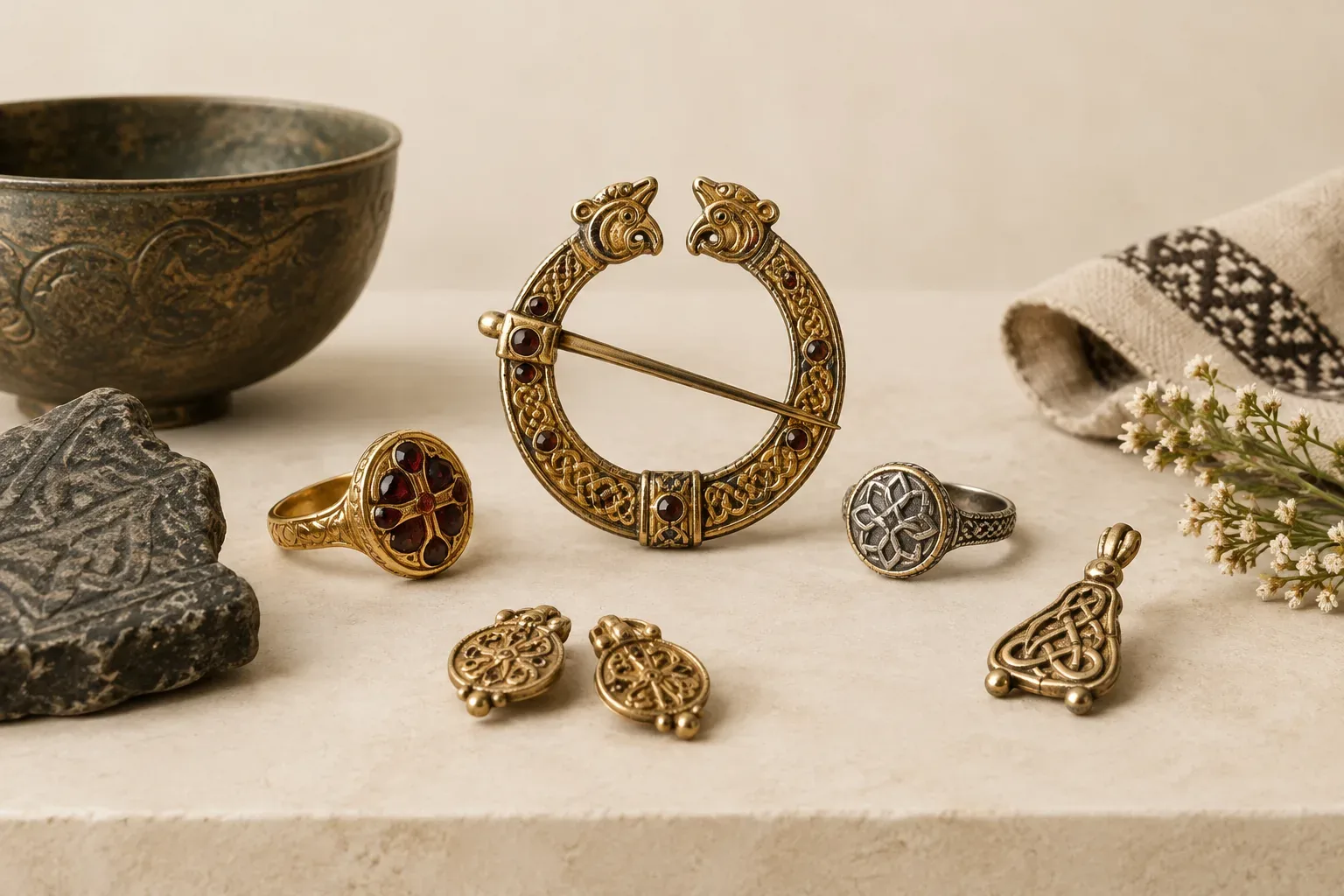
In museum descriptions and catalogues, motifs are identified by their visual features and by comparisons across securely-dated finds. Commonly discussed decorative themes in early medieval collections include interlace, stylised animals, geometric panels, and repeated formal elements; these appear in forms such as brooches, pendants, finger-rings, and mountwork. The V&A highlights that such motifs and their technical execution are best understood alongside the object's purpose and find-context rather than as isolated symbols.
Gemstones and inlays are identified by their material properties and setting techniques. The same V&A resources that survey gemstones note both their historical use and how later techniques or imitations complicate identification. Gemstones may appear as inlays set within gold cells, as stringed beads, or as mounted cabochons; technical marks, the way a stone is cut or set, and wear patterns are part of specialist identification. Modern replicas may imitate these appearances with different materials or surface treatments, so visual similarity alone does not establish authenticity.
Dating: how specialists assign broad periods and what that means
Specialists date pieces through combinations of context, typology, and scientific methods when possible. Archaeological context — a datable grave assemblage or secure hoard — provides strong evidence for a piece’s date. Curators also use typologies: certain brooch shapes, decorative schemes, or manufacturing details appear in particular sequences and regions, and museums place objects within those sequences when dating them. The V&A emphasises that dates and attributions are conclusions based on evidence, not simple labels.
For collectors and researchers, therefore, date statements on a label should indicate the basis for the attribution: is the label based on archaeological find-context, technical analysis, stylistic comparison, or an expert assessment? When that basis is not provided, treat dated claims with caution and seek provenance documentation or a curatorial report.
Common mislabels and frequent identification errors
Mislabels arise in several ways. First, modern sellers sometimes use catch-all terms such as “medieval,” “Celtic,” “Viking,” or “Anglo-Saxon” for market appeal without substantiating provenance. Second, reproductions made in historicising styles can be mis-presented as originals when conservation, patina, and manufacturing marks are not considered. Third, modern symbolic readings are often presented as historical facts: a motif sold as an “ancient protective knot” may be a recent marketing narrative rather than an archaeologically documented belief.
The Victoria and Albert Museum’s examinations of jewellery history remind us that context matters. A brooch or pendant found without provenance cannot reliably be assigned to a narrow cultural or chronological category on visual similarity alone. Likewise, gemstones that look like historic garnet inlay or glass-filled stones in modern jewellery may be treated or synthetic — the U.S. Federal Trade Commission requires sellers to disclose treatments and imitations, so always ask for that information.
Practical guidance for choosing or gifting Anglo-Saxon–inspired pieces
If you want historical authenticity: seek objects with clear provenance and documentation from reputable dealers, auction houses, or museums. Ask for the basis of the attribution and for any laboratory reports or conservation records. Museums such as the V&A show how attributions are made; a seller should be able to point to similar documented examples and the evidence for a claim.
If you prefer a modern piece inspired by Anglo-Saxon motifs: choose items clearly labelled as “inspired by,” “replica,” or “contemporary interpretation.” This is respectful of cultural and scholarly distinctions and prevents inadvertent support of illicit trade in antiquities. For gemstones and treated materials, ask the seller to disclose any enhancements, imitations, or stabilising substances in line with the Federal Trade Commission’s guidance on disclosure of treatments and imitations.
When gifting, be explicit about the piece’s status. If it is an archaeological object, include provenance information or a certificate; if it is a replica or modern reinterpretation, explain that clearly and possibly include a short note about why that style appealed to you. Respect for historic cultures includes transparent attribution and an avoidance of marketing romanticised or incorrect historical claims.
Closing notes
Anglo-Saxon jewellery identification works best when archaeological evidence, technical study, and careful curatorial language guide interpretation. Museum scholarship reminds collectors and gifters that motifs and materials must be read in context, and that many modern symbolic claims are contemporary choices rather than documented historical meanings. Prioritize provenance, transparent labelling, and seller disclosure when buying or giving jewellery related to historic cultures.
Frequently asked questions
How can I tell if a piece is authentically Anglo-Saxon?
Authentic attributions are supported by provenance (archaeological find-spot or documented chain of custody), technical study, and comparison with securely dated museum examples. If a seller cannot provide provenance or the basis for dating, treat claims of authenticity cautiously.
Are motifs on Anglo-Saxon jewellery known to have fixed symbolic meanings?
Direct evidence linking motifs to fixed symbolic meanings is limited. Museum research infers function and social roles from context and form, but many specific symbolic claims are modern interpretations rather than documented historical meanings.
What are common mislabels to watch for when buying online?
Watch for broad or vague labels such as “medieval,” “Celtic,” or “Anglo-Saxon” without provenance, for pieces presented as originals but lacking documentation, and for modern items marketed with asserted ancient meanings. Ask for photos of hallmarks, provenance, and any lab reports.
How should sellers disclose gemstone treatments or imitations?
Sellers should follow disclosure practices such as those outlined by the Federal Trade Commission: clearly state if a stone is treated, synthetic, or an imitation and provide details of the treatment when known.
Is it appropriate to wear Anglo-Saxon–style jewellery today?
Yes, provided the piece is accurately described. Wearing a modern piece inspired by Anglo-Saxon design is a valid contemporary choice. If the object is an archaeological artifact, ensure it was legally acquired and consider the cultural and ethical implications before displaying it.
Should I buy a replica or an original as a gift?
For most gifters, a well-made replica or contemporary piece labelled as inspired is the most ethical and affordable choice. If purchasing an original, insist on provenance documentation and be prepared for higher cost and specialist care requirements.
Sources and further reading
- Bedazzled: A History of Jewellery — Victoria and Albert Museum
- An A-Z of Gemstones — Victoria and Albert Museum
- Buying Gemstones, Diamonds, and Pearls — Federal Trade Commission