Meaning at a glance
Acrylic jewelry is a modern, lightweight material most often used for bold, affordable costume pieces; historically it belongs to the broader rise of 20th‑century mass‑produced costume jewellery noted by the Victoria and Albert Museum, and buyers should prioritize maker transparency, finish quality, and truthful labeling over assumed cultural or spiritual meaning.
Direct answer — the short thesis
Acrylic jewelry is a modern, manufactured material used mainly for costume and fashion pieces; treat it as a design and material choice rather than a bearer of long‑established cultural symbolism. The most useful buying criteria are documented: transparency about materials and treatments, craftsmanship of joins and finishes, and appropriate price relative to size and technique. This article explains the documented history and changing contexts of acrylic jewellery, separates historical evidence from later popular interpretation, describes how acrylic appears in jewellery, and gives practical guidance for selecting, wearing, and gifting acrylic pieces.
Documented historical context and evidence
The Victoria and Albert Museum frames jewellery history as a long sequence of changing social contexts, tastes, and technologies. The museum's material makes clear that what we call 'jewellery' shifts over time between high‑value, precious pieces and affordable decorative objects produced for everyday fashion. That broad history helps place acrylic: it is part of the 20th‑century expansion of mass‑produced, accessible fashion jewellery rather than a continuation of ancient gem traditions.
Museum surveys such as the V&A's Bedazzled presentation emphasize how techniques and materials change meaning. Precious gemstones and metals carry long documentary histories and specific cultural associations catalogued by museums, while new industrial materials are typically tied to modern fashion movements, manufacturing methods, and consumer trends rather than sustained ritual or religious practice. Relying on these museum descriptions keeps a clear line between long‑established symbolic systems and recent material trends.
Separate documented historical meanings from modern personal interpretations
For gemstones and classic motifs, museum resources list documented historical meanings in particular cultures and periods. For example, older traditions around pearls, gold, or particular gem types are treated as part of the recorded past in the V&A's collections and interpretive materials. Those documented meanings are tied to specific cultures, religions, social classes, and historical periods that the museum identifies precisely.
Acrylic, by contrast, lacks the long documentary record of ancient gemstones. Its meanings are largely contemporary and personal. When someone assigns a spiritual or cultural meaning to an acrylic object today, that is a modern interpretation or fashion statement rather than a documented cultural tradition. Distinguish carefully between what is recorded by museums or historical sources and what is a modern personal, commercial, or pop‑culture attribution.
How acrylic appears in jewellery: motifs, imitations, and techniques
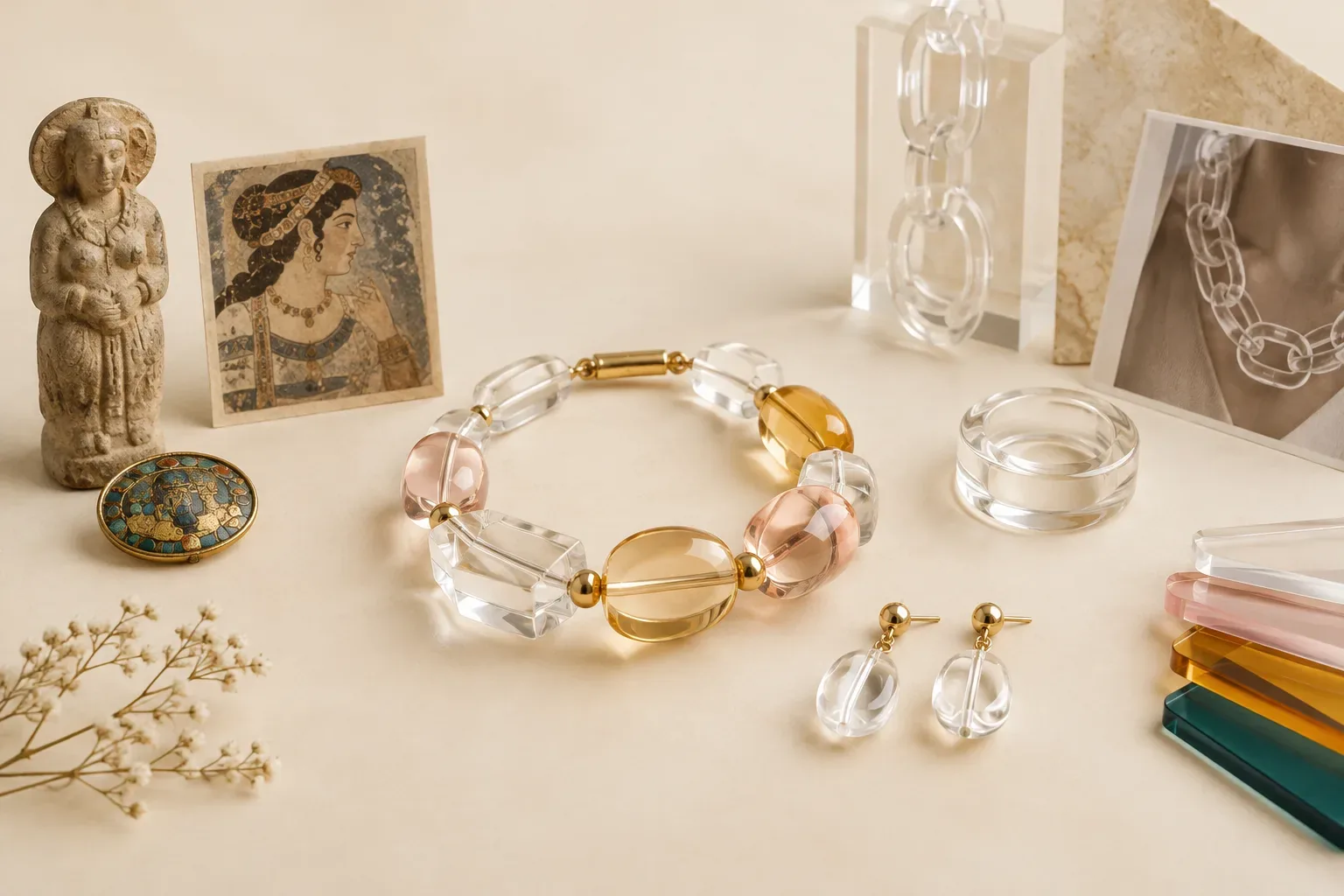
Acrylic is used in a few consistent ways in jewellery: as bold, colourful bodies for statement pieces; as carved or moulded components in earrings, bangles, and necklaces; and as an inexpensive material used to imitate the weight, colour, or translucence of more costly materials. Acrylic can be cast, dyed, laminated, and finished to simulate glass, resin, or certain gem colours and is often combined with metal findings, beads, and other components.
Because acrylic is easy to shape and colour, designers exploit it for modern motifs—oversized geometric shapes, layered colour blocks, and lightweight versions of classic forms such as cameos or beads. The Victoria and Albert Museum's discussion of jewellery history helps explain this shift: new materials and manufacturing techniques allow designers to reinterpret older motifs for contemporary fashion without inheriting the historical symbolism those motifs once carried.
Quality and price: what to look for when buying acrylic jewellery
Price for acrylic jewellery usually reflects design complexity, finish quality, brand, and labour rather than intrinsic material value. A hand‑finished, well‑designed acrylic bangle can command a higher price than a mass‑injected piece because of the labour and design involved. Evaluate pieces by their craftsmanship: even edges, smooth joins where acrylic meets metal, secure fastenings, and consistency of colour or pattern indicate better quality.
Because acrylic can imitate gemstones or glass, verify how sellers describe the material. The Federal Trade Commission advises sellers to disclose treatments and imitations; while the FTC guidance specifically targets gemstones, diamonds, and pearls, the principle applies broadly: truthful labeling of materials and any treatments or coatings is an important consumer protection. If a seller markets an item as 'resin', 'acrylic', or an 'imitative material,' that should be made explicit rather than implied to be a natural gemstone.
Examine weight and feel. Acrylic is lightweight compared with glass and many gemstones. That can be an advantage for wearable large pieces but should be expected; unusually heavy 'acrylic' claims may warrant closer inspection. Check colourfastness by asking whether colours are dyed through the material or only surface‑applied, as surface coatings may wear over time.
Practical selection and respectful gifting guidance
Match the piece to the recipient's style and needs. Acrylic is excellent for statement, casual, and travel jewellery because it is affordable and light. For someone who favours minimal, high‑value heirloom pieces, acrylic may not align with expectations. When gifting, consider context: a bold acrylic necklace can be an excellent present for a fashion‑forward friend but may feel inappropriate in occasions that traditionally call for precious jewellery, such as certain religious or family rituals that value heirlooms.
When material authenticity or cultural meaning matters to the recipient, ask questions or choose a different material. If a motif has documented significance in a named culture or religion, prefer pieces made of the traditional materials and by makers who respect that tradition, or choose a neutral motif instead. For general fashion gifts, focus on craftsmanship, the receiver's colour palette and comfort (weight and size), and clear labeling of materials so the recipient understands what they are being given.
Be transparent when giving acrylic as a symbolic object. If you intend the piece to carry a special meaning—such as memory, encouragement, or celebration—explain that meaning in your note and avoid asserting that the material itself has a long cultural or religious pedigree.
Care, repair, and longevity
Acrylic is more scratch‑prone than glass and can be sensitive to some solvents and high heat. Clean gently with a soft cloth and mild soap; avoid abrasive cleaners and alcohol‑based products that can dull or crack the surface. Store acrylic pieces away from direct sunlight when possible to reduce fading and distortion over long periods.
Repairs are possible for some acrylic items, but complex restorations are often impractical; for expensive or sentimentally important pieces, opt for professional repairers experienced with plastics. For lower‑cost items, keep the possibility of fading or wear in mind when deciding whether to buy a piece intended as an heirloom.
When to choose acrylic, and when to choose something else
Choose acrylic when you want a lightweight, colourful statement piece, when budget and wearability matter, or when experimenting with bold shapes and large scales. Choose traditional precious materials if the occasion calls for documented cultural or religious symbolism, long‑term durability, or intrinsic monetary value.
If authenticity, documented historic meaning, or resale value is important, consult museum resources and expert guidance about specific gemstones, motifs, and cultural uses before buying. The V&A's resources on jewellery history and gemstones are useful starting points to understand how materials carried particular meanings in specific cultures and periods.
Frequently asked questions
Is acrylic jewellery durable?
Acrylic is lightweight and reasonably durable for everyday fashion wear, but it scratches more easily than glass or gemstone materials and can be sensitive to solvents and heat. Regular gentle cleaning and careful storage will extend its life.
How should sellers describe acrylic pieces?
Sellers should clearly label materials and any treatments. The Federal Trade Commission guidance on gemstones and imitations underscores the importance of disclosure; while that guidance focuses on gems, the same principle—truthful material descriptions—applies to acrylic jewellery.
Can acrylic imitate gemstones?
Yes. Acrylic can be coloured, layered, or finished to resemble certain gem colours or glass, but imitation should be explicitly disclosed by the seller rather than presented as a natural gemstone.
Are there cultural meanings tied to acrylic jewellery?
Acrylic itself has no long, documented cultural or religious meanings. Museums such as the Victoria and Albert Museum record meanings for older, traditional materials and motifs; modern meanings for acrylic are usually personal, fashion‑based, or commercial rather than historical.
Is acrylic a good choice for a gift?
Acrylic can make an excellent gift when the recipient enjoys bold, lightweight fashion jewellery and you want an affordable, wearable piece. For occasions that call for traditional symbolic materials or heirlooms, choose a material that aligns with that cultural expectation.
How do I care for acrylic jewellery?
Clean acrylic with a soft cloth and mild soap, avoid abrasive cleaners and solvents, and store pieces away from direct sunlight and extreme heat to prevent fading and deformation.
Sources and further reading
- Bedazzled: A History of Jewellery — Victoria and Albert Museum
- An A-Z of Gemstones — Victoria and Albert Museum
- Buying Gemstones, Diamonds, and Pearls — Federal Trade Commission