Meaning at a glance
This article explains the documented history and changing contexts of wood jewelry, separates historically recorded meanings from later personal interpretations, details how wood appears with motifs and gemstones, and gives practical guidance for selecting and disclosing wooden pieces today.
Composition and craft: what we mean by "wood jewelry"
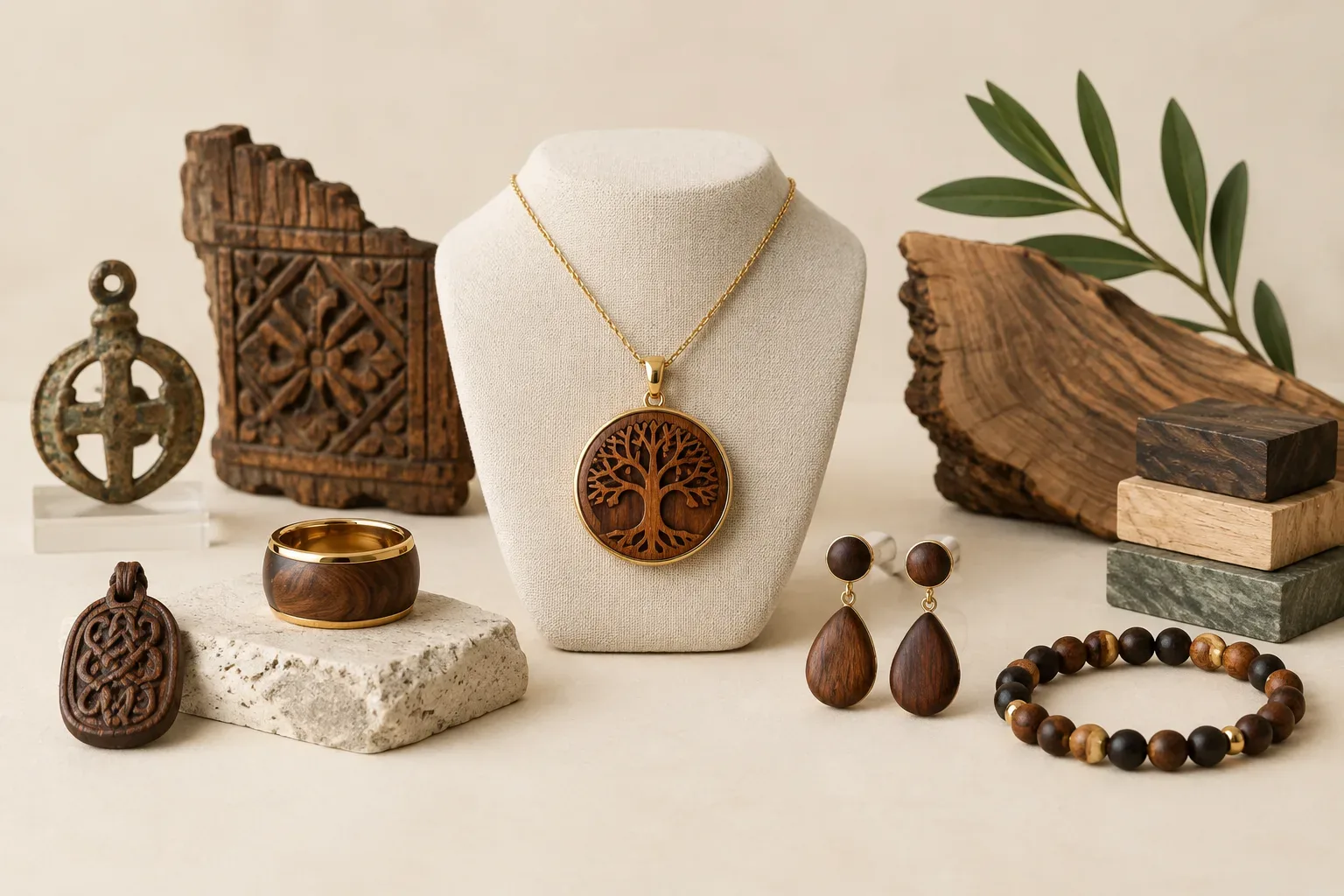
When people refer to wood jewelry they mean wearable objects in which wood is a principal component. That includes carved pendants, beads and rosary-type strands, inlaid panels set into metal frames, small carved toggles or charms, and contemporary designs that mix wood with metals, resins, or gemstones. Wood can be the entire object, a component, or a decorative motif applied to another carrier.
Craft techniques vary by place and period. Artisans carve, join, turn on a lathe, inlay, stain, paint, polish, or lacquer wood to achieve a durable surface and the visual effect desired. Contemporary makers may also stabilize wood with resins, laminate thin veneers for strength, or mount wooden elements within metal bezels or wirework. The Victoria and Albert Museum's materials on jewellery history emphasize that jewellers have long combined diverse materials and techniques to answer aesthetic, social, and technical demands.
Historical evidence: where and when wood appears in jewellery
Museum collections and scholarship document wooden components in jewellery and personal ornament from many different cultures and periods. The Victoria and Albert Museum records that jewellery materials and meanings shift over time, and its collections span ancient, medieval, early modern, and contemporary examples in which organic materials appear alongside metal and stone.
Specific concentrations include small carved personal objects from East Asia that enter European collections; decorative beadwork and strung elements in African and Oceanic traditions; and 18th–19th century European sentimental and costume pieces that incorporate a range of organic substances. These are recorded as part of broader narratives about changing taste, technology, and social use of ornament. The V&A makes clear that context—who made the object, for whom, and why—matters when reading historical meanings.
Documented historical meanings versus modern interpretations
Documented meanings are the symbolic or social functions recorded in historical sources or preserved object contexts. Where museum records or provenance indicate that a wooden object had a specific role—such as a talisman, a trade good, or a component of ritual dress—those meanings are particular to the culture and period recorded. The Victoria and Albert Museum emphasizes that museum labels and collection records link objects to these contexts when that evidence exists.
Modern interpretations are often personal, aesthetic, or commercial. Today people commonly describe wooden jewellery as "natural," "eco," or a symbol of simplicity or sustainability, but those are contemporary readings and not universal historical facts. Avoid assuming a single, timeless meaning: a wooden bead that signified status, protection, or devotion in one place or age may be worn today primarily for style or as a statement of environmental concern. Treat historical claims as specific and sourced, and treat modern symbolic meanings as individual or community-based preferences rather than inherited facts.
How motifs, gemstones, and traditions appear with wood in jewellery
Wood is used both as a surface for motifs and as a structural element that carries other decorative features. Carved motifs can be figurative, geometric, or textual and may be left in plain wood grain or enhanced with paint, gold leaf, or metal fittings. Inlaid work places small pieces of wood next to other materials to form patterns, and veneering uses thin sheets of wood for surface decoration.
Gemstones and other traditional jewellery elements are sometimes combined with wood. Museum discussions of gemstones and jewellery composition note that makers historically combined hard stones, glass beads, pearls, and organic materials in single pieces when the design or social context called for it. Contemporary designers do the same: you will find wooden settings framed by silver or gold, small stones set into wooden beads, and mixed-material pendants that juxtapose the warmth of wood with the brilliance of gem facets.
Hallmarks, maker marks, and disclosure: what to expect
Unlike precious metals such as gold and silver, wood does not carry a universal industry hallmark that guarantees species or origin. For wooden jewellery, provenance, maker marks, documented collection records, and seller disclosure are the practical equivalents of a hallmark. Look for a reliable maker's stamp, written provenance, or a clear product description that states species, country of origin, and whether the wood has been stabilized or treated.
U.S. consumer guidance from the Federal Trade Commission requires sellers to disclose treatments, enhancements, or imitations for gems and organic materials. While the FTC guidance focuses on gemstones, diamonds and pearls, its principles apply to materials sold for their intrinsic or decorative value: sellers should be transparent about artificial coatings, resins, laminates, dyeing, or any composite construction that affects a piece's appearance or value. Ask sellers explicitly what treatments have been applied and whether any synthetic materials are present.
Practical and respectful selection or gifting guidance
If you plan to buy or gift wooden jewellery, start by asking about provenance and treatments. Request written or verbal confirmation of wood species, whether the piece has been stabilized or coated, and whether any non-wood components are synthetic. If the item is described as antique or ethnographic, ask for documentation or a clear museum-style provenance so you can be confident about age and origin.
Consider cultural sensitivity. If a piece is described as a cultural or ritual object, research its meaning before wearing or gifting it; museum resources and specialist publications can help. A respectful approach is to acknowledge the object's origins, use it in appropriate contexts, and avoid presenting ritual objects as mere fashion accessories without understanding their significance. When in doubt, choose contemporary artisan-made pieces that reference a look without appropriating sacred or ceremonial forms.
Care and longevity matter for wooden pieces. Finished and lacquered surfaces resist moisture and wear better than raw wood, and stabilized woods are less prone to cracking. If longevity is a priority for a gift, ask about finishes and maintenance recommendations. Finally, if you value ecological credentials, ask about sustainably sourced species and whether the maker follows any recognized sourcing standards, but treat such claims as seller statements and seek verification if certification is important.
Further research and resources
For historical context and documented examples, consult museum collections and their published guides. The Victoria and Albert Museum provides long-form material on jewellery history and how different materials and motifs function across time. For questions about seller disclosure and treatments, check guidance from consumer protection agencies such as the Federal Trade Commission, which sets principles for honest description of material treatments and imitations.
If you want practical buying or gifting advice specific to a piece, consult the maker for details, ask for a condition report for older objects, and research comparable objects in museum collections or reputable dealer catalogues to gauge age and cultural context. For general guidance on choosing meaningful pieces, see related guides on JewelryGuides and how to research jewellery symbols linked below.
Frequently asked questions
Is wood jewelry hypoallergenic?
Wood itself is often well tolerated, but finishes, coatings, adhesives, or metal fittings may cause reactions. If you have sensitive skin, ask the seller what finishes and metal alloys are present and look for nickel-free or hypoallergenic fittings.
How can I verify that a wooden piece is antique or ethnographic?
Ask for provenance or a condition report and compare the piece to documented museum examples. Museum catalogues and reputable dealers can help establish age and origin. If provenance is important, seek written documentation rather than relying solely on a seller's verbal claim.
What should sellers disclose about wood jewellery?
Sellers should state the species (when known), any stabilization or resin impregnation, coatings or dyes, and whether any parts are composite or synthetic. The Federal Trade Commission advises clear disclosure of treatments or imitations for materials used in jewellery.
Is it appropriate to gift culturally specific wooden jewellery?
Gifting items with cultural or ritual significance requires sensitivity. Research the object's meaning and provenance first. When in doubt, choose contemporary pieces by makers from the relevant community or select non-ritual designs that celebrate craft without appropriating sacred forms.
How should I care for wooden jewellery?
Follow the maker's instructions. In general, avoid prolonged exposure to water, extreme heat, and harsh chemicals. Finished and lacquered surfaces are more durable; untreated woods may benefit from occasional conditioning by a jeweller or conservator familiar with organics.
Sources and further reading
- Bedazzled: A History of Jewellery — Victoria and Albert Museum
- An A-Z of Gemstones — Victoria and Albert Museum
- Buying Gemstones, Diamonds, and Pearls — Federal Trade Commission