Meaning at a glance
To research a jewelry symbol reliably, begin with the object itself, record its materials and design, identify its date and cultural context, consult museum and scholarly records, compare independent sources, and clearly separate documented history from later or personal interpretations.
Quick answer
A symbol does not carry one fixed meaning wherever it appears. A reliable interpretation starts with a specific object: what it depicts, how it was made, when and where it was produced, who may have used it, and what evidence survives about its purpose. Museum records, collection catalogues, scholarly references, inscriptions, and provenance can then be compared. The final explanation should distinguish direct evidence from informed inference and modern personal meaning.
1. Observe the jewelry before assigning a meaning
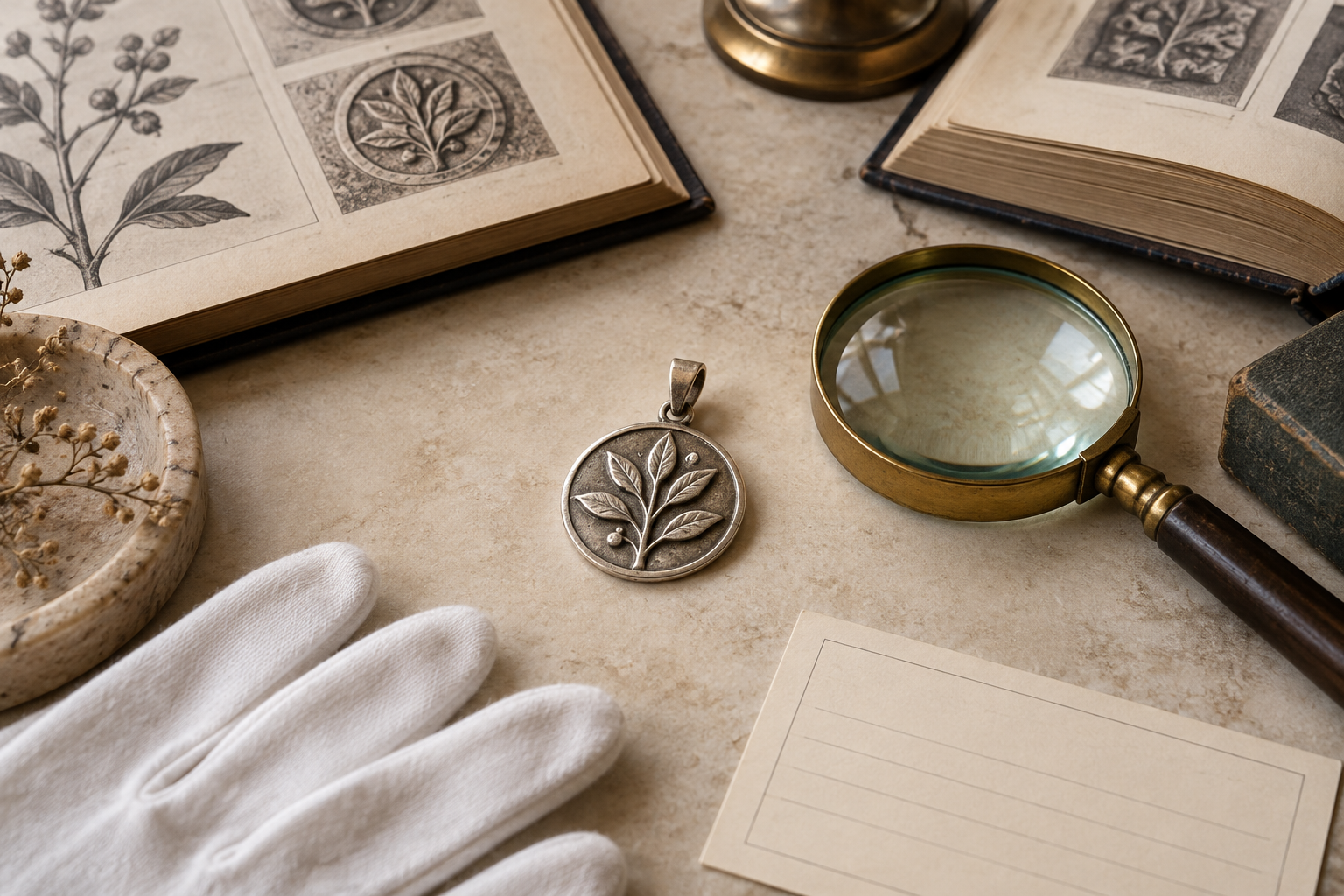
Begin by describing what is actually visible. Note the type of object, metal, stones, colors, construction, condition, dimensions, fastenings, inscriptions, hallmarks, and every figurative element. If the design resembles an eye, tree, serpent, flower, hand, star, or cross, record that observation without immediately deciding what the image means. A description such as “blue-and-white concentric eye motif in a silver pendant” is more useful than “protective amulet” at this stage because the first statement is observable and the second requires evidence.
The U.S. National Archives’ artifact-analysis method follows the same discipline. It asks researchers to identify materials and physical qualities before considering use, maker, owner, place, period, and what the object may reveal about its society. That order helps prevent a familiar-looking modern design from being projected onto an older or culturally different object (U.S. National Archives and Records Administration).
Photograph the front, back, edges, clasp, and any marks in clear light. Transcribe inscriptions exactly, including characters you do not recognize. Record what is missing or uncertain. If you are working only from an online image, state that limitation: scale, weight, hidden marks, restorations, and material tests may not be available.
2. Establish date, place, maker, materials, and use
Meaning depends on context. The same shape may function as a religious sign, an amulet, a family emblem, a fashionable revival, a maker’s logo, or a purely decorative pattern in different settings. Look for a documented date or date range, geographic origin, maker or workshop, materials, technique, original owner, findspot, and intended use. Treat a retailer’s current product description as evidence of modern marketing, not proof of an ancient belief.
Start with the collection record for the particular object whenever possible. Major museums commonly provide an accession number, title, culture or place, date, medium, dimensions, credit line, and bibliography. Search the accession number as well as the object title because titles and interpretations can change. A museum attribution may use words such as “probably,” “possibly,” or “formerly attributed”; preserve those qualifications instead of converting them into certainty.
Provenance—the documented history of an object’s ownership and movement—can clarify when an interpretation entered the record and whether the object has been removed from its original setting. The Metropolitan Museum of Art describes provenance research as an ongoing process that may involve archives, scientific analysis, scholars, communities, museums, and other institutions. It also notes that records can be updated when new evidence appears. A responsible article therefore gives the best supported conclusion available while remaining open to revision (The Metropolitan Museum of Art).
3. Build a source ladder and compare the evidence
Use sources according to the claim you need to support. For an individual jewel, begin with the holding museum’s object record and linked bibliography. For cultural or religious context, look for scholarship from museums, universities, archaeological publications, cultural institutions, or recognized reference works. For materials and techniques, conservation departments and professional bodies may be especially useful. A search result, social post, marketplace listing, or unsourced blog can suggest a question, but it should not establish a historical fact.
One source is rarely enough for a broad statement. Compare records from independent institutions and note where they agree, differ, or address different periods. The Library of Congress primary-source framework moves among observation, reflection, and questioning, then calls for further investigation. Its advanced guidance encourages comparing a series of sources and revising conclusions as additional evidence is considered (Library of Congress).
Keep a simple claim map while researching. Write each proposed statement in one column and list the sources that directly support it in another. Mark whether the support comes from the object itself, a primary document, a museum interpretation, or later scholarship. If no dependable source supports a claim, remove it or label it clearly as a modern interpretation. This method is more reliable than collecting many links that never connect to the article’s actual statements.
4. Check iconography, terminology, and uncertainty
Iconography is the study and classification of subjects and symbolic content in images. Search both everyday terms and the vocabulary used by museums. A “tree of life,” for example, may be catalogued more broadly as a sacred tree, vegetal motif, world tree, or stylized plant depending on the object and tradition. Controlled vocabularies help reveal related records without assuming that all results express the same belief.
The Getty Research Institute’s guidance for cultural-object records distinguishes broad subject description from specific iconography and provides ways to record context and uncertainty. Its model includes qualifiers for interpretations that are probable or formerly accepted, which is a useful editorial lesson: uncertainty is information, not a defect to hide (Getty Research Institute).
Pay close attention to transliteration and translation. A familiar English name may group several distinct regional terms, while similar-looking signs may have different origins. Record the original term when a dependable source supplies it, explain the specific culture and period, and avoid combining separate traditions into an invented universal story. Quotations and translations should be traceable to their source.
5. Separate historical evidence from modern jewelry meanings
A modern jewel can have a sincere personal meaning even when that meaning is not historically documented. The important task is to label the layers. “This motif was used in this place and period” is a historical claim. “Today it is often chosen to represent resilience” describes contemporary use and needs contemporary evidence. “For me it represents my family” is a personal interpretation and does not need to be presented as ancient tradition.
The Victoria and Albert Museum’s overview of jewelry history demonstrates why period and context matter. It describes jewelry functioning as adornment, protection, rank, devotion, remembrance, fashion, and artistic expression across different eras. It also shows that materials, techniques, trade, social hierarchy, and revival styles shaped how designs were made and understood. These examples do not create a universal dictionary; they show that jewelry meaning changes with use and historical setting (Victoria and Albert Museum).
Be especially cautious with claims that a symbol has meant exactly the same thing “for thousands of years,” that an entire civilization shared one interpretation, or that wearing a design guarantees protection, healing, luck, or another outcome. Such statements often compress different objects, centuries, and communities into a marketable story. If the evidence supports only a narrower conclusion, write the narrower conclusion.
6. Use a repeatable research checklist
For each symbol, complete the same sequence: describe the object; photograph or save the collection record; identify date, place, maker, materials, technique, and use; search museum catalogues with alternate terms; read the cited scholarship; compare at least two independent authoritative sources; map each factual claim to evidence; separate historical, contemporary, and personal meanings; preserve uncertainty; and record the date on which every online source was checked.
Finish with an editorial review. Ask whether the article names cultures and periods precisely, whether every historical claim has nearby support, whether a source actually says what the sentence claims, and whether modern commerce has been mistaken for historical evidence. Check that links point to stable institutional pages and that image rights are documented separately from the factual research.
This process will not always produce a single answer. Sometimes the most accurate result is that several interpretations exist, the original use is uncertain, or a popular modern meaning cannot yet be traced to historical evidence. Saying so gives the reader a more useful and trustworthy guide than presenting an attractive story as settled fact.
Frequently asked questions
Where should I start when researching a jewelry symbol?
Start with the specific object. Describe its visible motif, materials, construction, inscriptions, and marks before assigning meaning. Then identify its documented date, place, maker, use, and provenance, and compare the object record with independent institutional or scholarly sources.
Are marketplace listings reliable sources for symbol history?
Marketplace descriptions can show how a symbol is marketed today, but they are not sufficient evidence for historical claims. Use museum collection records, academic publications, cultural institutions, and other authoritative references to establish origin, context, and documented use.
Can one jewelry symbol have several meanings?
Yes. Similar motifs may appear in different periods and cultures, and a modern wearer may give a design a personal meaning. A careful explanation identifies each context separately instead of presenting one interpretation as universal.
What should I do when sources disagree?
Record the disagreement, compare the date and expertise of each source, look for the evidence behind each interpretation, and preserve uncertainty in the final wording. A qualified conclusion is more accurate than choosing the most appealing claim.
Sources and further reading
- Analyze an Artifact or Object — U.S. National Archives and Records Administration
- Teacher's Guides and Analysis Tool — Library of Congress
- Depicted Subject, Iconography Authority — Getty Research Institute
- A history of jewellery — Victoria and Albert Museum
- About The Met's Collecting Practices — The Metropolitan Museum of Art