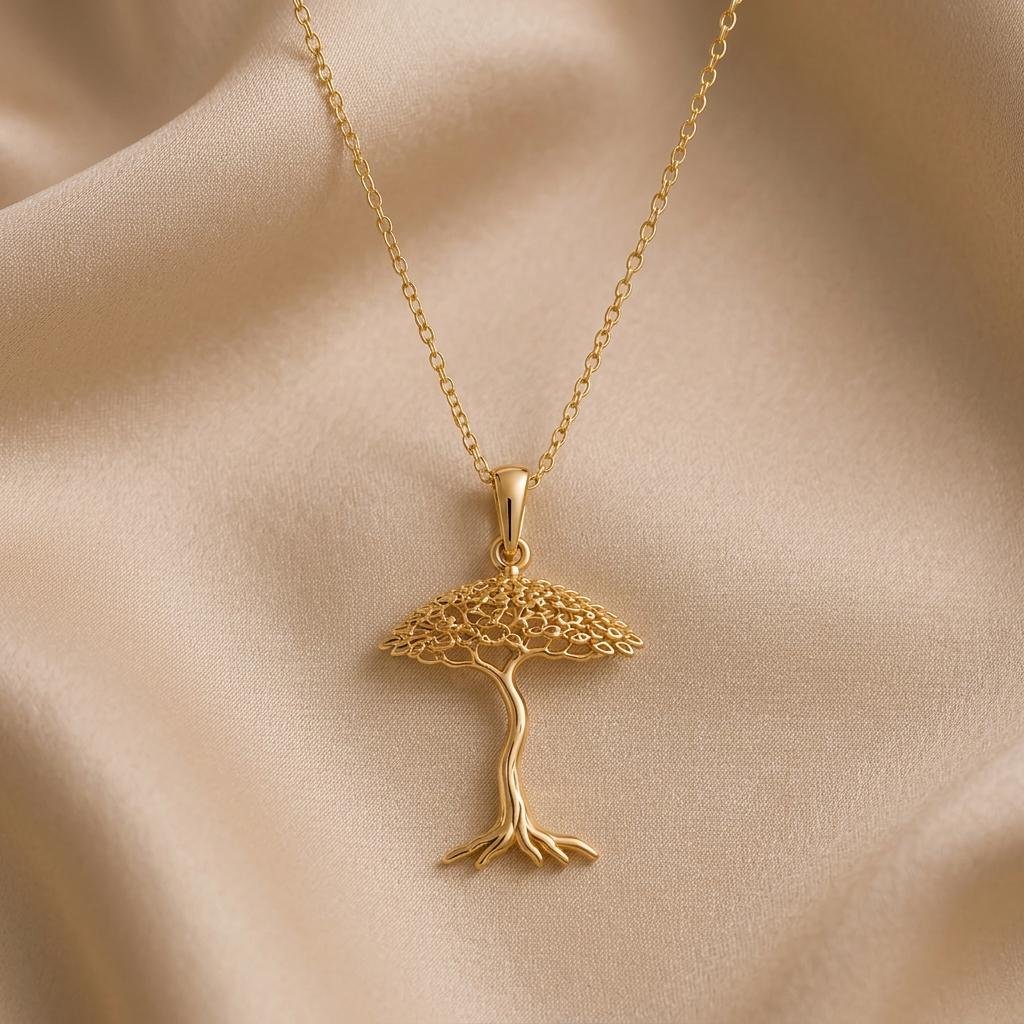
Meaning at a glance
Tree of Life jewelry commonly represents connection, continuity, growth, and renewal, but its precise meaning depends on the cultural tradition and the intention of the wearer.
Quick answer
Tree of Life jewelry commonly symbolizes connection, continuity, growth, and renewal, but it is not a single, fixed meaning across time or cultures. The motif appears in many traditions with different emphases; any modern wearer’s meaning often combines historical associations with personal intention.
What the historical record actually shows
The archetype of a sacred or symbolic tree appears across widely separated cultures and media. For example, the Metropolitan Museum of Art documents a textile fragment that features facing pairs of birds flanking a tree-of-life motif, showing the motif’s use in decorative and possibly symbolic textiles in the broader Iran/Islamic/Byzantine Mediterranean sphere. This demonstrates that tree imagery was an established decorative and narrative device in that material and region (The Metropolitan Museum of Art).
The British Museum holds an example catalogued as a necklace or amulet (Eu1971,01.313) that incorporates a tree motif, showing that the image was used in portable, wearable objects as an amulet or ornament in some medieval Balkan contexts (The British Museum).
In the ancient Near East, palace reliefs and monumental sculpture show a stylized 'sacred tree' used in royal and religious contexts. Smarthistory highlights the Neo-Assyrian reliefs—where pairs of protective figures appear beside a stylized tree—indicating that a tree motif played a role in visual programs that associated kings, deities, or divine protection with ordered, life-giving imagery (Smarthistory).
Northern Europe provides another documented tradition: the Norse concept of Yggdrasil, the great world-tree that connects multiple realms, is discussed in reference works as a central cosmological image in Norse myth, later influencing visual motifs described as world-tree imagery (World History Encyclopedia).
These museum and reference records document that tree imagery appears in textiles, amulets, palace reliefs, and mythic narrative across different times and places. They do not, however, establish a single universal meaning; each instance must be read in its cultural and chronological context (Metropolitan Museum of Art; The British Museum; Smarthistory; World History Encyclopedia).
Historical meanings versus modern interpretations
Documented historical meanings: museum and academic sources show that tree imagery could be part of religious, royal, protective, or cosmological programs. For example, the Neo-Assyrian palace relief context suggests an association with divine order and protection in an imperial setting (Smarthistory). The presence of a tree motif on a wearable amulet in the British Museum’s collection indicates use in personal, protective, or identity-related contexts for that object (The British Museum). The Met’s textile record demonstrates the motif’s decorative and likely narrative use in a Mediterranean-Islamic-Byzantine textile medium (The Metropolitan Museum of Art). The Norse world-tree framed the cosmos in myth rather than serving as a personal amulet in the same way (World History Encyclopedia).
Modern personal interpretations: contemporary wearers often choose tree of life jewelry to express ideas such as family ties, personal growth, resilience, rootedness, renewal, or ecological concern. These modern meanings draw on, adapt, or generalize historical themes of life, protection, and cosmic order, but they are personal, situated, and variable. It is important to treat modern meanings as contemporary uses and intentions that may be inspired by historical motifs rather than direct continuations of a single ancient belief.
How the tree-of-life motif and related traditions appear in jewelry
Design languages: jewelers use the tree motif in many ways—linear silhouettes of trunks and branches, circular 'life-wheel' frames, hammered or filigree branches, and stylized roots. Historically attested wearable examples (for instance the British Museum amulet) show that the motif has long been adapted to pendants and amulets, and modern craft continues to translate the motif into pendants, rings, earrings, and charms (The British Museum).
Materials and techniques: historically, tree motifs appear in textiles, stone reliefs, and metalwork; in jewelry the motif can be rendered in precious metals (gold, silver), base metals, or combined with inlays and enamel. Modern makers also set gemstones—green stones such as peridot or emerald, or any colored gem the maker or wearer prefers—to echo leaves or fruit. Note: the choice of gemstone for symbolic color is a modern design decision and not an assertion that any historical culture universally paired a specific gem with tree imagery.
Iconography variety: some designs emphasize roots and branches equally (to suggest balance or continuity), others focus on branching upward (growth) or on symmetrical, stylized 'sacred tree' imagery that recalls ancient reliefs and textile patterns. Northern 'world-tree' references tend to emphasize verticality and cosmic connection in jewelry inspired by Norse myth (World History Encyclopedia).
Wearability and function: tree motifs have served as amuletic objects historically and are widely worn today as expressions of identity, family, spiritual outlook, or aesthetic preference. The Met’s textile and the British Museum’s necklace show that the motif has been portable and portable-adaptable for a long time (The Metropolitan Museum of Art; The British Museum).
Practical, respectful guidance for choosing or gifting tree of life jewelry
Start with the recipient’s context and preferences: ask whether the wearer values explicit cultural or mythic symbolism, prefers purely decorative pieces, or would like a design tied to family meaning (e.g., a pendant with birthstone 'leaves').
Be culturally respectful: if a design is explicitly linked to a culture’s sacred imagery (for example, a piece that uses Norse mythic motifs or those closely modeled on identifiable objects in museum collections), consider whether the recipient appreciates culturally specific symbolism. When in doubt, choose neutral or clearly contemporary styles rather than appropriative reproductions of sacred artifacts. If you are buying or gifting a piece tied to a living tradition, learning and sharing the correct cultural context shows respect.
Consider materials and wearability: take into account metal allergies, the recipient’s everyday dress style, and activity level. For daily wear choose durable settings and metals; for occasional wear, a more delicate design may be fine. If gemstones are included for symbolic color, discuss ethical sourcing if that is important to the recipient.
Personalize thoughtfully: engraving a short message that clarifies your intended meaning (e.g., 'For growth & new beginnings' or a family name) reduces the chance that the recipient misreads your intent. Selecting a design element—roots for grounding, many small branches for a growing family, a circular frame for continuity—lets you tailor symbolism without claiming historic authority.
Budget and provenance: set a comfortable budget and, when possible, ask for information about the maker, country of origin, and materials. If provenance or historical accuracy matters (for example, if you seek a piece inspired by a museum object), consult museum descriptions or maker notes to avoid misattribution.
Frequently asked questions
What does tree of life jewelry mean?
Tree of life jewelry commonly symbolizes connection, continuity, growth, and renewal. Historical sources show multiple cultural meanings, so the precise sense of a piece depends on its cultural reference and the wearer’s personal intent (The Metropolitan Museum of Art; The British Museum; Smarthistory; World History Encyclopedia).
Is tree of life jewelry religious?
Sometimes. In some cultures the tree motif is part of religious or cosmological imagery (for example, Norse mythic conceptions of a world-tree), while in others it appears in decorative or protective contexts. Whether a contemporary piece is religious depends on its design and the wearer’s intention.
How do I choose a respectful tree of life gift?
Ask about the recipient’s preferences, avoid claiming sacred or cultural authority for a contemporary decorative piece, prefer makers who disclose provenance or cultural background when a design references a living tradition, and personalize the piece (engraving, birthstones) to clarify your intended meaning.
Sources and further reading
- Textile Fragment with Facing Pairs of Birds Flanking a Tree of Life — The Metropolitan Museum of Art
- Necklace; amulet (Eu1971,01.313) — The British Museum
- Lamassu from the citadel of Sargon II — Smarthistory
- Norse-Viking Symbols & Meanings — World History Encyclopedia