Meaning at a glance
This article explains the documented history and changing contexts of the cross motif, separates cultural and religious evidence from later popular interpretations, and offers practical guidance for selecting and wearing cross jewelry today.
Historical evidence and where it comes from
Museum collections and exhibitions provide the primary documentary evidence that cross forms have been used in jewelry for many centuries. The Metropolitan Museum of Art's collection, for example, includes objects such as a brooch incorporating a Greek cross form; that object is an instance of a cross appearing in a wearable ornament and is recorded in the Met’s online catalogue as a specific historical object. This is an example of the material evidence that a cross motif was incorporated into personal adornment in the past.
The Victoria and Albert Museum frames jewelry within changing social and cultural contexts in its exhibition materials; the museum’s work emphasizes that motifs, including crosses, acquire different meanings as fashion, religion, patronage, and technology change. Use of the cross in jewelry cannot be treated as originating in a single moment or culture; instead museum scholarship shows that cross motifs reappear across periods with different local meanings tied to devotion, status, commemoration, or decorative fashion, depending on time and place.
Identifying cultures and periods precisely
In late antiquity and the early medieval period, Christian communities adopted cross imagery as a visible sign of faith, and archaeological finds and museum collections document crosses in small-scale personal objects from some of these periods. The Metropolitan Museum record for a brooch with a Greek cross provides a concrete example from an archaeological or art-historical context where the cross was integrated into wearable forms.
During the later Middle Ages and into the Renaissance, crosses were common as devotional jewelry, sometimes enclosing relics or functioning as pectoral crosses for clergy and laity; museums such as the V&A discuss these shifts in function and taste as part of broader changes in jewelry’s social role. From the 18th century onward, cross motifs continued to appear but often entered secular fashion cycles, ornamented with gemstones or used as sentimental motifs rather than solely as public confessions of faith.
Documented historical meanings versus modern personal interpretations
Documented historical meanings are tied to the contexts in which an object was made and used. When a cross-shaped pendant is found in an archaeological context dated to a Christian community, or when museum documentation identifies a cross brooch as part of devotional dress, those attributions are evidence-based and reflect the cultural and religious associations of that time and place. The Metropolitan Museum and similar collections provide object-level description that supports these historically specific readings.
Modern personal interpretations are diverse and not the same as the original, documented meanings. Today people wear crosses for explicit religious devotion, as family or heritage symbols, as fashion statements, or as personal talismans. These contemporary uses are legitimate expressions of individual identity and style, but they are modern meanings layered onto a motif that had different functions in earlier periods. The Victoria and Albert Museum’s framing of jewelry as socially conditional helps explain why the same motif can mean devotion in one era and fashion in another.
How the cross motif, gemstones, and traditions appear in jewelry
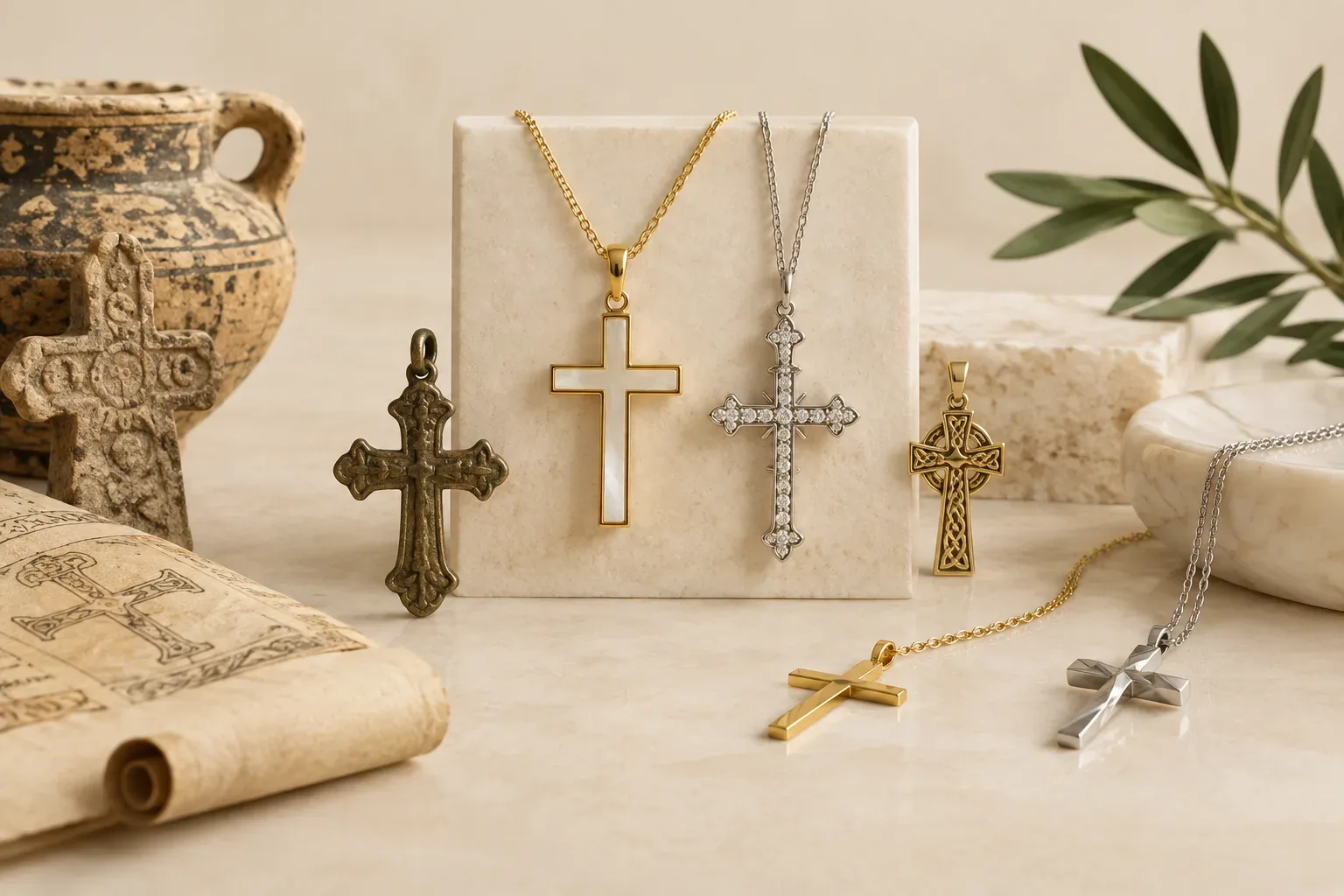
Across museum collections and modern catalogs, the cross appears in multiple jewelry types: brooches, pendants, rings, earrings, and larger ecclesiastical pieces. In the historical record, the form of a cross can range from simple linear crosses to complex, gem-studded reliquary crosses; surviving pieces in museums show that artisans adapted the motif to prevailing techniques and tastes of their period and region, as noted in the V&A’s discussions of jewelry history and social context.
Gemstones and treatments are commonly used to ornament cross jewelry. In modern commerce a buyer may encounter natural stones, treated stones, simulants, or manufactured composites. The Federal Trade Commission provides guidance on buying gemstones, diamonds, and pearls and stresses that sellers should disclose treatments, enhancements, or imitations so buyers can understand what they are purchasing. This applies to gemstone-studded crosses as well as any jewelry where the stone’s identity, origin, or treatment affects value and meaning.
Practical and respectful guidance for selection or gifting
When choosing or gifting a cross, clarify whether the intended meaning is religious, cultural, sentimental, or purely aesthetic. If the gift is meant to mark a religious milestone—such as baptism, confirmation, or ordination—select styles and materials appropriate to the recipient’s faith tradition and ask discreetly about any denominational preferences. For a secular gift, choose a design that respects the cross as a symbol without assuming the recipient’s beliefs.
Consider scale and context. A small pendant worn close to the heart is a conventional gift for personal commemoration; a larger, elaborate cross may be appropriate for a formal religious occasion or for someone who appreciates historical or statement pieces. Match the metal and finish to the recipient’s usual jewelry—gold or silver tones, polished or oxidized surfaces—to increase the likelihood it will be worn.
If the piece includes gemstones, ask the seller about the stones and any treatments or imitations and request written disclosure. The Federal Trade Commission advises that accurate information about gemstone treatments and imitations is important for informed purchases. For high-value or antique pieces, consider asking for provenance or a professional appraisal if authenticity or historical significance is a concern.
When gifting across cultures or faiths, be mindful that the cross can carry sacred meaning for many people. Framing the gift with a respectful note that acknowledges its significance and your intentions can prevent misunderstandings and show care for the recipient’s values.
Caring for cross jewelry and avoiding common pitfalls
Care for cross jewelry as you would any comparable precious-metal or gemstone piece, accounting for the specific materials used. Historic and museum examples often survive because they were valued and repaired; modern custodial care—gentle cleaning, appropriate storage, and professional servicing when needed—helps preserve both appearance and structural integrity. When a piece contains fragile enamels, stones set with historic techniques, or glued components, professional advice is recommended.
When buying, watch for unclear descriptions. The FTC guidance highlights the importance of clear disclosure about treatments and imitations. If a seller cannot or will not disclose stone treatments or metal purity, seek another source. For antique crosses, ask for documentation from reputable dealers or institutions, and use conservators or experienced appraisers to confirm condition and authenticity where relevant.
Final considerations: respectful wearing and interpretation
Wearing a cross in public can communicate multiple things—faith, family memory, fashion sensibility, or historical interest—but those communicative effects depend on the viewer’s assumptions and the wearer’s intent. Because the historical record, as represented in museum collections, shows cross jewelry used in religious and secular ways, contemporary wearers should be conscious that others may read the symbol differently.
If you want a piece that explicitly reflects historical practice—such as a reproduction medieval reliquary cross or a historically styled brooch—check museum references and reputable reproductions for design accuracy. The Victoria and Albert Museum and collections like the Metropolitan Museum provide object examples that help identify historically grounded designs for those seeking informed reproductions or historically inspired pieces.
Frequently asked questions
Does a cross necklace always mean the wearer is Christian?
No. While crosses have long been used as Christian devotional symbols in many historical contexts, modern wearers may choose a cross for reasons of family heritage, fashion, memory, or personal symbolism. Museum records indicate historical Christian uses, but contemporary meanings are diverse and personal.
How can I tell if the gemstones in a cross are genuine or treated?
Ask the seller for written disclosure about the stone’s identity and any treatments or enhancements. The Federal Trade Commission recommends clear disclosure for gemstones, diamonds, and pearls, and reputable dealers will provide details or certification on request.
Is it appropriate to give a cross as a gift to someone of a different faith?
Gifting a cross across faiths requires sensitivity. Clarify your intention and, when possible, ask about the recipient’s preferences indirectly. If the recipient is not Christian, consider explaining the personal or aesthetic reason for the gift to avoid presuming their beliefs.
Where can I find historically accurate cross designs for study or reproduction?
Museum collections and catalogues are good starting points. Institutions such as the Victoria and Albert Museum and the Metropolitan Museum of Art document objects and provide context that helps identify period-accurate designs and construction methods.
Sources and further reading
- Bedazzled: A History of Jewellery — Victoria and Albert Museum
- Brooch with Greek Cross — The Metropolitan Museum of Art
- Buying Gemstones, Diamonds, and Pearls — Federal Trade Commission