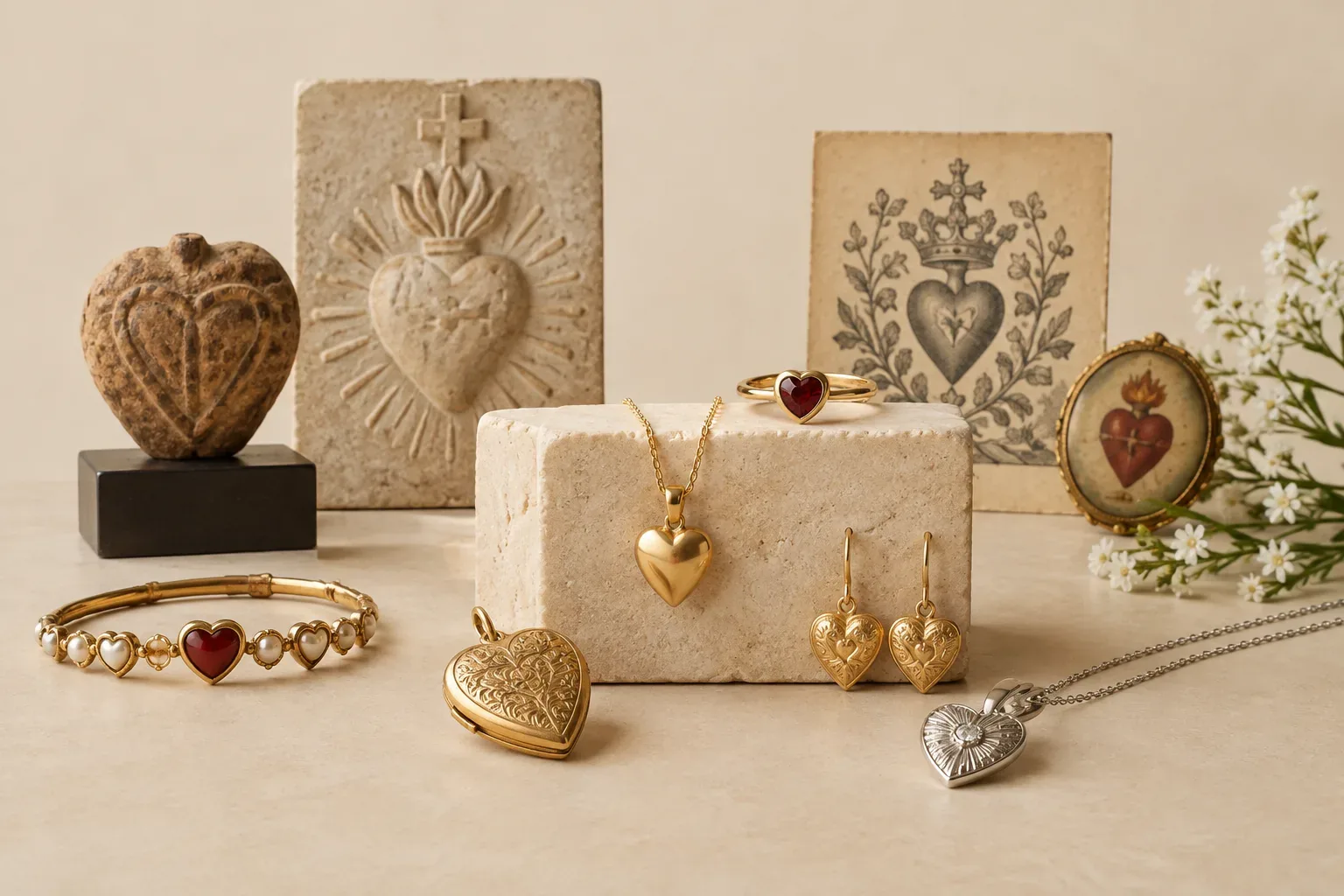
Meaning at a glance
Heart jewelry meaning is rooted in changing cultural and social contexts: museums and jewellery histories document the motif used for devotion, memory, social identification and sentiment; modern wear adds personal and fashion-related interpretations. Choose pieces with attention to documented context, material transparency, and the recipient’s values.
What historical evidence tells us
Museums and major collections trace the heart motif through many changing social and aesthetic contexts rather than a single, continuous symbolic meaning. The Victoria and Albert Museum describes how jewellery forms and motifs—including hearts—acquire different associations as they move between devotional objects, social tokens and fashionable accessories, and it uses historical objects to illustrate those shifts. Usefully, museum narratives emphasise provenance and object function rather than assuming a single, universal symbolic meaning (Victoria and Albert Museum).
Specific object-based studies such as the V&A’s article on brooches document instances in which a heart motif appears alongside other symbols in identifiable social practices. For example, curated brooches placed in bridal or bridesmaid contexts demonstrate how a heart design could be read as a sign of affiliation or sentiment within a particular ceremony or social group rather than as a universal emblem of romantic love (Victoria and Albert Museum).
Those museum records are valuable because they refer to surviving objects, maker marks, provenance records and documented uses. They show that the heart shape has been adapted by makers to suit materials, techniques and functions—pendants, brooches, lockets and rings—and that meanings change according to who commissioned, wore, and displayed the piece (Victoria and Albert Museum).
Documented historical meanings versus modern personal interpretations
Documented historical meanings are tied to how objects were used and recorded. Museums and curatorial research show hearts acting as tokens of devotion, markers of social membership, keepsakes for memory and mourning, or fashionable motifs. Those meanings are grounded in the surviving objects, contemporary inventories, inscriptions and the contexts in which items were worn or given (Victoria and Albert Museum).
Modern personal interpretations are diverse and often layered on top of earlier uses. Today a heart pendant can signify romantic love, platonic affection, self-care, identity, or simply an aesthetic preference. These personal meanings are valid for the wearer but should not be conflated with a single historical meaning: a heart in a museum inventory may have been a devotional badge or wedding token rather than a romantic emblem as modern audiences might assume (Victoria and Albert Museum).
Separating the two means checking provenance and context when possible, and remembering that contemporary marketing and jewellery design frequently repurpose historical motifs for new stories and functions.
How the heart motif and related traditions appear in jewellery
Form and technique shape how the heart appears: as openwork pierced hearts, engraved or repoussé silhouettes, sheet-metal appliqué, gem-set pendants, or as the front of lockets and reliquaries. Curated collections show hearts incorporated into brooches, pendants and rings where the maker’s technique, the metal and the presence of inscriptions or portraits informs likely function and meaning (Victoria and Albert Museum).
Gemstones, enamelling and engraving are common ways makers enriched the motif. Gem settings can be purely decorative or intentional: a stone added to a heart pendant might mark value and prestige, or be chosen for personal reasons such as a birthstone. Museums document such material choices as part of an object’s social history rather than as fixed symbolic rules (Victoria and Albert Museum).
The tradition of lockets and concealed compartments has been an important way to literalize the idea of ‘holding someone close to the heart.’ Museum narratives about sentimental jewellery emphasise that the form—an opening pendant or compartment for hair, a miniature portrait or a written note—affects interpretation because the object’s use is often recorded in inventories, wills or contemporary descriptions (Victoria and Albert Museum).
Choosing, wearing, and gifting heart jewellery—practical guidance
Start with context and relationship. Match the piece to the occasion and the relationship: a delicate heart pendant may be a suitable token between close partners; a simple heart brooch can be an elegant gift for a friend or family member; a historic or antique heart piece may carry layers of meaning that are appropriate for memorial or commemorative gifts. Think about whether the recipient prefers overt symbolism or a subtler reference.
Consider materials and durability. Choose metals and settings suitable for the recipient’s lifestyle and any metal sensitivities. If a gemstone or imitation is important to the gift’s meaning, ask about origin and treatment. The Federal Trade Commission recommends that sellers disclose treatments, imitations, and the nature of gemstone enhancements, so buyers should request that information before purchase and keep documentation (Federal Trade Commission).
Respect cultural and commemorative associations. In some contexts, heart motifs are linked to religious devotion, mourning or specific community traditions. If you are gifting a piece from another culture or with evident historical associations, take time to learn its documented meaning and avoid assuming contemporary romantic intent. Museums show how easily meanings can change; a considerate gift-giver will research or ask before attributing a single symbolic interpretation (Victoria and Albert Museum).
Personalise thoughtfully. Engravings, inscriptions, birthstones or paired motifs can make a heart piece more meaningful. A locket with a small photograph or a discreet engraved date will steer the receiver toward an intended reading. If privacy matters, choose a design that allows a private inscription or compartment rather than public signage.
Verify authenticity and claims. Ask the seller for hallmark information, gemstone reports where relevant, and any disclosures about treatments or imitations. The FTC offers consumer guidance on buying gemstones, diamonds and pearls, including disclosure expectations for treated or synthetic stones (Federal Trade Commission). Keep written receipts and any certificates as part of the gift.
Wearing and caring for heart jewellery
Match the scale and placement to your wardrobe and the piece’s significance. Small heart pendants layer easily for everyday wear; larger brooches and statement rings read more publicly. Consider how often the recipient will wear the item and select practical closures and settings for frequent use.
Care depends on materials. Follow maker or seller instructions, avoid exposure to chemicals and humidity where possible, and have settings professionally checked if gemstones are present. For purchases where material transparency matters, use documentation from the seller and follow recommended conservation or cleaning methods when caring for vintage or antique heart pieces (Victoria and Albert Museum).
Final thoughts
Heart jewellery meaning is not fixed. Museums show that the motif’s significance is shaped by time, place, use and the people connected to an object. Today’s personal meanings are legitimate and meaningful to wearers, but they rest alongside a documented history of varied uses. When selecting or gifting heart jewellery, respect documented contexts, ask about materials and treatments, and choose a form that suits the relationship and occasion.
Frequently asked questions
What does heart jewelry traditionally mean?
Traditionally, heart jewellery has carried meanings tied to how it was used: tokens of devotion, keepsakes for memory, or social markers within particular ceremonies or groups. Museums document these meanings through surviving objects and their contexts, and curators caution against assuming a single universal meaning.
Is a heart pendant always a romantic gift?
No. A heart pendant can signify romantic love in many modern contexts, but it has also been used historically for friendship, family ties, memorial purposes, or simply as decorative ornament. Consider the relationship, cultural context and the recipient’s preferences before assuming romantic intent.
How can I be sure a gemstone in heart jewellery is genuine or untreated?
Ask the seller for written details about the gem, including any treatment disclosures and certification. The Federal Trade Commission recommends that buyers request full disclosure for treatments, synthetics or imitations when purchasing gemstones, diamonds and pearls.
Are there cultural sensitivities to be aware of when gifting heart jewellery?
Yes. Heart motifs may be associated with specific religious, memorial or community traditions in some cultures. If the piece is historic or clearly linked to a cultural practice, learn its documented meaning first and choose a gift that respects that background rather than imposing a new symbolic reading.
What is a meaningful way to personalise a heart piece?
Consider discreet inscriptions, a locket compartment with a small keepsake, or a birthstone chosen for the recipient. Personalisation that reflects a shared memory or a private sentiment tends to feel thoughtful and enduring.
How should I care for vintage or antique heart jewellery?
Follow professional conservation advice when possible. Have settings checked before wearing, avoid harsh chemicals and moisture, and keep documentation of provenance. Museums and curators emphasise careful handling for objects with historical value.
Sources and further reading
- Bedazzled: A History of Jewellery — Victoria and Albert Museum
- Brooches for bridesmaids — Victoria and Albert Museum
- Buying Gemstones, Diamonds, and Pearls — Federal Trade Commission