Meaning at a glance
This article explains documented evidence for the angel wing motif in jewelry, distinguishes historical uses from modern personal meanings, and offers practical selection and gifting guidance.
Quick answer
Historically, wing and feather motifs have appeared across many periods and cultural contexts as decorative or symbolic elements in jewelry; modern "angel wing" jewelry blends these visual traditions with contemporary spiritual and memorial meanings. This article explains the recorded historical contexts identified by museum scholarship, separates those documented uses from later personal or popular interpretations, and offers practical guidance for choosing and gifting angel wing pieces today.
What the historical evidence shows
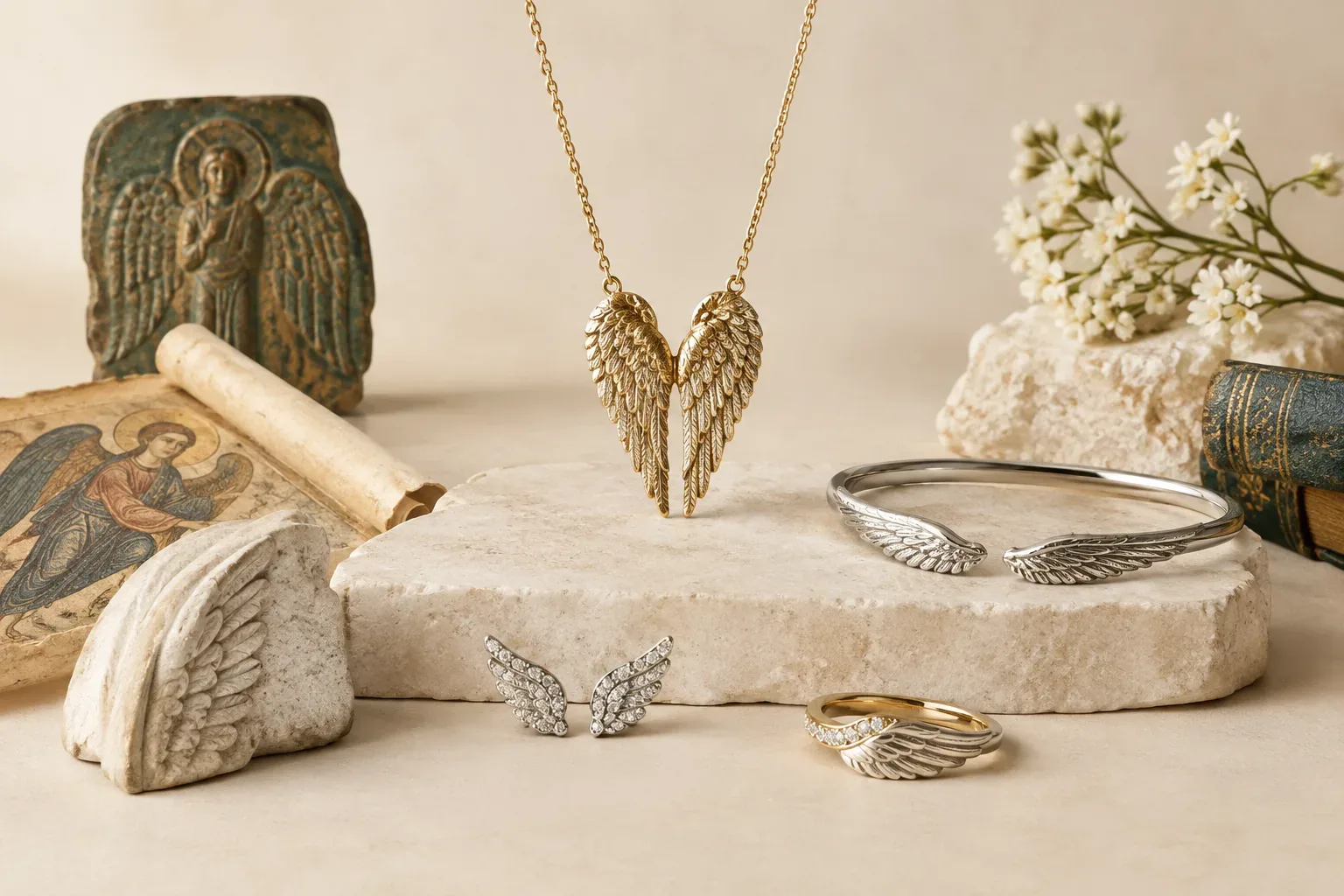
Museum scholarship places wing and feather imagery into a broad, long-lived visual vocabulary used in jewellery-making and related arts. The Victoria and Albert Museum describes how motifs and materials in jewellery change with social context, and how motifs move between functional ornament, religious symbolism, and sentimental fashion. Winged forms and feather patterns can be found in artifacts associated with ancient Egyptian and Classical Mediterranean art, in medieval Christian iconography, and again in later European decorative and mourning jewellery, each time with different local meanings and uses rather than a single, continuous meaning.
Identifying cultures and periods precisely
In museum collections and catalogues the V&A traces continuity and change rather than one fixed story: winged or feathered motifs are visually present in some ancient Egyptian and Greco-Roman objects, where wings could be part of deities or decorative friezes; in medieval Christian art wings became associated with angels and spiritual intermediaries; and in nineteenth-century Britain winged motifs were incorporated into sentimental and mourning jewellery as part of a broader fashion for symbolic ornament. The Victoria and Albert Museum frames these developments as shifts in social meaning and material practice rather than as evidence of a single transhistorical "angel wing" symbol.
Documented historical meanings versus modern personal interpretations
The documented meanings are those attached to wing imagery in specific historical contexts by makers, patrons, or commentators. For example, in medieval Christian art a wing indicated an angelic being within a theological and liturgical framework; in Victorian sentimental jewellery, motifs such as feathers, wings, and lockets often related to memory, mourning, and social display, as described by museum accounts of jewellery history. These are historically grounded readings recorded by curators and scholars.
Modern uses and personal interpretations are often layered on top of those histories. Contemporary wearers commonly choose angel wing jewellery to express ideas of protection, remembrance of a deceased person, a sense of spiritual guidance, or simply for aesthetic preference. Those modern meanings are valid as personal or cultural expressions, but they are not the only or necessarily the historically original meanings of wing imagery. It is accurate to say that today’s "angel wing" jewelry is frequently a hybrid: a visual form with antecedents in historical ornament that people now read through contemporary spiritual, memorial, or fashion lenses.
How the motif, gemstones, and traditions appear in jewelry
The wing motif appears in wearable forms ranging from small charms and pendants to elaborate brooches and mourning pieces. Designers render wings realistically with feather detailing or stylise them into abstract shapes that reference flight and uplift. In wearable objects the wing can be combined with other motifs—hearts, crosses, lockets, or stars—each combination changing the work’s emphasis toward affinity, faith, or memory.
Gemstones are brought into angel wing designs for color, material prestige, or symbolic associations. Museum resources on gemstones explain how particular gems have been valued and used across periods; for example, purple stones like amethyst have long histories of use in jewellery and are often chosen today for their color and supposed calming associations. Commercial and historic pieces alike use settings and stones to add personal or visual meaning to the wing motif, but the specific symbolic weight of any stone in a contemporary piece is usually a modern assignment rather than a fixed historical code.
Material concerns, disclosure, and authenticity
When selecting angel wing jewellery it is useful to know the basics of material disclosure. The Federal Trade Commission provides guidance for consumers on buying gemstones, diamonds, and pearls and on the importance of accurate disclosure about treatments, synthetic stones, and imitations. Sellers should state whether a gemstone has been heat-treated, dyed, or is lab-made, and whether metal is plated versus solid. Those facts affect value, long-term wear, and care requirements and are part of making an informed purchase.
Practical and respectful selection or gifting guidance
Decide first whether the piece is intended as a fashion accessory, a spiritual token, or a memorial object. A brightly finished, stylised wing pendant may be best for everyday fashion, while a subdued, simple wing locket or a piece that accommodates a photo, inscription, or hair might suit memorial purposes. If gifting to someone for comfort after loss, choose modest, non-prescriptive wording and respect the recipient’s beliefs; an open-ended inscription like "in memory" is often more appropriate than explicitly religious phrases unless you know the recipient’s preference.
Consider materials, budget, and lifestyle. Solid precious metals and securely set stones suit daily wear better than plated pieces for longevity. If you are buying a gemstone, ask the seller about any treatments or lab origins because these affect care and resale. For heirloom intentions, choose classic designs and higher-quality materials, and consider adding a small inscription or date to mark the gift’s intent. If the piece will carry deep personal meaning, allow the recipient to participate in choosing metal, stone, or engraving whenever possible.
Styling, care, and ethical notes
Angel wing jewellery works at many scales: small charms layer well with other necklaces; larger pendants stand alone. A wing combined with a locket can emphasize memory, while a simple open-wing silhouette reads as a contemporary emblem of uplift. Match proportions to neckline and overall wardrobe for a harmonious look.
To care for wings that incorporate gemstones or delicate filigree, follow the manufacturer’s instructions and standard care guidelines. Store pieces away from chemicals and excessive moisture and have precious stones and settings checked by a jeweller if worn daily. When buying, ask about sourcing and treatment disclosures so you can make an ethically informed choice.
Final note
Museum scholarship emphasises that motifs travel across time and are reinterpreted in different social and material contexts. The angel wing in modern jewellery is a visual heirloom drawn from those historical vocabularies and reworked to meet contemporary needs for comfort, identity, or style. Being clear about the difference between documented historical uses and contemporary personal meanings helps you choose, wear, or give an angel wing piece with attention and respect.
Frequently asked questions
What is the basic meaning of angel wing jewelry?
Angel wing jewellery combines a long history of wing and feather imagery with modern personal meanings; historically wings could indicate angels, divine messengers, or decorative motifs depending on context, while today many wearers use wings to express protection, remembrance, or spiritual feeling.
Is angel wing jewelry always a religious symbol?
No; while wings have been used in religious art—particularly in medieval Christian contexts to depict angels—the motif also appears as purely decorative or sentimental ornament in non-religious jewellery. The wearer’s intent and the cultural setting determine whether a piece is read as religious.
Can I give an angel wing piece as a sympathy gift?
Yes, but choose respectfully: simple designs, options that accommodate a small inscription or photo, and neutral inscriptions are often best. When in doubt, check the recipient’s preferences about religious language or symbols.
How should I check the authenticity of gemstones used in angel wing jewelry?
Ask the seller for information on treatments, lab origins, and any certification. The Federal Trade Commission recommends clear disclosure about gemstone treatments and whether stones are synthetic or imitations, as these factors affect care and value.
How can I care for delicate angel wing pieces?
Store jewellery away from chemicals and humidity, clean according to metal and stone type, and have settings and clasps inspected if the piece is worn frequently. Follow any care instructions provided by the maker or seller.
Sources and further reading
- Bedazzled: A History of Jewellery — Victoria and Albert Museum
- An A-Z of Gemstones — Victoria and Albert Museum
- Buying Gemstones, Diamonds, and Pearls — Federal Trade Commission