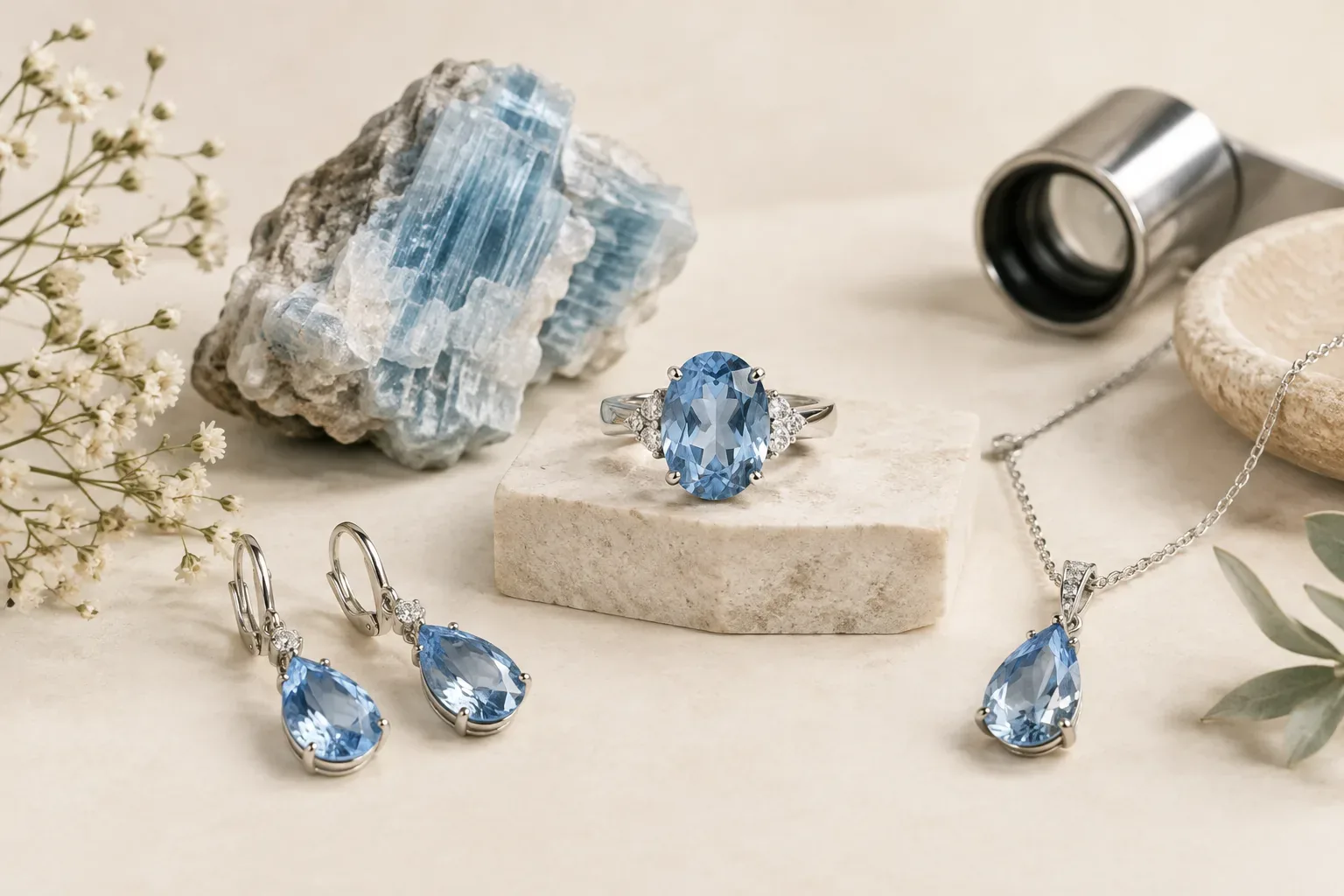
Meaning at a glance
Jeremejevite is a rare aluminum borate occurring in pale to blue colors. Laboratory confirmation, provenance, durability, and setting should precede modern clarity symbolism.
Direct answer — concise
Jeremejevite jewelry meaning in practical terms begins with the gem itself: jeremejevite is a rare aluminum borate that most commonly occurs in pale to blue tones. Because it is uncommon and can be fragile depending on individual material and cut, modern symbolic attributions—such as clarity, calm, or uniqueness—are personal or commercial interpretations; before relying on such meanings you should obtain laboratory confirmation, documented provenance, and an assessment of durability and setting suitability.
What jeremejevite is and why it’s rare
Jeremejevite is a mineralogical species classified as an aluminum borate. It is not a mainstream jewelry gem like sapphire or diamond, and its supply is limited by the mineral’s restricted geological occurrences and the small sizes in which gem-quality material tends to form. The Smithsonian National Museum of Natural History discusses how mineral identity, crystal habit, and geological rarity influence whether a specimen becomes suitable and practical for use in jewelry, and that principle applies to jeremejevite: limited occurrences and small crystal sizes make large, clean facetable material uncommon.
Professionals who document rare gems and reference collections note that jeremejevite is known for pale colors and a range that can include blue tones; this visual rarity adds to its appeal for collectors and niche jewelry use. Because many gem and mineral reference projects group rare species together for study, gemological institutes treat jeremejevite as a specialty gem that benefits from laboratory grading and reliable reference specimens rather than general consumer-oriented grading practices.
Documented historical evidence and cultural usage
There is no well-documented ancient or traditional cultural symbolism for jeremejevite recorded in the major institutional references consulted. The Gemological Institute of America and the Smithsonian’s educational materials focus on mineral identification, occurrence, and suitability for jewelry, and do not record a historical, culture-specific symbolic use for jeremejevite in the way that, for example, jade or lapis lazuli have documented cultural histories.
Because jeremejevite is primarily a mineralogical rarity acknowledged in modern gemological literature and museum collections, the record shows its significance arising in the context of scientific collecting and modern gem markets rather than in longstanding cultural or ritual traditions. For readers interested in the distinction, that means there is no authoritative historical lineage of symbolic meanings tied to particular cultures or periods for this mineral in the core institutional sources.
Documented meanings vs. modern personal interpretations
A clear separation is helpful: documented meanings are those you can attribute to historical records, cultural practice, or institutional documentation. For jeremejevite, the documentation centers on its mineralogy, rarity, and collecting interest. Modern personal interpretations, by contrast, are the symbolic or emotional meanings that collectors, sellers, or wearers attach to the gem today—often ideas such as clarity of thought, serenity, uniqueness, or a connection to the sky because of pale blue hues.
Modern meanings are valid as personal or contemporary cultural statements, but they are not the same as a recorded historical symbolism transmitted across generations. If you value a gem for a symbolic reason—personal clarity, a memory, or the idea of rarity—that is a meaningful choice. Just be clear that such attributions are contemporary interpretations rather than documented historical uses.
How jeremejevite appears in jewelry
Because gem-quality jeremejevite is uncommon, pieces tend to be produced in small editions or for custom work rather than mass-market jewelry lines. Typical uses include small faceted stones set as pendants, earrings, or centerpieces in bespoke rings, where the cutter and designer have worked to protect the stone’s proportions and orientation. Collectors and designers often highlight the stone’s pale blue or near-colorless range in simple settings that show color without exposing sharp edges.
Practical design choices reflect the stone’s rarity and variable physical properties. Many jewelers prefer protective settings—bezel mounts, halo surrounds, or low-profile prongs—to shield the pavilion and girdle. Because available pieces are usually modest in size, jewellers often pair jeremejevite with small accent stones or fine metalwork that emphasizes the gem’s rarity rather than trying to mimic the scale of more common center stones.
Buying guidance: verification, provenance, and disclosure
When purchasing jeremejevite, start with laboratory confirmation and a written report from a reputable gemological laboratory. The rarity of material and the potential for lookalike stones or treated specimens means a formal identification that states whether the stone is natural, whether treatments are present, and the gem’s species is essential. The Federal Trade Commission’s consumer guidance on buying gemstones, diamonds, and pearls emphasizes that sellers must disclose treatment, enhancement, and whether a stone is natural or lab-grown, and that buyers should ask for written confirmation of any such claims.
Provenance matters with rare gems. Ask the seller for details about the stone’s origin, how long it has been on the market, and whether it was cut from a specimen with museum or reference provenance. Seek sellers who will provide a clear return policy and who allow independent verification. Because jeremejevite is uncommon, price comparisons will often rely on the stone’s individual quality, size, and certification rather than standard market lists; insist on transparent documentation and avoid purchases based solely on evocative marketing language about “rare energies” or guaranteed symbolic effects.
Care and maintenance for jeremejevite jewelry
Care recommendations begin with an assessment from the seller or laboratory about durability and stability. The Smithsonian’s resources on minerals and gems underline that some minerals, even when attractive, are less suited to everyday wear and need protective design choices or occasional specialized care. For jeremejevite, that generally means avoiding exposure to harsh chemicals, extreme heat, and forceful knocks, and asking the seller whether the particular stone can withstand ultrasonic or steam cleaning.
When wearing jeremejevite jewelry, treat it as a special-piece item if the seller has advised caution: remove it for heavy manual work, for gardening, or during tasks where the stone could be struck. Store it separately from harder gemstones to prevent abrasion. For cleaning, use mild soap, lukewarm water, and a soft brush only if the seller or laboratory report confirms that the stone and any treatments tolerate such cleaning; if in doubt, leave cleaning to a qualified jeweler who understands rare gemstones. For more general color-care guidance for jewelry, consult our Jewelry Color Care Guide.
Selection and gifting guidance — practical and respectful
Selecting jeremejevite as a gift is best done with awareness of the recipient’s lifestyle and expectations. Because the stone is rare and often marketed with modern symbolic meanings, talk with the recipient (if the gift is not a surprise) about their preferences for durability and whether they prefer pieces that can be worn daily. If you plan the purchase as a surprise, choose settings that balance protection and beauty—a bezel or halo can increase resilience while showcasing the gem.
Respectful gifting also includes documentation. Give the recipient the laboratory report, the seller’s provenance notes, and any care instructions. If you are emphasizing a personal meaning—clarity, uniqueness, or calm—frame that as your personal interpretation rather than an inherited cultural fact. For help choosing meaningful pieces more broadly, see our practical gift guide on how to choose meaningful jewelry.
Summary
Jeremejevite is a rare aluminum borate prized by collectors and niche designers for its pale to blue appearance and scarcity. Institutional references emphasize its status as a mineralogical rarity rather than a gem with a long, documented cultural symbolism. Buyers should prioritize laboratory confirmation, clear provenance, sensible setting choices, and appropriate care. Modern symbolic meanings can be meaningful on a personal level, but they are contemporary attributions rather than recorded historical meanings.
Frequently asked questions
Is jeremejevite an ancient gemstone with cultural symbolism?
No authoritative institutional references consulted do not record an ancient or traditional cultural symbolism for jeremejevite; institutions such as the Gemological Institute of America and the Smithsonian focus on its mineralogy and rarity rather than historical cultural use.
How can I be sure a jeremejevite is authentic?
Obtain a gemological laboratory report that identifies the species, notes any treatments, and confirms whether the stone is natural or lab-grown; the Federal Trade Commission advises buyers to ask for written disclosure and independent verification for rare gemstones.
Is jeremejevite suitable for everyday rings or engagement jewelry?
Suitability depends on the individual stone’s durability and the chosen setting; because jeremejevite is a rare mineral and can be more fragile than common jewelry gems, many experts recommend protective settings and caution for daily-wear rings unless a laboratory or jeweler confirms the stone’s robustness.
How should I clean jeremejevite jewelry?
Start by asking the seller or lab report whether the specific stone tolerates ultrasonic or steam cleaning; when in doubt, use mild soap, lukewarm water, and a soft brush or have a qualified jeweler clean it. Avoid harsh chemicals and extreme heat unless you have confirmation that the gem and any treatments will tolerate those methods.
Why is jeremejevite expensive?
Price reflects rarity, the small size of gem-quality material, color, clarity, and the presence of reliable laboratory documentation and provenance; because large, clean jeremejevite crystals are uncommon, the market is limited and prices are set on individual merit rather than broad retail lists.
What should I include if giving jeremejevite as a gift?
Include the laboratory identification report, any provenance or seller documentation, written care instructions, and a note explaining your personal symbolic choice, making clear it is a contemporary interpretation rather than a historic cultural meaning.
Sources and further reading
- Gübelin Gem Project: Kornerupine–Natrolite — Gemological Institute of America
- Gems and Minerals: Beauties and Building Blocks — Smithsonian National Museum of Natural History
- Buying Gemstones, Diamonds, and Pearls — Federal Trade Commission