Meaning at a glance
Settings differ in how much of a birthstone they expose and how they protect it; choose based on the stone’s hardness, intended wear frequency, cleaning needs, and expected repair or inspection.
Quick answer
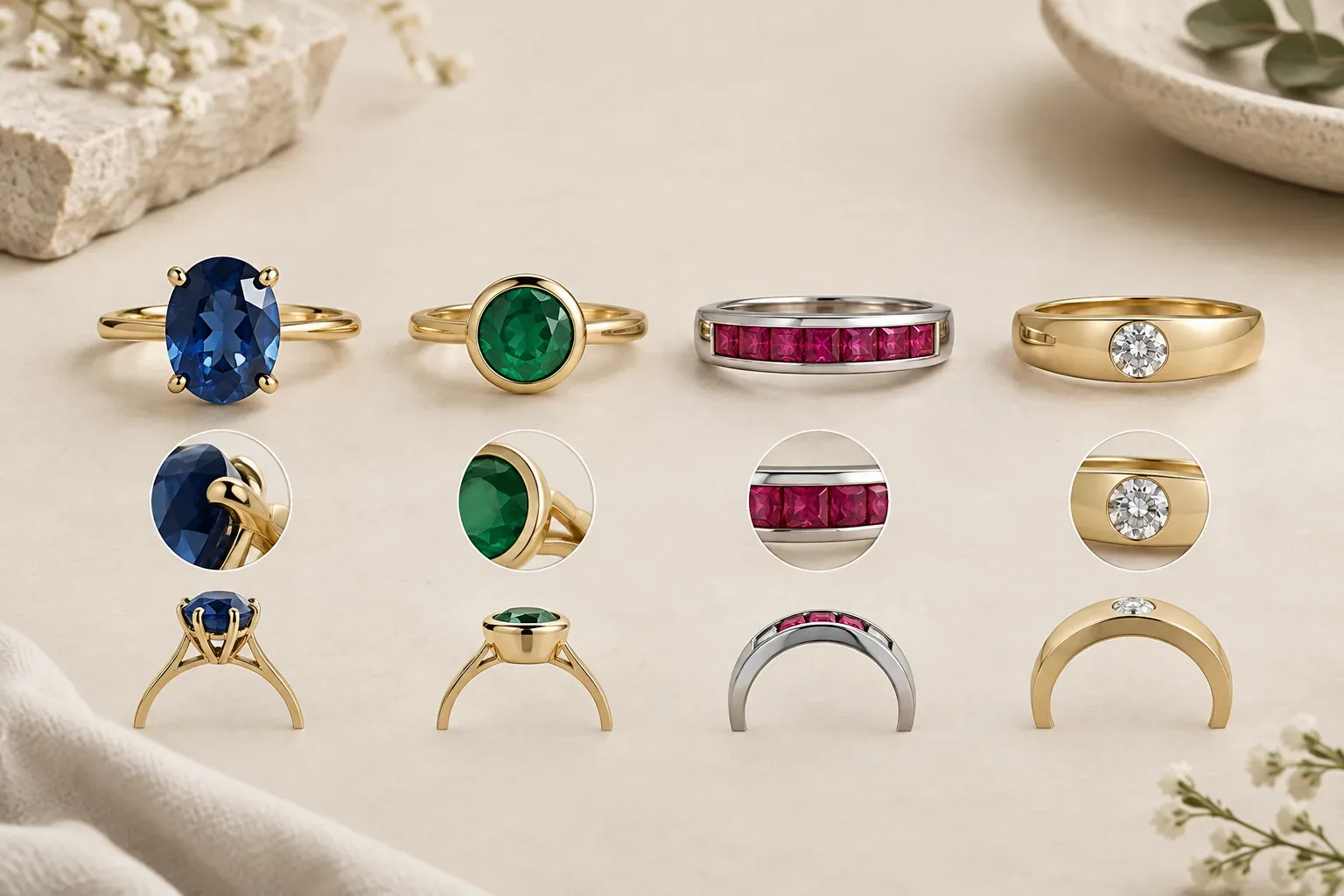
Prong settings lift and expose most of a stone to light and are easiest to clean but need regular inspection because the raised claws can catch and wear. Bezel settings wrap a metal rim around the stone for superior protection and low profile cleaning but reduce side light. Channel settings hold stones between two metal walls, ideal for rows of small birthstones and balance protection with sparkle. Flush settings seat a stone into the metal so the table is level with the surface, offering maximum snag resistance and a very low profile but limited light entry. These trade-offs connect directly to protection, cleaning access, repairability, and how often you should wear the piece.
How major setting types hold and expose gemstones
Prong settings use claws—commonly four or six—to secure a stone by the girdle while exposing the crown and pavilion to light. Because most of the gem is visible, prongs maximize brilliance and color, especially for faceted stones, and they provide straightforward access for cleaning and repolishing. The exposed nature also means prongs are more likely to bend or abrade with frequent wear, so regular inspection or occasional re-tipping is necessary (Gemological Institute of America).
Bezel settings form a continuous or partial metal rim that overlaps the stone’s edge and holds it in place. A full bezel offers strong edge protection and resists snagging and impact; a partial or “open” bezel sacrifices some protection for more light. Bezels make cleaning the crown simpler because the rim keeps contaminants out of the girdle, but their metal surround reduces light from the sides, which can mute brilliance on faceted gems while stabilizing cabochons and softer stones (Gemological Institute of America).
Channel settings seat multiple stones in a track between two parallel metal walls, with no prongs between stones. Channel settings are common for birthstone bands and accent rows because they protect the girdles and distribute shock across the metal walls, but because the stones sit tightly together cleaning between stones is more challenging and individual stone repair can require resetting the whole channel (Jewelers of America; Gemological Institute of America).
Flush settings, also called gypsy settings, are made by cutting a seat into the metal and hammering the surrounding metal to secure the stone so its table is flush with the surface. This yields the lowest profile and best snag resistance. Light access is limited to the table and any pavilion window, so flush settings often work best with gemstones that have strong color or with small accent stones rather than those chosen for maximum brilliance. Repair often means repunching the seat or resetting the stone (Jewelers of America).
Historical evidence and where these settings appear in the record
Professional and trade literature trace broad patterns in the evolution of settings without treating a single setting as universally dominant. Archaeological and museum records summarized in gemological and jewelry trade resources show bezel-like mounts appearing early in metalwork traditions of antiquity, with prong styles becoming more common as cutting techniques and display preferences changed in later centuries, and channel and flush styles emerging or spreading with industrial and precision metalworking in the 19th and 20th centuries (Gemological Institute of America; Jewelers of America).
Those sources document change in manufacturing technique more than fixed symbolic meanings tied to a setting. For example, the shift to prong settings in some European jewelry corresponded to cutting techniques that emphasized brilliance, while later channel and flush methods matched new machine capabilities and tastes for low-profile, secure mounts (Gemological Institute of America; Jewelers of America).
Documented historical meanings versus modern personal interpretations
The published professional literature emphasizes function—protection, light, and manufacture—over consistent historical symbolism attached to specific settings. Where scholars or museum catalogs have interpreted symbolic use of motifs or gemstones, those interpretations are cited in historical or archaeological sources rather than in modern trade guidance. Gemological and trade publications therefore treat symbolic meanings as modern or personal unless a clear documentary or archaeological source links a motif to a cultural belief (Gemological Institute of America; Jewelers of America).
Modern buyers and wearers commonly assign personal meaning to a birthstone or to the style of a setting—choosing a bezel because it feels protective, or a prong because it feels celebratory. Those contemporary interpretations are valid personal choices, but they are not the same as documented historical usage. When you are interested in historically grounded symbolism, consult specialized historical or museum scholarship; when you are choosing a birthstone gift, balance emotional meaning with practical durability and maintenance needs.
How these settings appear in birthstone jewelry choices
Prong settings are frequent for solitaire birthstone rings and pendants where the goal is maximum color play and fire. They are especially common with harder, faceted stones such as sapphires, rubies, and topaz identified on month lists maintained by professional bodies (Gemological Institute of America).
Bezel settings are popular for cabochon birthstones, for soft or porous stones, and for designs intended for everyday wear such as signet-style rings and children’s jewelry. Bezels also appear in modern minimalist and vintage-inspired designs because the rim creates a clean silhouette and stabilizes the stone.
Channel settings are typical in multi-stone bands and bracelets where several small birthstones form a colored row. They balance protection and a continuous sparkle but can be harder to clean between stones without professional equipment (Gemological Institute of America; Jewelers of America).
Flush settings appear in low-profile rings, men’s birthstone jewelry, and pieces intended for active wear. They give a very smooth surface that resists catching on clothing and are often selected when durability and daily practicality are priorities.
Practical selection and gifting guidance
Start with the stone’s durability. Consult month-by-month birthstone lists and gemological descriptions to learn each stone’s hardness and toughness (Gemological Institute of America). Hard, tough stones like sapphires tolerate prongs and more exposed mounts; softer or cleavage-prone stones benefit from protective bezels or low-profile flush settings.
Think about intended wear frequency. For a piece worn daily—especially rings—choose a setting that reduces snagging and impact: bezel or flush settings usually win for daily wearers. If the recipient favors occasional or ceremonial use, a more exposed prong setting can maximize sparkle.
Consider cleaning access and expected maintenance. Prong and open settings make at-home cleaning and inspection easier, but they require periodic inspection of the metal claws. Channel and flush settings protect stones well but can trap grime and often need professional ultrasonic or steam cleaning; plan for periodic professional inspection and cleaning as recommended by trade associations (Jewelers of America).
Ask sellers about treatments, origin, and disclosure. The Federal Trade Commission and professional bodies advise that buyers receive disclosure about treatments, lab-grown versus natural status, and any enhancements that affect durability or required care (Federal Trade Commission; Gemological Institute of America). A disclosed treatment can influence both the ideal setting and cleaning method.
Budget and repair considerations matter. Complex channel or flush work can be more expensive to repair because resetting a single stone may involve remaking a section of the metal track or repunching a seat. Prong re-tipping is often simpler and less costly. For heirloom gifting, choose a setting that balances aesthetics with the long-term likelihood of repair and the availability of qualified repair services (Jewelers of America).
When gifting, include care instructions and an encouragement to have the piece inspected annually if it will be worn frequently. Internal resources such as a birthstone care guide and a treatment disclosure guide can help the recipient understand how to clean and protect their stone (see internal links).
Care, inspection, and repair notes tied to settings
Inspect prongs visually and on a jeweler’s loupe for thinning, bending, or loose stones. Re-tipping is a routine repair and can often be done without removing the stone, but it is a repair you should expect over the life of a frequently worn prong-set ring (Jewelers of America).
For bezels, watch for dirt accumulation at the rim and for the rim to loosen after impact. A skilled bench jeweler can reflow or tighten a bezel, but heavy machining risks reducing the stone’s girdle if done improperly; communicate any treatments or fragility to the jeweler (Gemological Institute of America; Jewelers of America).
Channel and flush repairs may require removing or resetting adjacent stones to preserve the track or seat. That means repairs can be more invasive and sometimes more expensive, so factor that into both purchase price and long-term expectations.
Follow treatment and cleaning guidance from the seller and from professional bodies. Some enhancements limit safe cleaning methods; the Federal Trade Commission and the Gemological Institute of America advise that disclosure of treatments should inform any cleaning or repair choices (Federal Trade Commission; Gemological Institute of America).
Frequently asked questions
Which setting is best for a birthstone worn every day?
For daily wear choose a low-profile, protective setting such as a full bezel or a flush setting, especially if the birthstone is softer or has cleavage. Both minimize snagging and shield edges from impact, reducing the need for frequent repairs (Gemological Institute of America; Jewelers of America).
Is a prong setting unsafe for birthstones?
Not inherently. Prongs expose the stone to more light and make cleaning easier, but they can bend or wear with heavy use. If you choose prongs for a frequently worn piece, plan for annual inspections and occasional re-tipping (Jewelers of America; Gemological Institute of America).
Can a setting be changed after purchase?
Yes, settings can often be changed, but complexity, cost, and risk vary. Moving a stone from a channel or flush seat to a prong mount may require additional work and risk to the stone; always disclose treatments and consult a reputable bench jeweler (Jewelers of America; Federal Trade Commission).
How do treatments affect setting choice and care?
Some treatments alter a gem’s durability or how it responds to heat, chemicals, or ultrasonic cleaning. Ask the seller for full disclosure and follow cleaning recommendations; treatment information should inform whether to choose an exposed or protective setting (Federal Trade Commission; Gemological Institute of America).
Which settings are easiest to clean at home?
Prong and open bezel settings allow the most straightforward access for gentle at-home cleaning. Channel and flush settings often trap debris and typically require professional cleaning to restore full sparkle without risking damage (Gemological Institute of America; Jewelers of America).
Do some settings change how colorful or sparkly a birthstone appears?
Yes. Prong settings maximize light entry and generally emphasize brilliance and fire for faceted stones. Bezels and flush settings reduce side light and can emphasize color over sparkle, which may be desirable for richly colored stones (Gemological Institute of America).
Sources and further reading
- Birthstones for Each Month — Gemological Institute of America
- Buying Gemstones, Diamonds, and Pearls — Federal Trade Commission
- Jewelry Buying Guides — Jewelers of America
- Gemstone Durability: Design to Display — Gemological Institute of America
- An Introduction to Gem Treatments — Gemological Institute of America
- Jewelry Repair — Jewelers of America