Meaning at a glance
This guide helps readers compare fixed and removable birthstone charms, assess attachment security, check material disclosure, and choose size, weight, and compatibility for safe everyday wear without making supernatural claims.
Short answer
Compare fixed and removable birthstone charms by prioritizing attachment security, the gem and metal materials, disclosed origin and treatments, and a size/weight that matches how the charm will be worn. Fixed mounts (soldered bezels or integrated settings) tend to be more secure for heavy or high-activity wear, while removable bails, jump rings, or clasps offer versatility but need robust closures. Check written disclosures about natural, lab-grown, treated, or imitation stones, consider gemstone hardness and setting type for durability, and choose a charm that fits the recipient’s daily habits and metal sensitivities—without assuming any supernatural effect.
What the historical record shows
Ideas linking specific stones to months or people have a long and varied history, and modern birthstone lists are the result of many cultural and commercial developments rather than a single origin. The Gemological Institute of America (GIA) summarizes that associations between stones and people can be traced to multiple traditions, including references that link gemstones to the breastplate described in the Hebrew Bible and to ancient Hindu systems that associated gems with astrological ideas.
The GIA also documents that lists and meanings varied across time and place; what people call a “birthstone” today usually follows industry lists that evolved in the modern era. These lists reflect commercial and cultural choices rather than a single ancient prescription, so historical associations should be presented as specific to the culture or period that recorded them, not as universal facts.
Documented historical meanings versus modern personal interpretations
When scholars describe historical gemstone associations, they point to particular texts or traditions rather than claiming the meanings applied everywhere. For example, references tied to the Hebrew Bible are particular to Jewish scriptural contexts, while gemstone use in Hindu traditions is tied to its own systems. Those are documented cultural links, and the GIA is a useful professional source for this background.
Modern wearers often attach personal meanings to birthstones—family connection, memory of a child’s birth, or an expression of color preference. These contemporary, personal interpretations are valid for the wearer but are different in kind from recorded historical attributions. Distinguish documented cultural or textual origins from a gift recipient’s private symbolism when you choose or explain a charm.
How the motif and gemstone appear in jewelry
Birthstone motifs appear across formats: pendants, charm bracelet beads, dangling charms, cluster charms, and integrated settings on rings or earrings. Jewelers of America notes that jewelry formats and metal choices are major considerations when planning how a stone will be carried and viewed.
Design choices affect both appearance and durability. The Gemological Institute of America’s guidance on gemstone durability explains that setting type (bezel, prong, channel, or flush) and design context (pendant subject to knocks, ring exposed to abrasion) influence how a gem will wear over time. Softer gems or those prone to cleavage benefit from protective settings such as bezels, while harder stones can be safely used in open prong settings more often.
Materials: natural, lab-grown, treated, and simulants—know what you’re buying
The Federal Trade Commission requires honest disclosure about whether a gemstone is natural, lab-grown, treated, or an imitation. If the stone’s origin, treatments, or whether it is a simulant matters to you or the recipient, request written confirmation at purchase. Sellers should disclose whether a gem is natural, has been heat-treated or otherwise enhanced, or is lab-grown.
Different materials have different upkeep and market expectations. Natural stones can vary widely in clarity and color; lab-grown gems have the same chemical composition as natural counterparts but are created in controlled conditions; simulants mimic appearance without the gem’s composition. Treatments may improve durability or appearance but should be disclosed so you can make an informed choice about care, insurance, and resale value.
Attachment styles and security
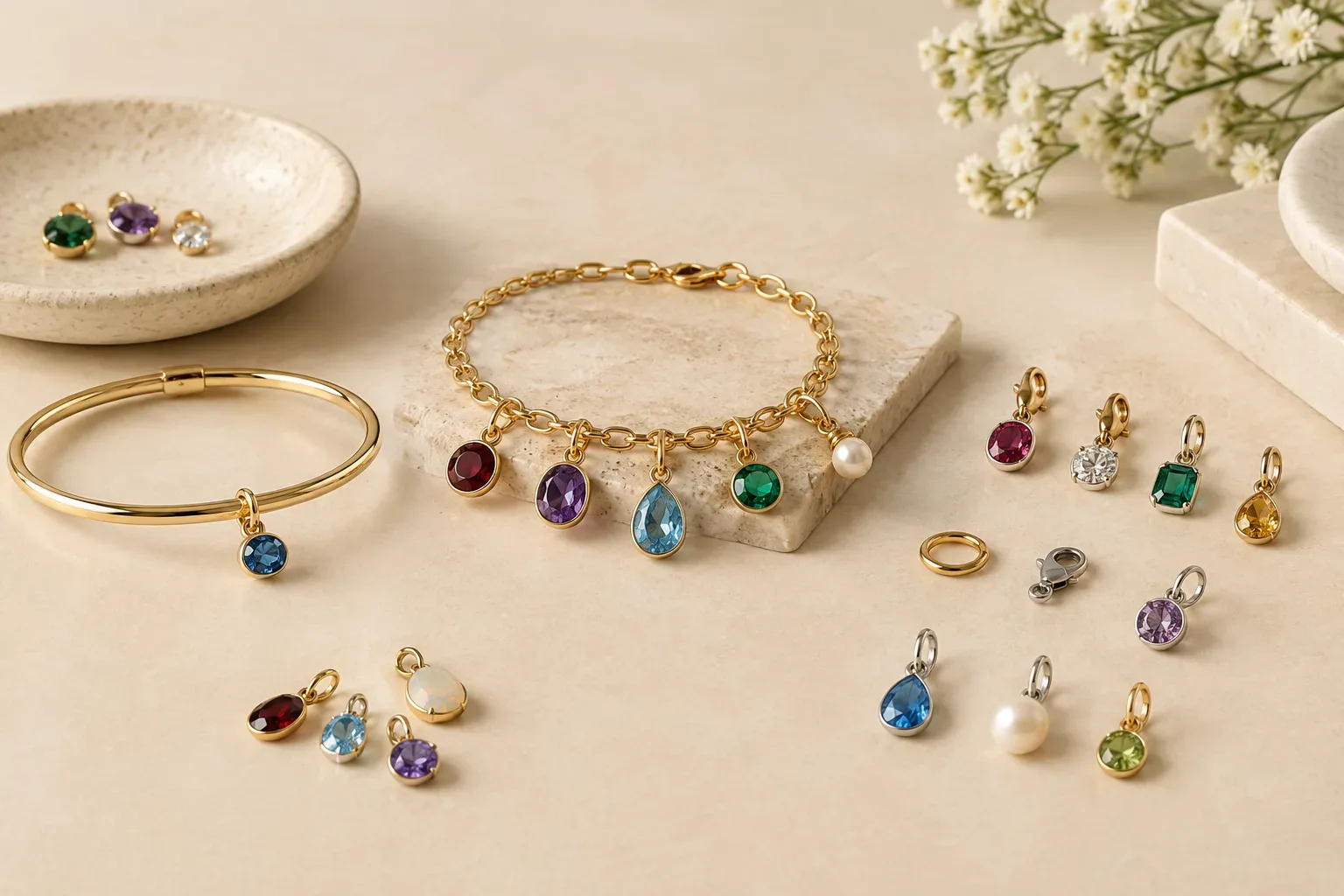
Attachment methods fall on a spectrum from fixed to removable. Fixed attachments include soldered bails, integrated mounts, or settings that are part of the piece’s metalwork. These are typically more secure for heavy stones or for jewelry worn during active use. Removable attachments include open jump rings, clip bails, screw bails, and small clasps that let a charm move between chains or bracelets.
Removable attachments add flexibility—one charm can go on multiple chains or bracelets—but they demand careful inspection. Check that jump rings are soldered or use split rings, that clasps and bails lock tightly, and that hardware matches the charm’s weight. For bracelets, consider a locking clasp or safety chain to prevent loss. The GIA’s work on durability and the Jewelers of America guides on formats both underline that matching attachment type to likely wear conditions is essential to keeping a charm safe.
Size, weight, and compatibility considerations
Bigger stones and heavier metal settings place more stress on attachments and chains. A lightweight charm that dangles freely is appropriate for a delicate chain, but a heavier charm requires a stronger chain and more secure bail. Jewelers of America recommends matching the structural strength of the necklace or bracelet to the weight of the pendant or charm to avoid breakage.
Think about the recipient’s daily habits. A charm intended for constant wear should favor low-profile settings and harder gems to resist scratching. Consider metal allergies and choose hypoallergenic metals when needed. If the charm will be part of a family cluster or stacked look, check that dimensions align so charms do not collide and cause abrasion.
Practical buying and gifting guidance
Start with disclosure and documentation. Ask for written information about the gem’s origin (natural, lab-grown), any treatments, and the metal’s karat or plating. The Federal Trade Commission’s consumer guidance stresses that sellers should not misrepresent these facts and that buyers have the right to clear information before purchase.
Match the design to use. For everyday wear choose beads or pendants with protective bezels and secure soldered connections; for an occasionally worn decorative piece you can prioritize openness and sparkle. Check gemstone hardness and setting style using GIA durability guidance so your choice will stand up to the recipient’s lifestyle.
Check seller credentials and policies. Jewelers of America recommends buying from reputable retailers with clear return, repair, and warranty policies. For gifts, verify sizing, ask about engraving options if desired, and keep receipts and documentation so the recipient can have the piece appraised or serviced if needed.
Care, repairs, and long-term considerations
Plan for care and occasional inspection. Settings loosen over time, jump rings can open, and stones can chip. The GIA’s guidance on gemstone design and display emphasizes preventive design choices and periodic inspection by a professional jeweler to tighten settings or replace worn components.
If you intend to insure the gift, keep documentation that states the stone type, treatments, and purchase price. When in doubt about cleaning or repair, consult the seller or a qualified jeweler rather than using household chemicals that can damage certain stones or metal finishes.
Final thoughts
A considered birthstone charm begins with clarity about materials and attachment style and ends with a choice that suits the wearer’s life. Use disclosure rules and durability guidance as practical tools: they tell you what the piece is made of and how it will stand up to actual use.
Respect the recipient’s preferences and any cultural meanings they hold; separate documented historical context from personal symbolism, and choose a secure attachment and appropriate size so the charm brings pleasure without unnecessary risk of loss or damage.
Frequently asked questions
Should I choose a natural or lab-grown birthstone?
Both natural and lab-grown stones can be beautiful; the Federal Trade Commission requires sellers to disclose whether a stone is natural, lab-grown, treated, or an imitation. Choose based on budget, the recipient’s preferences, and whether you want a documented natural origin. Ask for written disclosure at purchase so you and the recipient know exactly what was bought.
Is a removable charm less secure than a fixed one?
Removable charms offer versatility but can be less secure if their hardware is thin or unsoldered. For frequent wear, prefer soldered jump rings, split rings, locking bails, or integrated mounts; for occasional wear, a well-made removable bail can be appropriate. Inspect closures and match the attachment strength to the charm’s weight and the wearer’s activities.
How do I know whether a birthstone will stand up to everyday wear?
Check the gemstone’s hardness and susceptibility to cleavage, and choose protective settings for softer stones. The Gemological Institute of America’s durability guidance explains that design and setting determine how a gem will perform; use bezels or low-profile mounts for active use and save fragile cuts for occasional-wear pieces.
What documentation should I ask for when buying a birthstone charm as a gift?
Ask for written disclosure on whether the stone is natural, lab-grown, treated, or a simulant; the metal type and weight or karat; and the seller’s return, repair, and warranty policies. Keep the receipt and any certificates for insurance or future servicing.
Can I mix different birthstone charms on one chain or bracelet?
Yes, but check that sizes and attachment types are compatible to avoid collisions and abrasion. Match the chain strength to the cumulative weight and ensure jump rings and clasps are robust enough for the combined load.
Sources and further reading
- Birthstones for Each Month — Gemological Institute of America
- Buying Gemstones, Diamonds, and Pearls — Federal Trade Commission
- Jewelry Buying Guides — Jewelers of America
- Gemstone Durability: Design to Display — Gemological Institute of America