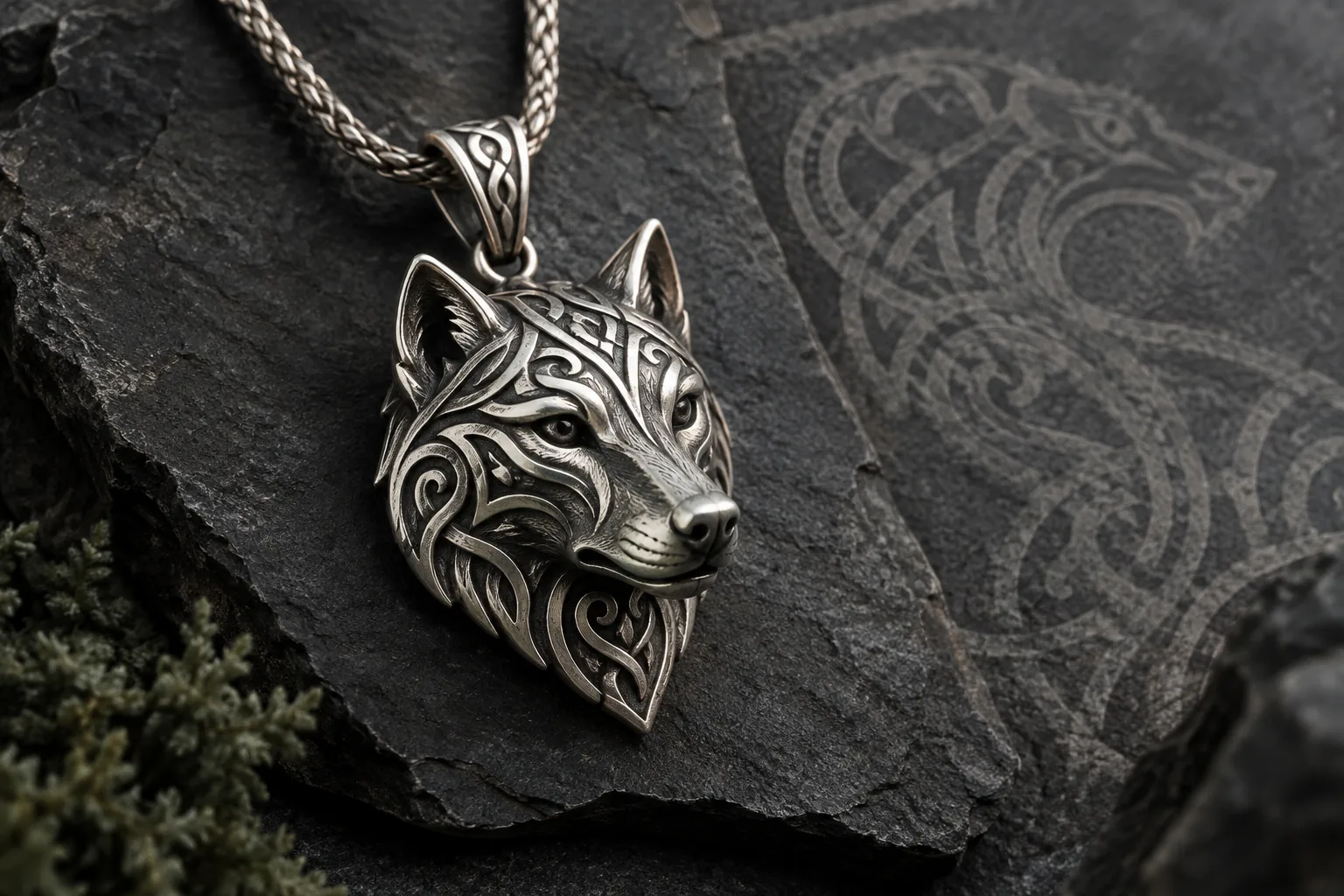
Meaning at a glance
Wolf imagery in Norse-themed jewelry may refer to Fenrir, Odin's wolves, predation, loyalty, or modern identity, and those readings should not be collapsed into one ancient meaning.
Quick answer
Wolf imagery in Norse‑themed jewelry may refer to Fenrir, Odin’s wolves (Geri and Freki), ideas of predation and wild force, or modern identity and affiliation; these are different strands—some attested in medieval Norse sources and archaeological contexts and others that are contemporary personal meanings, and they should not be conflated into one single "ancient" symbolism.
What the historical evidence actually shows
When historians and museums discuss wolf figures in Norse contexts they point to multiple, specific references rather than a single, fixed meaning. The mythological corpus preserved in medieval Icelandic compilations—represented for readers today by editions such as the Uppsala Edda (published by the Viking Society for Northern Research)—records wolves in several roles, including the monstrous wolf Fenrir and the wolves associated with the god Odin. The Uppsala Edda contains poems and prose that place wolves within narratives of gods, fate, and cosmic conflict rather than as a straightforward emblem of a single virtue.
Archaeological and museum collections reinforce that animals were important in Viking Age religion and material culture. The National Museum of Denmark presents the "old religion" of Scandinavia as a complex set of practices and images in which animals, magic, death, and ritual interrelate; wolf motifs appear among the wider repertoire of animal art that accompanied belief and practice in the Viking Age. Overviews like the World History Encyclopedia's entry on Fenrir summarize how the monster‑wolf appears in mythic narratives and how that myth was meaningful to medieval audiences and later storytellers.
Taken together, these sources support three careful points: medieval Norse texts explicitly use wolves in named mythic roles; archaeological and museum evidence shows animal imagery was a prominent part of material culture; and modern authors interpret those sources in varied ways. None of the approved sources claims a single, universal symbolic meaning for wolf motifs across time and place.
Distinguishing documented meanings from modern interpretations
Documented or textually attested meanings. The best‑attested historical meanings come from medieval Norse literature preserved in manuscripts and summarized by scholars. For example, the Fenrir narrative—found in the Norse mythic tradition and discussed in secondary overviews—presents a wolf figure tied to cosmic conflict and the death of a god at Ragnarök rather than an everyday moral lesson. Separately, Odin’s wolves figure in texts as companions of a deity who is himself complex: associated with wisdom, war, and other domains. Those textual roles are specific to the literary corpus and the worldview expressed there.
Archaeological meaning and material contexts are harder to pin down to single ideas. Museums such as the National Museum of Denmark emphasize that animals appeared within ritual and funerary contexts, decorative art, and possibly amuletic use, but they do not reduce animal imagery to a single symbolic gloss for all objects. A wolf image on a piece of metalwork does not automatically mean "Fenrir," just as a raven does not always mean "Odin."
Modern interpretations and personal meanings. Contemporary makers and wearers often read wolf motifs through modern lenses: strength, protection, loyalty to a group, identification with nature, or even as a marker of subcultural identity. These readings are valid as personal or contemporary symbolic choices, but they are not direct evidence of a single, uniform Viking Age meaning. The approved historical sources caution against collapsing medieval, material, and modern interpretations into one.
How the motif and tradition appear in jewelry—historically and today
Historically attested jewelry and metalwork demonstrate that animal art was common in Norse contexts, though surviving written sources and museum catalogues rarely identify a single object as "wolf jewelry" with a known, explicit meaning. The archaeological record and museum interpretation show that animals featured widely in ornament and may have had ritual or social significance, but exact intentions are rarely preserved in the documents.
In modern jewelry, designers draw from the mythic narratives and the visual vocabulary of Norse‑inspired art to make pieces that explicitly reference Fenrir, Odin’s wolves, or a more general wildness. Typical contemporary forms include pendants shaped as wolf heads or snarling wolves, stylized linear animal forms inspired by earlier Scandinavian art, and combinations of runic inscriptions or valknut motifs. Makers may pair wolf motifs with metals that evoke antiquity—oxidized sterling silver, bronze tones—and with stones chosen for color or perceived symbolism such as onyx, moonstone, garnet, or amber. Those gemstone choices reflect modern taste and marketing more than direct continuity with Viking Age practice.
Design cues and motifs to recognize
If you are trying to understand what a piece is invoking, look at the overall design vocabulary. A piece that shows a single snarling or biting wolf in a mythic scene is likely referencing the Fenrir narrative or the idea of a dangerous, chaotic force, an interpretation rooted in the mythological tradition. A wolf paired with a human figure or with runes and Odin symbolism may be invoking Odin’s wolves or a companion relationship. Simplified or abstracted wolf heads used as personal talismans frequently reflect modern ideas of loyalty, guardianship, or personal identity rather than a precise medieval reading.
Museum and scholarly sources caution that literal translations from motif to meaning are seldom straightforward. Use the published context or the maker’s notes to see whether the design is meant as a historical reference, a mythic retelling, or a contemporary symbol.
Practical and respectful guidance for choosing or gifting Viking wolf jewelry
Decide whether your priority is historical authenticity, mythic storytelling, or contemporary personal symbolism. If you want a piece grounded in historical evidence, look for makers who document their sources and who base designs on named archaeological finds or literature; check museum catalogues or academic notes when possible. If the intent is personal or symbolic, choose a design that clearly speaks to the recipient’s values and explain the meaning you attach to it.
Be mindful of context and respect when using mythic symbols. Some people approach Norse symbols as part of living heritage; others may adopt them as aesthetic or personal emblems. Avoid assuming that a symbol has one safe or neutral meaning for everyone. When gifting, consider the recipient’s background and any community associations the motif may carry, and if appropriate ask about or explain the mythic references—this both honours the cultural source material and prevents misunderstandings.
Practical jewellery choices: match metal and finish to everyday wear—sterling silver and stainless steel are durable and common for oxidized, detailed motifs; bronze or brass can read as antiqued. Consider scale and comfort: detailed mythic scenes suit larger pendants while stylized wolf heads work well as smaller charms or rings. For cared longevity, follow standard care instructions for the metal and stones used and, if the piece references historical designs, keep any documentation from the maker as provenance.
Frequently asked questions
Does Viking wolf jewelry always mean Fenrir?
No. While some pieces explicitly reference Fenrir, medieval Norse sources show multiple wolf roles (Fenrir, Odin’s wolves, etc.), and many modern pieces use wolves as general symbols of strength or identity.
Is it culturally insensitive to wear Norse wolf symbols?
Not necessarily, but context matters. Be aware that symbols can carry different meanings for different people. Choose makers who document their references, avoid misusing symbols associated with problematic groups, and consider the recipient’s feelings before gifting.
How can I tell if a piece is historically informed?
Look for designers who cite archaeological finds, museum catalogs, or literary sources. Historical pieces will often explain which text or artifact inspired the design and may reference museum collections or academic editions like the Uppsala Edda.
Are particular gemstones historically linked to Viking wolf jewelry?
There is no secure evidence linking specific gemstones to wolf imagery in Viking Age texts; modern makers often pair stones for color or perceived symbolic value rather than historical continuity.
What should I consider when gifting wolf jewelry?
Consider the recipient’s cultural background and personal values, choose a well‑made piece that suits their everyday wear, and explain the intended meaning—whether mythic, historical, or personal—to avoid misunderstandings.
Sources and further reading
- Fenrir — World History Encyclopedia
- The old religion — National Museum of Denmark
- The Uppsala Edda — Viking Society for Northern Research