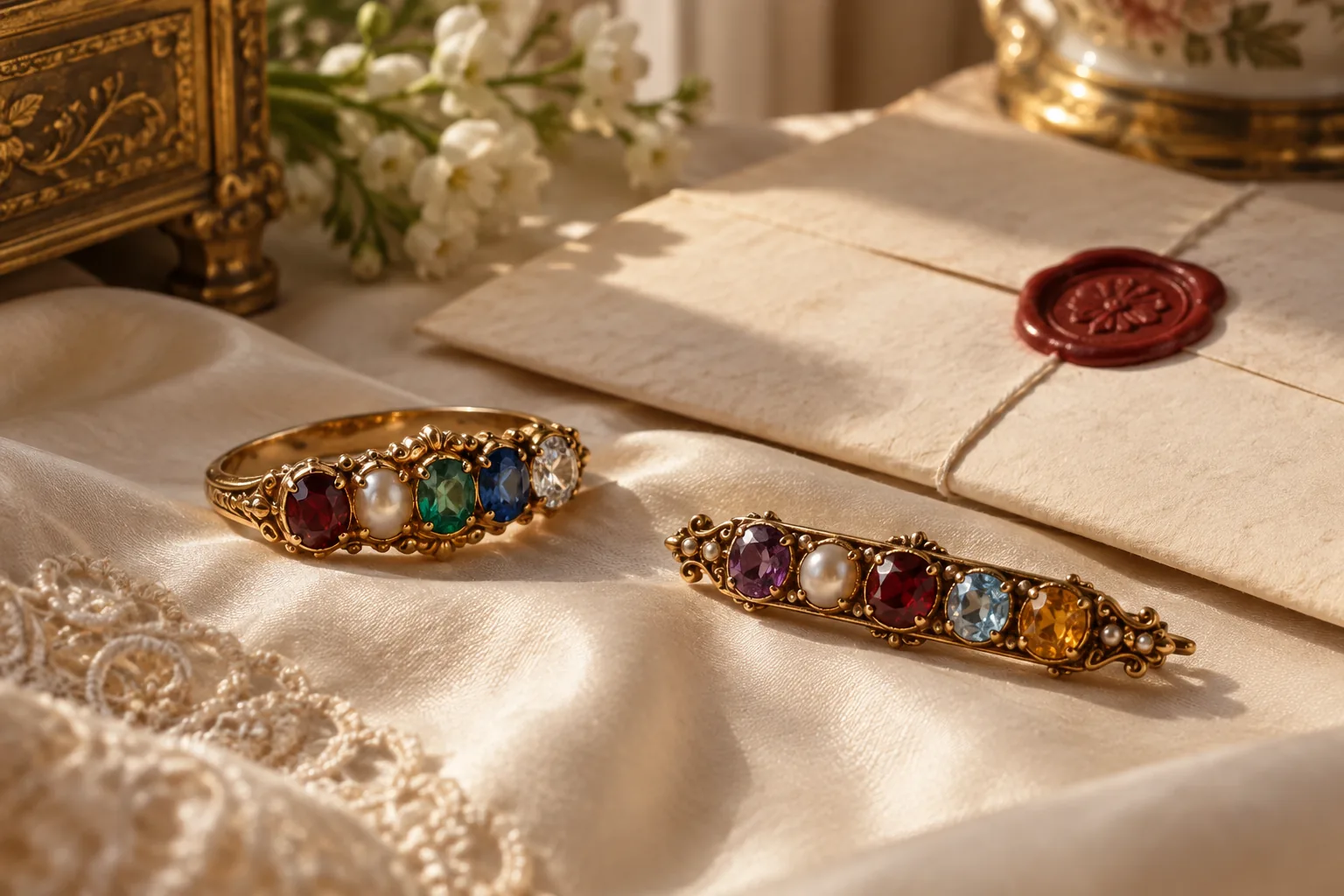
Meaning at a glance
Acrostic jewelry encoded words through the initials of selected gemstones as part of a nineteenth‑century culture of sentimental objects, color symbolism, and private messages; museums such as the Victoria and Albert Museum and The Metropolitan Museum of Art document this context and related material.
Quick answer
Acrostic jewelry encoded words through gemstone initials within a broader nineteenth‑century culture of sentimental objects, color, and private messages. Jewelers and owners arranged stones so that the first letters of their names, read in order, spelled short words, names, or phrases meant as private declarations or reminders.
What acrostic jewelry is and why it mattered in the nineteenth century
The simplest way to understand acrostic jewelry is to imagine a small sequence of gems whose initial letters spell a word. For example, a sequence of stones chosen for R, E, G, A, R, D—such as ruby, emerald, garnet, amethyst, ruby, diamond—would read as the word "regard" when the wearer or recipient knew the code. The device is linguistic in intent: meaning is carried by the names of the stones rather than solely by their color or iconography.
This practice fits into a larger nineteenth‑century interest in sentimental expression through objects. During the Victorian era and the century surrounding it, people used jewelry, lockets, hairwork, and small personal tokens to communicate feelings that were often constrained in public language. Museums such as the Victoria and Albert Museum and The Metropolitan Museum of Art describe rich traditions of personal ornament, color symbolism, and coded sentiment in the period's jewelry and decorative objects. These institutions document both the material types and the cultural environment that made acrostic devices legible and desirable to contemporary owners.
Historical evidence and precise cultural instances
The documentary and material record for acrostic jewelry is strongest in nineteenth‑century Britain and America, where a market for sentimental jewelry expanded and jewelers experimented with new modes of personalization. The Victoria and Albert Museum's surveys of gemstones and jewelry history place these practices within the broader nineteenth‑century chronology of taste, technology, and social customs, noting how color, material, and meaning were intertwined in decorative arts of that time. The Metropolitan Museum of Art's exhibitions on American jewelry likewise trace how jewelry served as a vehicle for personal messages and identity in the nineteenth century.
Surviving pieces, period jewelry catalogs, pattern books, and the collecting habits recorded by museums provide the material evidence that acrostic devices were used. When museums display or describe such pieces, they situate them among other sentimental forms—mourning jewelry, portrait lockets, and love tokens—indicating that acrostic gems were one of several overlapping ways people made emotion legible in private. The sources from the Victoria and Albert Museum and The Metropolitan Museum of Art emphasize this overlap rather than treating acrostic work as an isolated novelty.
Documented historical meanings versus modern personal interpretations
What is documented in museum writing and collections is a practice and a cultural context: nineteenth‑century jewelers and consumers selected stones and arranged them so their initials formed words, and this occurred within a social environment that valued coded, personal messages. The Victoria and Albert Museum and The Metropolitan Museum of Art provide evidence for those facts and for the broader symbolic uses of color and material in jewelry of the period.
What is not documented as universal are fixed, universal meanings for particular stones beyond their role as letters in an acrostic. Modern writers and gift‑givers frequently layer additional symbolism—assigning emotional or metaphysical meanings to particular gems, or treating historic acrostics as bearer of a single, universal sentiment. Those contemporary interpretations are personal or culturally specific and should be presented as modern meaning‑making rather than historical fact. In short, the historical record shows the method and the cultural appetite for coded messages; modern users may add new associations, but those are contemporary choices, not universal continuations of nineteenth‑century belief.
How the motif, gemstone, and tradition appear in jewelry
Acrostic motifs appear in many wearable forms: rings, brooches, bracelets, and necklaces could all host short sequences of stones. Jewelers arranged the gems in a linear sequence or clustered them so that the intended order was clear to someone who knew the code. Settings ranged from delicate Victorian frameworks to bolder, later nineteenth‑century designs, reflecting changes in fashion and technology that museums document in their surveys of jewelry history.
Gemstone choice is integral to the device. The practice depends on the English names of gems (or, occasionally, on names in the owner's language) so that their initials form the message. The visual qualities of the stones—color, cut, and relative size—also mattered. Designers balanced legibility, aesthetic harmony, and durability: harder stones and secure settings were chosen for rings and bracelets intended for frequent wear, while more fragile combinations might be reserved for brooches or necklace pendants.
Because acrostic devices rely on linguistic coding, they often accompanied other sentimental motifs familiar from the period—heart shapes, arrows, initials, and locks and keys—creating layered messages in a single object. Museums that catalogue jewelry place such pieces within those broader typologies to show how owners combined visual and verbal codes in everyday adornment.
Choosing or gifting acrostic jewelry: practical and respectful guidance
If you are choosing or giving acrostic jewelry today, be explicit about which tradition you are drawing from and careful not to claim universality for a symbolic meaning. Begin by deciding whether the piece will emphasize the historic practice, its contemporary reinterpretation, or both. If you want a historically informed piece, consult reputable collections and descriptions from institutions such as the Victoria and Albert Museum and The Metropolitan Museum of Art to understand how nineteenth‑century owners used and wore such objects.
Consider the recipient's preferences and cultural background. Not all communities share the same symbolic associations with specific stones, and some persons might find coded messages intimate or intrusive. Ask whether a public declaration or a private code is appropriate. If the jewelry is meant to be private, discuss which words or names are meaningful and whether the recipient prefers an explained or unexplained code.
Practical selection matters. Choose stones and settings suited to the intended wear: for daily wear, favor harder gems and secure prong or bezel settings; for occasional wear, you can consider more delicate stones and decorative settings. Be mindful of size and weight so the piece is comfortable, and check for appropriate hallmarks and documented provenance when buying antique or vintage items. For contemporary commissions, work with a jeweler who understands both gem durability and historical forms so the finished object will be legible as an acrostic and durable in practice.
Respect provenance and ethics. If historical authenticity is important, request documentation about age, previous ownership, and any conservation work. If sourcing new gemstones, seek information about ethical supply chains and be prepared to ask sellers about origin and certification. Museums can be a helpful reference for what constitutes a typical historical design, but modern buyers should balance historical fidelity with contemporary standards of ethical sourcing and personal suitability.
When gifting, include a short card or note explaining the acrostic tradition and the intended word or name, unless the surprise depends on secrecy. Providing context honors the historical practice and helps recipients appreciate both the craft and the sentiment without assuming they already know the custom.
Conclusion
Acrostic jewelry is a historically documented technique for encoding short words through the initials of gemstones, rooted in a nineteenth‑century culture of sentimental objects, color symbolism, and private communication. Museums such as the Victoria and Albert Museum and The Metropolitan Museum of Art record the broader cultural and material setting in which acrostic devices were meaningful.
Today the motif can be revived with sensitivity to history and to the recipient's preferences. Presenting the historical facts separately from modern symbolic layers lets jewelers and wearers honor the past while adapting the tradition to contemporary tastes and ethical expectations.
Frequently asked questions
What exactly is acrostic jewelry?
Acrostic jewelry arranges gemstones so that the initial letters of their common names, read in sequence, spell short words, names, or phrases; it was a way to encode messages in wearable form, particularly popular in the nineteenth century.
Did people in the nineteenth century use acrostic jewelry for love messages only?
No. Museums place acrostic jewelry among a range of sentimental objects that communicated love, remembrance, friendship, and identity. The device was flexible and could be used for various private messages, not exclusively romantic declarations.
How can I tell if a piece is a genuine nineteenth‑century acrostic or a modern reproduction?
Check documented provenance, hallmarks, and condition, and consult specialist descriptions from reputable institutions or appraisers. Museums such as the Victoria and Albert Museum and The Metropolitan Museum of Art offer reference material to help distinguish period characteristics from modern work.
Are there universal meanings for specific gemstones used in acrostics?
No. While nineteenth‑century owners used gem initials to spell words, fixed, universal symbolic meanings for particular stones are not documented as universal; modern symbolic associations vary and should be presented as contemporary interpretations rather than historical fact.
What practical factors should I consider when commissioning or buying acrostic jewelry?
Consider the durability of chosen stones for the intended wear, the security of the setting, the legibility of the acrostic, the recipient's cultural preferences, and provenance or ethical sourcing information when relevant.
Sources and further reading
- An A–Z of gemstones — Victoria and Albert Museum
- A history of jewellery — Victoria and Albert Museum
- Jewelry for America — The Metropolitan Museum of Art