Meaning at a glance
Opal and tourmaline are both recognized October birthstones but behave and wear very differently: opal is prized for its play-of-color and is relatively soft and sensitive, while tourmaline offers a broad color range, greater durability, and different treatment considerations; choose settings and care routines accordingly.
Quick answer
Opal and tourmaline are both modern October birthstones, but they contrast sharply in optical behavior, toughness, typical treatments, and care needs: opal shows unique play-of-color and is relatively fragile and often assembled or stabilized, while tourmaline comes in many colors, is generally tougher for everyday wear, and is subject to different but typically less delicate treatments. This comparison reflects gemological guidance and market practice, and it is the practical basis for choosing or gifting an October gemstone.
Documented history: how October stones became opal and tourmaline
The idea of assigning specific gems to months has changed over time rather than following a single, unbroken tradition. The Gemological Institute of America (GIA) documents that birthstone lists evolved across eras and regions, with different cultures and jeweler groups favoring different stones at different times. For example, historical lists and necklaces of labeled gems appear in museum and trade records that show shifting preferences rather than universal symbolism.
GIA's research and museum material explain that the modern list of month stones was shaped in the late 19th and 20th centuries as gem dealers and associations sought to standardize which gems represented each month. In that modern context, opal and tourmaline came to be recognized for October. The assignment reflects both gemological availability and commercial practice rather than a single ancient prescription tying those two stones uniquely to October across all cultures.
Gemology and optical behavior: why opal and tourmaline look so different
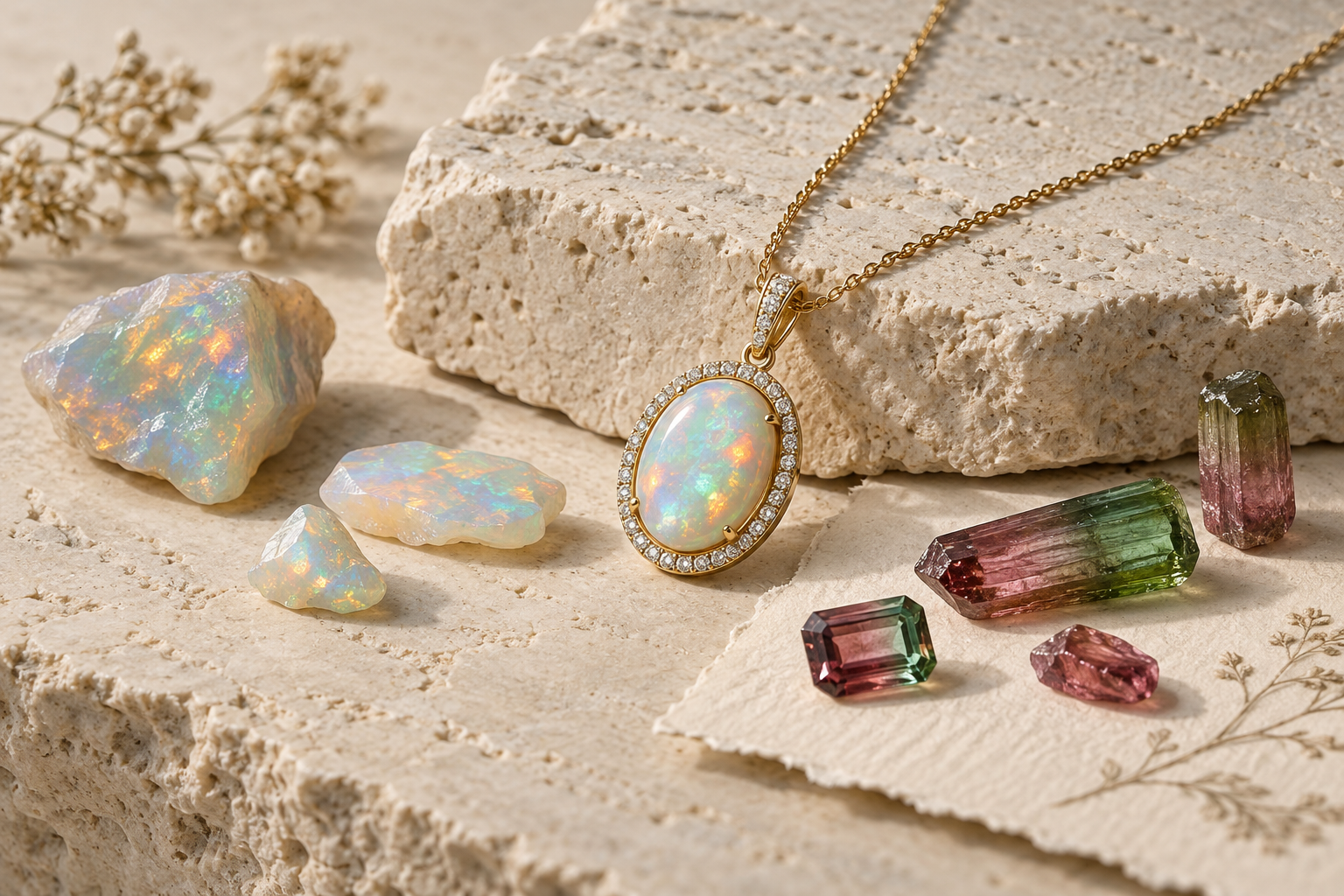
The two stones offer visibly different optical effects that help define their appeal. Opal's most celebrated feature is play-of-color, a shifting, internal flash of spectral hues that appears when the stone is moved. That effect comes from the way light interacts with microscopic silica spheres within precious opal and is the trait most often sought after in opal jewelry.
Tourmaline is prized for its broad and varied color range, from pinks and reds to greens, blues, and bicolors such as the popular watermelon tourmaline. Many tourmalines also show pleochroism, meaning the stone can display different colors or intensities when viewed from different angles. Those two differences—opals offering internal, shifting iridescence and tourmalines offering saturated body color and, in some cases, pleochroic effects—are why each stone is chosen for different jewelry looks.
Durability, treatments, and what gemological bodies say
Durability is a practical concern for wear and care. According to GIA guidance on birthstones, opal is relatively soft compared with many common jewelry gems and can be more susceptible to scratching, chipping, and damage from sudden temperature changes or strong blows. For that reason, opal jewelry often needs more protective settings and careful handling in everyday wear.
Tourmaline, by comparison, is generally harder and more resistant to everyday wear, making it a better candidate for rings and pieces intended for frequent use. That relative toughness does not make tourmaline indestructible, but it does widen the set of jewelry styles and activities for which it is suitable.
On treatments, the trade and gemological oversight bodies note a range of practices that affect both appearance and value. Opals are sometimes assembled as doublets or triplets to display attractive color without the cost of a solid gem, and certain opals may be stabilized or otherwise treated to improve durability or appearance. Tourmaline may be heat-treated or otherwise enhanced to improve clarity or color. The Federal Trade Commission (FTC) requires that dealers disclose known treatments, lab-grown status, or imitations, and gemological guidance stresses asking sellers about any treatments before purchase.
Documented historical meanings versus modern personal symbolism
When discussing meanings, it is important to separate documented historical associations from contemporary personal or cultural symbolism. GIA's historical overview shows that gemstone-month pairings and the symbolic language around gems have shifted over time and that no single meaning has been universally attached to these stones across all cultures and periods.
Modern personal meanings—such as people describing opal as a symbol of creativity, emotional expression, or inspiration, or calling tourmaline a stone of grounding, balance, or protection—are contemporary interpretations that many people find meaningful but that are not universal or historically uniform. Those modern meanings are personal or cultural preferences rather than documented, objective properties of the gems themselves.
How opal and tourmaline are used in jewelry
Opal is frequently cut en cabochon to show its play-of-color to best advantage, and it is commonly set in protective styles such as bezels or in pendants and earrings where the risk of impact is lower. Because of the way assembled opals (doublets and triplets) are made, some opal jewelry pieces use a layered construction to provide durability and to showcase color economically. Those assembled pieces wear and care differently from solid opal cabochons.
Tourmaline is commonly faceted to display its body color and brilliance and is used in a wide range of styles from solitaires and colored-stone rings to multi-stone and mixed-metal designs. The stone's variety of colors allows designers to place tourmaline in place of more traditional colored gems, and its relative toughness makes it suitable for everyday rings, bracelets, and pendants when set securely.
Practical selection and gifting guidance
Start by considering the recipient's lifestyle and how often they will wear the piece. If you are buying a ring meant for daily wear, tourmaline's greater toughness often makes it the safer choice. If the recipient prefers pendants, earrings, or occasional-wear rings and values the unique optical effect, a high-quality opal can be an exceptionally personal and striking gift.
Ask any seller about treatments and construction, and expect full disclosure. The FTC requires disclosure of treatments and of lab-grown or imitation materials, and reputable sellers will provide clear information about whether an opal is solid, a doublet, or a triplet, or whether a tourmaline has undergone heat treatment. That information affects care, durability, and value, so make it part of your buying checklist.
Think about setting and protective design choices. Bezel or halo settings can shield an opal's edges from knocks, and placing opal jewelry in styles that reduce direct impact—such as pendants or drop earrings—extends its life. For tourmaline, secure prong settings and attention to the stone's table and pavilion allow good light performance without unduly exposing edges to wear. When in doubt, request a jeweler's recommendation for setting and maintenance based on the exact stone.
Finally, consider budget and expectations about longevity. Opals with intense, broad play-of-color can be precious and command higher prices, and certain tourmaline colors, particularly rare saturated hues, can also be premium. Match your expenditure to the meaning you want the piece to carry and to the care you and the recipient are willing to provide. For higher-value pieces, obtain documentation of treatments and consider appraisal and insurance.
Short conclusion
Opal and tourmaline both make meaningful October birthstone gifts, but they suit different priorities. Choose opal when the recipient values unique internal color effects and is likely to handle the piece carefully or wear it in lower-impact settings. Choose tourmaline when you want a broader color range with greater everyday durability. In every case, ask about treatments and construction, choose protective settings as needed, and follow recommended care practices to preserve the stone and the sentiment behind the gift.
Frequently asked questions
Are both opal and tourmaline official October birthstones?
Yes. Modern birthstone lists recognize both opal and tourmaline for October. Gemological bodies such as the Gemological Institute of America (GIA) document that the modern assignment of month stones evolved over time and that both stones are associated with October in current practice.
Which of the two is more durable for everyday wear?
Tourmaline is generally harder and more durable for everyday wear than opal. Opal tends to be softer and more vulnerable to scratching, chipping, and damage from sudden temperature changes, so it is often placed in protective settings or used in jewelry for less-impact wear.
What treatments should I ask about when buying opal or tourmaline?
Ask whether an opal is a solid gem or an assembled piece such as a doublet or triplet, and whether it has been stabilized. For tourmaline, ask about heat treatment or other enhancements. The Federal Trade Commission (FTC) requires disclosure of known treatments, and reputable sellers will provide this information.
How should I clean and care for these stones?
Follow gemological guidance: clean opals gently with a soft cloth and mild soap and avoid ultrasonic or steam cleaners for fragile or assembled opals. Tourmaline can generally be cleaned with warm soapy water, but ask the jeweler about the stone's specific treatments and any cleaning methods to avoid. When in doubt, consult a professional jeweler.
Which stone should I choose as a gift if I do not know the recipient's habits?
If you are unsure about how often the recipient will wear the piece or how careful they will be, tourmaline is often the safer choice for a daily-wear ring because of its greater toughness. Choose opal for someone who values unique visual effects and who will likely wear the piece on special occasions or in lower-impact styles such as pendants or earrings.
Does color affect value for these stones?
Yes. For opal, the intensity and distribution of play-of-color strongly influence value, and for tourmaline, saturation and rarity of certain hues play a big role. In both cases, clarity, size, cut, and known treatments also affect value. Ask the seller for details and documentation when buying a higher-value stone.
Sources and further reading
- October Birthstone Guide — Gemological Institute of America
- Birthstones — Gemological Institute of America
- Birthstones: Gems Through the Ages — Gemological Institute of America
- Buying Gemstones, Diamonds, and Pearls — Federal Trade Commission