Meaning at a glance
This article answers the distinct search intent behind 'Fire Opal cleaning guide' with clear definitions, decision criteria, practical trade-offs, safe home-care methods, and unambiguous limits on what a shopper can confirm only with a qualified jeweler or gemological laboratory.
What we mean by 'fire opal' and what this guide will and will not determine
In this guide 'fire opal' refers to the opal varieties that display warm body colors—typically orange, yellow, or red—used in jewelry. This piece focuses on safe handling and consumer decision-making rather than technical gemological testing. The Gemological Institute of America (GIA) notes that treatments, disclosure, detectability and durability are core consumer questions for gemstones, and that guidance shapes practical care recommendations (Gemological Institute of America).
This article will not attempt to authenticate or certify a specific stone. Tests that identify treatments, porosity, synthetic origin, or value—such as spectroscopy, refractive index, or laboratory grading—require a qualified jeweler or a gemological laboratory. The Federal Trade Commission reminds consumers that clear written disclosures are essential when buying gemstones, and that some distinctions require professional verification (Federal Trade Commission).
Historical evidence and cultural notes
Among the approved sources for this article, there is limited direct detail on long-form cultural histories of fire opal specifically. Contemporary trade and consumer guidance emphasizes treatments, disclosure, and modern demand patterns rather than ancient cultural narratives (Gemological Institute of America; Federal Trade Commission).
Where historical meanings are discussed in wider literature they are often transmitted through modern writers and jewelers as personal or cultural interpretations, not as standardized, universally documented beliefs. Because the available, approved sources for this piece are consumer and trade-focused, I avoid attributing specific cultural or period beliefs to fire opal without primary historical citations. Modern trend reporting does, however, document renewed interest in opals and gemstone-driven design in recent years (Professional Jeweller / PRYA Jewellery Search Insights; Imaginaire Digital).
Documented historical meanings versus modern personal interpretations
Documented historical meanings require primary historical or anthropological evidence, which is not included among the approved sources used to write this guide. The GIA and the Federal Trade Commission focus on gem treatments and disclosure rather than assigning cultural meanings, so any cultural meanings presented in marketing or personal testimony should be treated as modern personal interpretations unless the seller provides a verifiable historical source (Gemological Institute of America; Federal Trade Commission).
Modern shoppers and designers frequently attach symbolic language to fire opals—such as warmth, passion, or autumnal color—but those are contemporary personal or marketing interpretations and not universally documented historical facts. Distinguish between these personal-attribution statements and any verified historical claim you may read elsewhere.
How fire opals commonly appear in jewelry today
Current market and search data show that opal and gemstone rings, necklaces and bespoke, sculptural pieces are in demand, and that designers are using vibrant stones in rings, pendants and cluster settings (Professional Jeweller / PRYA Jewellery Search Insights; Imaginaire Digital). Fire opals often appear as center stones in rings, as accent stones in clusters, and in pendant or earring designs where their warm color can be showcased.
Because fire opal body color can be quite vivid, jewelers may place these stones in bezel settings for extra protection or in prong settings for maximum light exposure. The choice of metal, mounting style and setting depth affects how the stone will withstand daily wear and cleaning, so consider how the piece will be worn when selecting or gifting a fire opal item.
Safe cleaning methods — step-by-step
Start with seller guidance and inspection. Before cleaning at home, read any care instructions provided by the retailer and ask whether the stone has been treated or is porous. The Federal Trade Commission emphasizes obtaining clear written disclosures when buying gemstones, and knowing a stone's treatment status changes the appropriate cleaning approach (Federal Trade Commission).
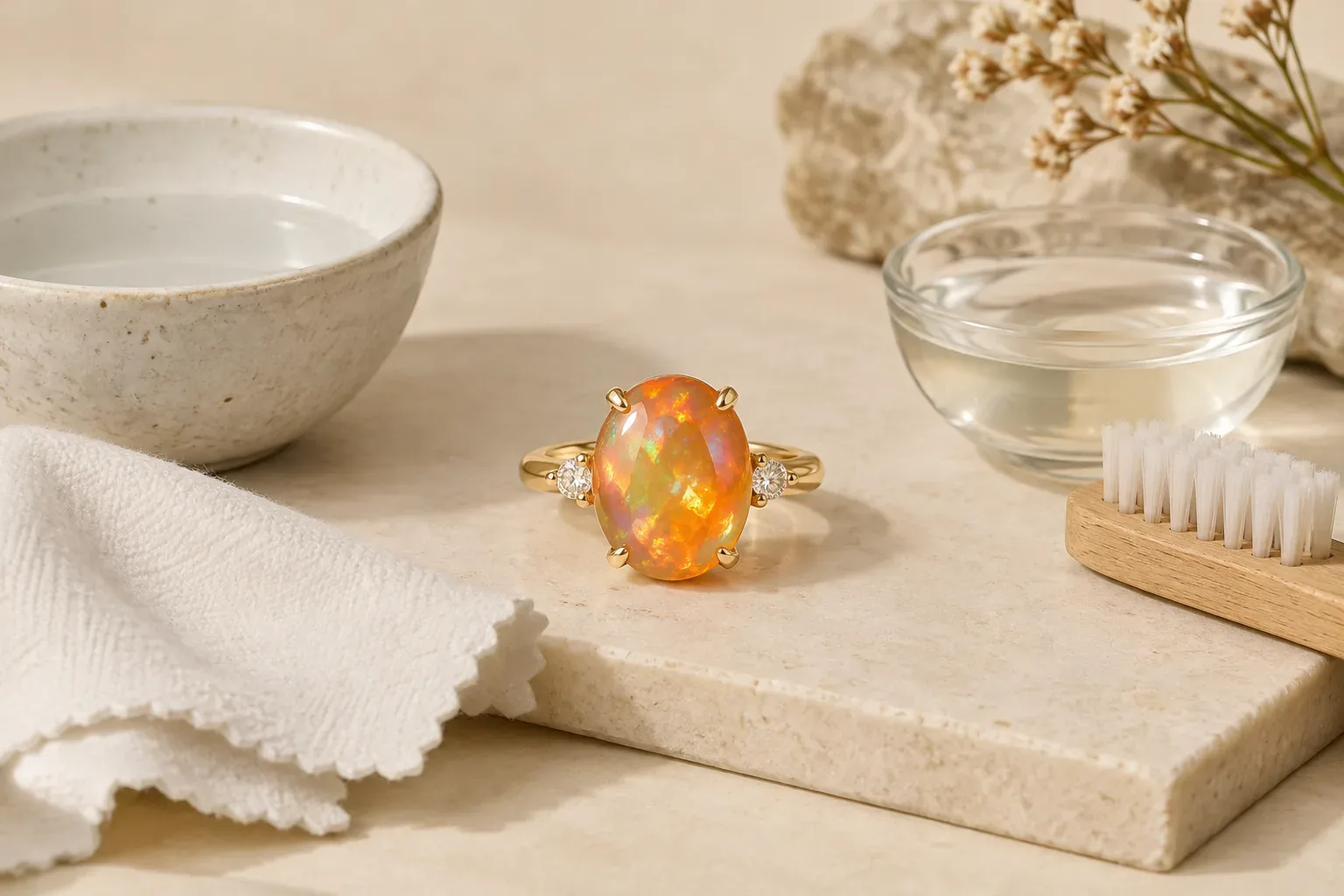
For routine cleaning, use lukewarm water, a drop of very mild dish soap, and a soft lint-free cloth. Gently wipe the stone and the metal setting. If dirt persists in the setting, use a soft-bristled brush and gentle strokes around the metal and between claws while supporting the piece to avoid dropping it.
Rinse carefully with lukewarm water and pat dry with a soft cloth. Dry the setting thoroughly and inspect for trapped moisture or residue. If a piece has cavities or an open back, take extra care to remove trapped water and let the jewelry air-dry completely before storing.
Practical trade-offs and when to be cautious
Gentle water-and-soap cleaning removes oils and light surface grime without exposing the stone to harsh conditions. The trade-off is that gentle cleaning may not remove deep-seated residues or invisible treatments. The GIA notes that treatments and durability differences create distinct consumer questions, and some treatments or porous stones respond poorly to water or solvents (Gemological Institute of America).
When a seller discloses that a stone is treated, resin-filled, or porous, avoid soaking and aggressive chemical cleaners. Aggressive cleaning may remove surface coatings, introduce moisture into pores, or damage stabilizing resins. If you need deep cleaning or suspect an internal problem—such as trapped moisture, internal fractures, or a soft treatment layer—seek professional service.
What to avoid
Do not use ultrasonic cleaners or steam cleaners on fire opal jewelry unless a qualified gemologist or the seller explicitly confirms the stone is stable and untreated. Both ultrasonic and steam cleaning apply mechanical or thermal stress that can crack or degrade certain opals or remove treatments.
Avoid household bleach, ammonia, acetone, and other harsh solvents. Also avoid exposing fire opal jewelry to extreme heat, sudden temperature changes, or prolonged direct sunlight while cleaning or storing, as thermal shock can cause cracking in many opal varieties.
Do not aggressively soak or scrub a stone if you do not know whether it is porous, hydrophane, or treated. Prolonged soaking can cause absorption of liquids or cleaning agents into porous stones and make later treatments ineffective or visible.
Selection and gifting guidance (practical and respectful)
Ask for written disclosures. Follow the Federal Trade Commission’s guidance by requesting clear, written information on whether the fire opal is natural, lab-created, treated or imitation before purchase, and retain receipts and any care instructions (Federal Trade Commission).
Favor secure settings for everyday wear. If the wearer is likely to use the ring or pendant daily, consider a bezel or half-bezel setting to protect the stone’s edges. For occasional-wear pieces, open settings may be acceptable and showcase the stone more dramatically.
Consider intended use, value and documentation. For higher-value pieces, ask the seller for a gemological report or recommend a third-party lab verification. If you are gifting a piece, provide the recipient with the seller’s disclosure, care instructions, and the option for a professional inspection if the receiver prefers.
When to consult a jeweler or gemological laboratory
Seek professional advice if you need to verify treatment status, porosity, origin, or authenticity. Tests that confirm whether a stone is hydrophane, has been resin-stabilized, or is synthetic require a trained gemologist and specialized equipment. The GIA explains that detectability and disclosure of treatments are central to consumer questions and that laboratory testing can resolve those questions (Gemological Institute of America).
Also consult a jeweler for repairs, re-setting, or polishing. A qualified jeweler can recommend whether a piece can tolerate ultrasonic cleaning or whether it needs a gentle professional steam and ultrasonic-free cleaning technique.
Summary and practical checklist
Clean fire opal jewelry gently at home with lukewarm water, a tiny amount of mild soap, and a soft cloth or brush. Avoid ultrasonic and steam cleaners, harsh solvents, prolonged soaking for unknown stones, and sudden temperature changes. Seek written disclosure at purchase and consult a qualified jeweler or gemological laboratory to verify treatment, porosity, or authenticity before using aggressive cleaning or repair methods.
These recommendations prioritize safe care, clear consumer decision-making and the limits of what you can confirm without professional testing, in line with trade and consumer guidance from the approved sources used to prepare this guide (Gemological Institute of America; Federal Trade Commission; Professional Jeweller / PRYA Jewellery Search Insights; Imaginaire Digital).
Frequently asked questions
How should I clean a fire opal at home?
Use lukewarm water, a tiny amount of mild dish soap, and a soft cloth or soft-bristled brush to gently clean the stone and setting. Rinse carefully and dry with a soft cloth. Avoid ultrasonic and steam cleaners unless a qualified gemologist or the seller confirms the stone is stable and untreated.
Can I soak my fire opal in water to remove dirt?
Do not soak the stone if you do not know whether it is porous or treated. Some opals can absorb liquids or have surface treatments that may be harmed by prolonged soaking. When in doubt, use brief, gentle cleaning and consult a jeweler for deeper cleaning.
Is it safe to use an ultrasonic cleaner or steam cleaner?
Avoid ultrasonic and steam cleaners for fire opals unless a qualified jeweler confirms the specific stone and setting are stable and free of treatments. These methods can cause cracks, thermal shock or loss of treatment layers.
How can I tell if a fire opal has been treated or is synthetic?
Determining treatments, porosity, or synthetic origin requires professional testing. Ask the seller for written disclosures and, for high-value stones, request an independent gemological report. The GIA and the FTC emphasize professional verification and clear disclosure.
How often should I clean my fire opal jewelry?
Clean as needed to remove visible oils and grime, typically every few weeks with gentle methods for frequently worn pieces. For pieces worn occasionally, clean before storage and inspect for trapped moisture or residues.
When should I take my fire opal to a jeweler?
Take it to a qualified jeweler if you suspect internal damage, trapped moisture, loose settings or if you need verification of treatment or origin. Professional inspection is also recommended before any aggressive cleaning, repair or resizing.
Sources and further reading
- Imaginaire Digital — Imaginaire Digital
- Professional Jeweller / PRYA Jewellery Search Insights — Professional Jeweller / PRYA Jewellery Search Insights
- Gemological Institute of America — Gemological Institute of America
- Federal Trade Commission — Federal Trade Commission