Meaning at a glance
This alexandrite treatment guide defines common gemstone enhancements, explains disclosure expectations under consumer guidance, clarifies what a buyer can verify without laboratory testing, and offers trade-offs and care advice to help buyers and gifters make informed decisions.
What the historical record and modern regulation tell us
Historically, records about specific treatments applied to particular gem types are uneven, and the sources approved for this article do not provide primary historic narratives about alexandrite itself. What is well documented in those sources is the evolution of treatment awareness, detectability and disclosure as a consumer issue. The GIA explains that gem treatments, their detectability, durability and required care vary by material and that these factors create distinct consumer questions when buying colored gemstones.
Modern market and regulatory context shape how treatment questions are handled today. The Federal Trade Commission (FTC) advises that consumers need clear distinctions among natural, lab-created, treated, cultured and imitation materials and that sellers should provide clear, accurate written disclosures. Market reporting for 2026 from industry observers shows strong or growing interest in gemstone rings and birthstone jewellery categories, which is relevant because buyer demand influences how frequently sellers encounter treatment questions in practice (see Imaginaire Digital and Professional Jeweller / PRYA Jewellery Search Insights).
Documented historical meanings versus modern personal interpretations
Documented historical meanings about specific gemstones are best supported by primary historical sources. The approved sources for this guide do not present historical claims about alexandrite’s symbolic meanings tied to distinct cultures or periods, so this article does not assert any single historic symbolic role for the gem.
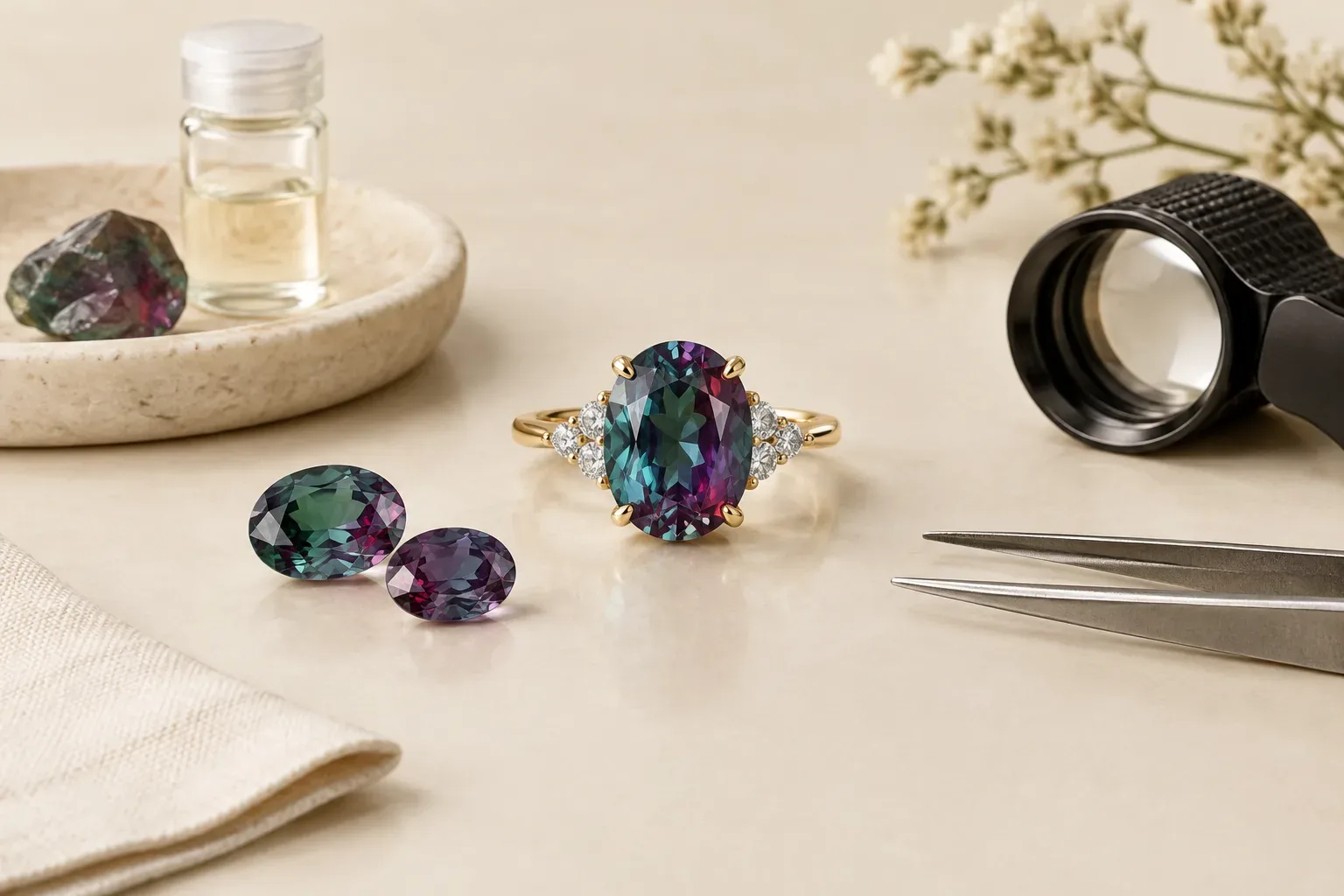
Modern personal interpretations are common and varied. Today many wearers and sellers treat alexandrite’s striking color-change (from greenish to reddish hues in many specimens) as a metaphor for balance or adaptability. Those are contemporary, individual interpretations rather than universal or historically documented meanings. Always treat symbolic claims as personal or marketing-forward unless specifically documented in reputable historical scholarship.
Which treatments should buyers know about (definitions and trade-offs)
When shoppers say "treatment" they commonly refer to a set of interventions that can change a gem’s color, clarity or stability. Authoritative guidance from the GIA groups treatments into categories such as heat treatment, diffusion, irradiation, fracture filling and surface or dye treatments. Each category has different detectability, permanence and care implications, and those differences form the trade-offs buyers must weigh.
Trade-offs to consider include price versus natural rarity, permanence versus cosmetic improvement, and everyday durability versus the need for special care. A permanent, well-detected treatment may be acceptable for a lower price, while untreated natural stones usually command higher prices and may be preferred for high-value pieces or heirlooms. Because detectability differs by technique and by stone type, an exact determination of treatment and its permanence often requires a gemological laboratory report.
How treatment questions relate specifically to alexandrite
Not all treatments are equally relevant to every gemstone. For alexandrite, buyers should focus on the general principles in this guide: ask whether the stone is natural, whether it is lab-created, and whether any treatments have been applied that change color or clarity. The FTC requires sellers to make clear distinctions among natural, lab-created and treated materials, and the GIA explains that consumers need to know which treatments affect detectability, durability and care.
Because the proven identification of specific treatments and natural origin usually depends on instrumented analysis, the practical limit for a shopper without lab access is this: you can request and expect written disclosure from the seller, ask for photos under different lighting to check color-change behavior, and ask whether a recognized gemological laboratory report accompanies the stone. Definitive claims about origin or subtle treatments are matters for a qualified jeweler or laboratory.
How alexandrite appears in jewelry and the buyer’s practical view
Alexandrite and alexandrite-like gems appear in a range of jewelry forms: rings, pendants, earrings and bespoke pieces. Industry trend reporting for 2026 shows growing interest in gemstone rings and birthstone necklaces, which are the contexts where buyers most often raise treatment and disclosure questions. Those trends suggest that treatment disclosure is a common concern for buyers of gemstone rings and necklaces.
From a practical standpoint, presentation matters. Sellers who provide clear written disclosures, several well-lit photographs, and a reputable lab report make it easier for buyers to evaluate trade-offs. If a seller cannot or will not disclose whether a stone is natural, lab-grown or treated in writing, treat that as a red flag and consider walking away or seeking alternate vendors who provide certification.
Selection and gifting guidance: respectful, practical, and evidence-led
If you are buying or gifting alexandrite and treatment status matters to you or the recipient, ask for written disclosure up front and request a lab report when price, rarity or sentiment justify the expense. The FTC’s guidance means you should expect honest, written descriptions of whether a stone is natural, lab-created or treated.
If budget is a major constraint, consider lab-created or well-disclosed treated stones as a valid choice, but make the trade-offs explicit to the recipient. If the piece is intended as an heirloom or investment, prioritize an untreated natural stone with a recognized laboratory report. For gifts where symbolic meaning is the primary concern rather than monetary value, a clearly disclosed, attractive stone may be the better pragmatic option.
What a buyer can verify without a gemological laboratory
Without a laboratory, buyers can and should obtain clear written seller disclosures, multiple high-quality photographs (including photos under different lighting to show color change), and any available seller or in-store test results. Buyers can also ask whether an independent, recognized laboratory report (for example, from a widely accepted lab) exists and request a copy before purchase.
What buyers cannot reliably do without laboratory equipment is determine natural origin beyond reasonable doubt, detect some advanced diffusion or irradiation techniques, or definitively quantify trace-element causes of color. For those determinations you need a qualified gemologist or a gemological laboratory report.
Care guidance and durability considerations
Treatment type affects care and durability. The GIA highlights that some treatments change how a stone should be handled, cleaned and stored. If a stone has been fracture-filled or surface-treated, avoid ultrasonic cleaners, harsh chemicals and steam cleaning. For any alexandrite or alexandrite-like stone, ask the seller about recommended cleaning methods and follow the specific guidance tied to any disclosed treatments.
When in doubt, clean gently with mild soap, warm water and a soft brush, and store the piece separately to avoid scratches. For high-value purchases, periodic professional inspections help ensure that settings are secure and that treatments have not been compromised over time.
Final checklist for buyers and gifters
Request written disclosure of whether the stone is natural, lab-created or treated and ask for any available laboratory report before completing a purchase. Inspect multiple photographs and, when possible, view the stone in person under different lighting to appreciate any color-change behavior. Ask the seller about recommended care and any special limitations tied to disclosed treatments. If the cost, rarity or sentiment warrants it, secure an independent gemological report; otherwise choose a clearly disclosed option that aligns with your budget and the recipient’s values.
Remember that the GIA and the FTC provide the consumer-focused framework that should guide your questions and expectations. When sellers follow those principles, buyers can make more informed, respectful choices.
Frequently asked questions
What is the most important question to ask a seller about alexandrite?
Ask for written disclosure that states whether the stone is natural, lab-created or has received any treatments, and request any available gemological laboratory report before purchasing.
Can I tell whether an alexandrite has been treated just by looking?
No. While photographs and in-person inspection can reveal some clues, definitive identification of many treatments usually requires instrumented analysis by a qualified jeweler or gemological laboratory.
Are treated alexandrites less durable?
Durability depends on the specific treatment. Some treatments are stable and long-lasting while others, such as certain surface or fracture-filling treatments, can require special care. Ask the seller about care instructions tied to any disclosed treatment.
Should I get a lab report for a gifted alexandrite?
If the piece is high-value, intended as an heirloom, or if treatment status matters to the recipient, a recognized laboratory report is a prudent step; for lower-cost or purely symbolic gifts, clear written disclosure from the seller may be sufficient.
What written disclosures should I expect under consumer guidance?
Under the FTC’s guidance you should expect clear language distinguishing natural from lab-created or treated stones, and disclosure of any treatments or enhancements that materially affect value or care.
How should I clean an alexandrite if I don't know its treatment status?
When treatment status is unknown, use the gentlest cleaning: mild soap, warm water and a soft brush, avoid ultrasonic and steam cleaners, and store the piece separately to reduce the risk of scratching.
Sources and further reading
- Imaginaire Digital — Imaginaire Digital
- Professional Jeweller / PRYA Jewellery Search Insights — Professional Jeweller / PRYA Jewellery Search Insights
- Gemological Institute of America — Gemological Institute of America
- Federal Trade Commission — Federal Trade Commission