Meaning at a glance
This guide defines spessartine garnet for engagement rings, summarizes practical decision criteria (durability, color, treatments, settings), describes how the stone is used in ring motifs, explains care and disclosure expectations, and identifies what only a qualified jeweler or gem laboratory can verify.
What spessartine garnet is (definition and practical characteristics)
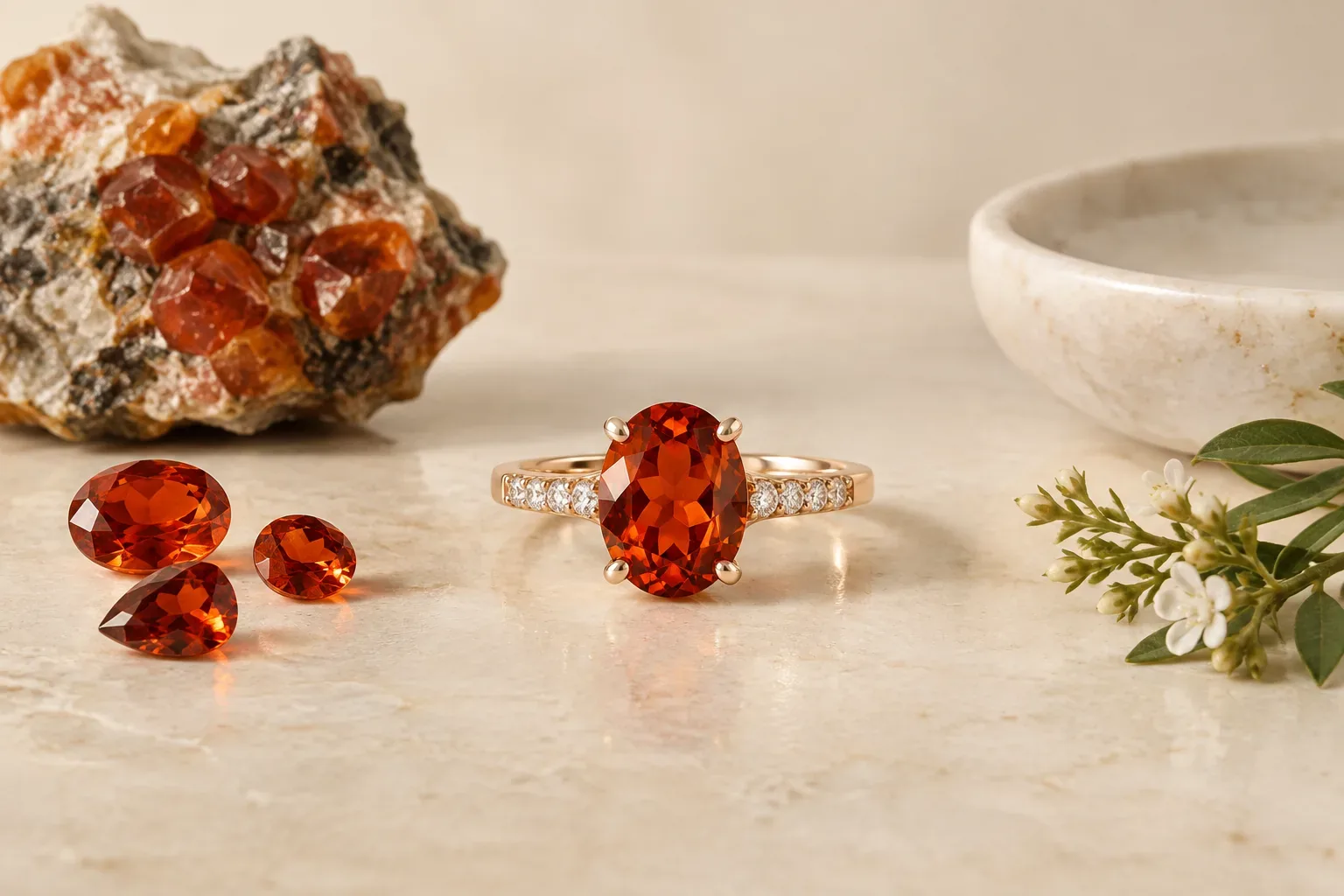
Spessartine is a variety of garnet known for lively orange to orange-red colors. In jewelry terms it is prized for saturated warm hues that read as vivid orange, tangerine, or occasionally orangey-pink depending on light and cut.
Practically, spessartine sits lower on the Mohs hardness scale than corundum or diamond, so it is more vulnerable to surface wear and chipping under rough daily use. That durability profile is one of the primary trade-offs when considering spessartine for an engagement ring.
Historical evidence and how this gemstone has been used
Documented historical evidence specifically naming spessartine garnet in ancient or medieval jewelry is limited within the evidence set used for this guide. Contemporary commercial and search-trend reporting, however, shows growing consumer interest in gemstone engagement rings generally and in distinctive colored stones in particular (Professional Jeweller / PRYA Jewellery Search Insights; Imaginaire Digital).
Because authoritative historical sources on spessartine’s cultural meanings are not part of the cited evidence, this guide does not assert long-standing ceremonial uses tied to named cultures or periods for spessartine specifically. Where older sources discuss ‘garnet’ broadly, those references generally concern a family of minerals with different chemical compositions, and practitioners should not assume that historic garnet symbolism maps directly to modern spessartine.
Documented meanings versus modern personal interpretations
Documented meanings supported by consumer protection and gemological authorities focus on disclosure, treatment, and durability rather than symbolic properties. The Gemological Institute of America (GIA) frames many consumer questions around treatments, detectability, durability, and special care needs rather than assigning symbolic values.
Modern buyers and designers often attach personal meanings to spessartine—warmth, creativity, boldness, autumnal color—and use those modern interpretations when choosing an engagement ring. These contemporary symbolic choices are personal and cultural, not universally documented; treat them as individual expression rather than verified historical attributes.
How spessartine appears in jewelry and common settings for engagement rings
Designs that protect the gem are common for spessartine engagement rings. Protective motifs include bezel and semi-bezel settings, halo settings that raise a frame of smaller stones around the center, and cathedral or low-profile mountings that reduce the chance of knocks against hand surfaces.
Contemporary jewelry trends toward colored gemstone rings, sculptural forms, and vintage references support a range of looks for spessartine from minimalist solitaires to Art Deco–inspired clusters. Professional Jeweller / PRYA Jewellery Search Insights and Imaginaire Digital report growing interest in sculptural jewelry and gemstone rings, trends that encourage creative uses of spessartine in modern engagement designs.
Suitability checklist and decision criteria
Ask first whether the recipient prefers a very hard, everyday stone or a distinctive colored gem that may require more careful wear. Spessartine is beautiful but less hard than corundum and diamond; accept that it will require protective settings and periodic inspection.
Assess color and cut as primary value drivers. Saturation and even color are often more valuable than carat weight for spessartine. Cut quality affects brilliance and durability; well-cut stones hide inclusions and distribute light evenly, but very shallow or deeply cut stones can be fragile at the girdle.
Consider treatments, disclosure, and origin. The GIA explains that treatments and detectability shape consumer questions about gemstones; insist on seller disclosures. The Federal Trade Commission requires clear distinctions among natural, lab-created, treated, and imitation materials and written seller disclosures—insist on these in writing before purchase.
Balance budget and insurance: spessartine can be more affordable than many other colored gems at similar visual impact, but insurance premiums and replacement costs should reflect its rarity, cut, and setting. Verify estimates with your insurer and seller documentation.
Practical selection and gifting guidance
Choose a setting that shields the stone and suits the recipient’s lifestyle. Active hands and manual work favor low-profile bezels or halo designs with protective side stones. For someone who prefers showy styles, a raised halo or cluster can showcase color while still offering some protection.
Require written seller representations. That includes a clear description of whether the stone is natural, treated, or lab-grown; any known treatments; the country of origin if known; and a return policy. The FTC guidance cited here stresses the importance of written disclosures for buyers of gemstones.
Obtain a recent appraisal and consider a gemological report for higher-value purchases. A gemological laboratory report will reliably identify the material, note treatments, and sometimes provide origin information; without a lab report, many important attributes cannot be independently verified.
Respect cultural and personal preferences when gifting. If the recipient values traditional symbols (for example, a diamond as a cultural norm), discuss the choice in advance or present the ring as a deliberate personal preference rather than a substitution driven solely by color or budget.
Care, cleaning, and maintenance
Follow gentle care practices. Because spessartine is more prone to surface abrasion than harder gems, clean with warm water, mild soap, and a soft brush. Avoid ultrasonic cleaners or steam unless a qualified gemologist or the seller confirms the particular stone and setting tolerate those methods.
Schedule periodic inspections. A jeweler should check the setting and prongs at least annually or when you notice looseness. The GIA guidance on treatments and durability emphasizes special care needs for treated or less-hard gemstones.
Protect from chemical exposure and hard impacts. Household chemicals, rough surfaces, and hard knocks can chip or dull spessartine. Remove the ring for heavy manual work, gardening, or sports to reduce the risk of damage.
What you cannot verify without a pro: limits of at-home checks
Color and visible inclusions are assessable at home, but many important attributes require professional testing. Only a qualified gemologist or gemological laboratory can reliably determine whether a spessartine has been treated, whether it is natural or synthetic, and (in many cases) its geographic origin.
For purchase decisions above modest value, insist on a current laboratory report. The GIA notes that detectability of treatments varies and that laboratory testing is often necessary; the FTC requires accurate labeling and disclosure that a laboratory report helps to substantiate.
Final considerations and trade-offs
Spessartine garnet engagement rings offer a distinctive, warm color statement that aligns with current interest in colored gemstone rings and sculptural jewelry reported by Professional Jeweller / PRYA and Imaginaire Digital. The buyer trades some everyday durability for color intensity and relative affordability compared with certain other gems.
Make decisions based on lifestyle, desired symbolism, and willingness to accept care, inspection, and certification needs. When in doubt, obtain written disclosures, a lab report for significant purchases, and an insurer’s replacement estimate before completing the sale.
Frequently asked questions
Is spessartine garnet durable enough for an engagement ring?
Spessartine is less hard than corundum and diamond and can be more vulnerable to scratches and chips, so it is suitable if you and the wearer accept protective settings, regular inspections, and gentler daily care.
How should I clean a spessartine engagement ring?
Clean with warm water, mild soap, and a soft brush. Avoid ultrasonic cleaners and steam unless a gemologist or the seller confirms the specific stone and setting tolerate those methods.
Can a jeweler verify if my spessartine is treated or natural?
A qualified jeweler can offer preliminary observations, but only a recognized gemological laboratory can reliably identify many treatments, distinguish natural from synthetic material, or make authoritative origin determinations.
What settings work best for spessartine engagement rings?
Protective settings such as bezels, low-profile halos, and designs with guard stones or side bezels reduce the risk of knocks and chipping and are commonly recommended for this gem.
Should I ask for a lab report when buying a spessartine engagement ring?
Yes—for purchases of significant value, insist on a current laboratory report and written disclosures identifying treatments, whether the stone is natural or lab-grown, and any known origin information.
Do sellers have to disclose treatments and origin?
Under guidance cited from the Federal Trade Commission, sellers should provide clear, written disclosures distinguishing natural, treated, lab-created, or imitation materials; demand these disclosures before purchase.
Sources and further reading
- Imaginaire Digital — Imaginaire Digital
- Professional Jeweller / PRYA Jewellery Search Insights — Professional Jeweller / PRYA Jewellery Search Insights
- Gemological Institute of America — Gemological Institute of America
- Federal Trade Commission — Federal Trade Commission