Meaning at a glance
This garnet treatment guide explains the difference between treated and untreated gemstones, summarizes how treatments are handled in the trade, lists decision criteria and trade-offs for buyers, gives safe care guidance, and makes explicit what verification requires a qualified jeweler or gemological laboratory.
What the historical evidence shows (and what it does not)
Many popular histories and museum labels associate garnet with specific periods or cultures—ancient Rome and Classical antiquity, medieval Europe, and Victorian-era jewelry collections. Those broad cultural associations appear frequently in general jewelry literature but are not documented in the specific sources used for this guide, which focus on treatments, disclosure, and market trends.
The sources used here emphasize modern trade practices rather than primary historical analysis. The Gemological Institute of America (GIA) discusses how different gem species are treated and how treatments affect detectability and care. The Federal Trade Commission (FTC) sets the legal expectations for disclosure of treatments and lab-created materials. Market trend reports from Professional Jeweller and Imaginaire Digital describe contemporary consumer interest in gemstone jewelry and styles, which helps explain current demand for untreated or ethically documented stones, but they do not provide primary historical evidence about garnet use in specific cultures or periods.
Because the approved source set does not include specialized historical scholarship on garnets, readers should treat commonly cited cultural connections as generalized historical associations found in popular jewelry writing rather than as evidence-led, primary-source claims. If precise archaeological or archival documentation is needed, consult specialist gemological history references or museum publications.
Documented historical meanings versus modern personal interpretations
Documented historical meanings: Within the scope of the sources cited for this article, reliable documentation focuses on treatment practice, disclosure standards, and contemporary buyer behavior rather than on symbolic meanings attached to garnet by past cultures. The GIA and FTC materials do not claim a universal traditional meaning for garnet; instead they frame the gemological and legal context buyers should expect.
Modern personal interpretations: Today people choose garnet for color, birthstone associations (January), and personal symbolism. Those personal meanings are contemporary and individual. They matter for gifting and design choices but are distinct from any historic claim about cultural symbolism unless supported by historical research. For practical purchase decisions, treat symbolism as a private preference and prioritize objective information—treatment status, durability, and documentation—when assessing value.
Common treatments in the gemstone trade and how they relate to garnet
The gem trade uses several broad categories of treatment: heat treatment, surface coating, filling of fractures, irradiation, diffusion, impregnation with resins, and laboratory-grown alternatives for certain species. The Gemological Institute of America (GIA) describes these types of treatments and stresses that the prevalence and detectability of each treatment vary by gem species.
GIA’s guidance is the relevant baseline: different gems have different typical treatments and testing regimes. Some gemstones are routinely treated and thus more commonly reported in laboratory notes; others are less frequently enhanced. For shoppers, the practical implication is to ask whether a garnet has been enhanced and to request written disclosure. Visual inspection alone seldom suffices to detect subtle or internal treatments; where treatment status materially affects value, insist on a gemological report.
How garnet appears in jewelry and how treatments affect its use
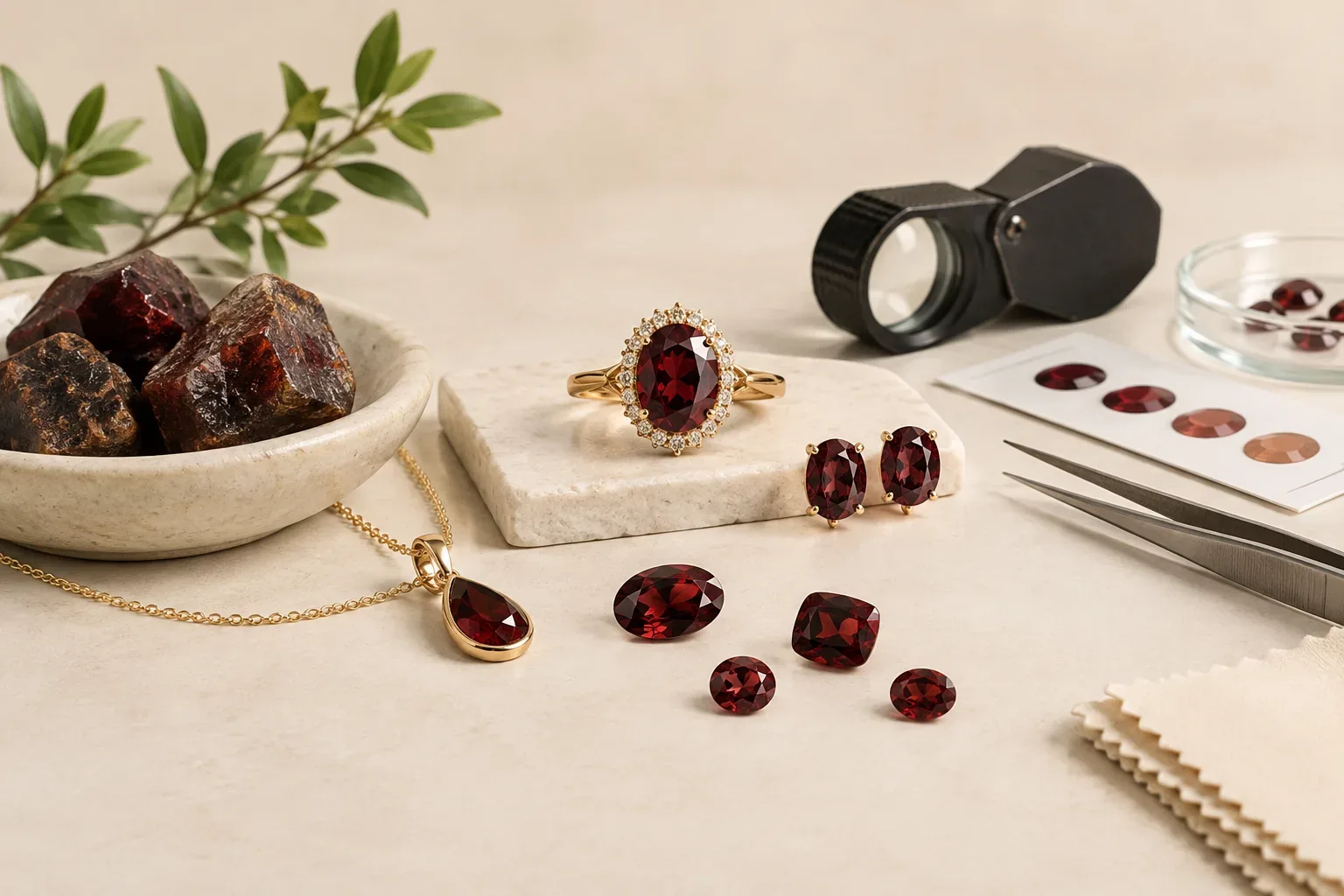
Garnet appears in many forms of jewelry—rings, pendants, studs, and vintage-style pieces. Market reports from Professional Jeweller and Imaginaire Digital show strong consumer interest in gemstone rings, necklaces, and birthstone pieces, which explains why garnet is commonly marketed in engagement-adjacent and fashion jewelry contexts. The stone’s range of red, orange, green, and other tones makes it adaptable to many designs.
When a garnet is untreated, designers and customers often value the natural color and durability. When any enhancement is disclosed, it can change how a setter designs protective settings and how a buyer expects the stone to perform over time. For example, a stone that has been filled or coated may be less suitable for everyday rings that face knocks or harsh cleaners; a stable, untreated garnet will usually tolerate everyday wear better. If a treatment affects porosity or surface stability, the setting choice and care instructions should reflect that risk.
Decision criteria and trade-offs for buyers
When choosing between treated and untreated garnet, consider four decision criteria: aesthetics, durability, price, and verifiability. A treated stone may offer a richer color or better apparent clarity for a lower price, but treatments can change durability and long-term appearance. An untreated stone will often command a premium and may be simpler to appraise for longevity.
Trade-offs include cost versus certainty, and beauty versus permanence. Sellers should disclose treatments; the FTC requires clear distinctions among natural, lab-created, treated, and imitation materials. If you prioritize resale value or long-term durability, pay more for independent documentation that describes the treatment status. If you prioritize upfront appearance and budget, a disclosed treatment might be acceptable—provided you understand care limits and return rights.
What you can verify yourself and what needs expert testing
What you can reasonably verify without a lab: Ask for written disclosure, look for obvious signs of surface coating (uneven sheen), request high-resolution photos and magnified views, check seller return and disclosure policies, and evaluate setting style for how the stone will be protected in wear. For many day-to-day purchases these steps are sufficient to make an informed decision.
What requires a qualified jeweler or lab: Identifying subtle enhancements, detecting partial or internal fracture-filling, distinguishing natural from certain lab-grown materials, and species-level identifications often require gemological instruments and expertise. If treatment status materially affects price or use—particularly for higher-value garnets—obtain a report from an accredited gemological laboratory. The GIA explains that detectability and reporting vary by treatment type and species.
Practical care guidance
Follow general, treatment-aware care: clean garnet jewelry in warm, soapy water and a soft brush unless the seller’s disclosure or lab report specifies a treatment that is sensitive to heat, solvents, or ultrasonic cleaning. The GIA emphasizes that treatments can change recommended care, so always follow any treatment-specific instructions that accompany a purchase.
Protect treated or fragile examples by avoiding chemical exposure and harsh mechanical impacts. For routine storage, keep garnet pieces separate from harder gems to prevent abrasion. When in doubt about a cleaning method, consult the seller or a professional jeweler before using ultrasonic cleaners, steamers, or household chemicals.
Respectful selection and gifting guidance
Be explicit about expectations before purchasing as a gift. If the recipient values natural, untreated materials, ask the seller for written confirmation and, for higher-value pieces, an independent lab report. If your budget steers you toward an enhanced stone, treat the enhancement as part of the gift story: disclose it to the recipient and include care guidance so the piece lasts.
Consider matching the setting and style to the stone’s characteristics. If a garnet has any surface treatments or is set in a ring for everyday wear, choose a protective setting like a bezel or a lower-profile mount. For heirloom intentions, prioritize documented, untreated stones where possible; for fashion jewelry, disclosed enhancements are often acceptable and let you achieve bolder color at a lower cost.
Questions to ask and disclosure language to request
Ask the seller these direct questions: Has this garnet been treated or enhanced? If yes, what specific treatment was used? Will you provide written disclosure or a lab report? What is your return policy if undisclosed treatment is later found? If the answer is uncertain or the seller declines to provide documentation, treat that as a material risk that should influence price and your willingness to buy.
Request documentation phrased clearly: 'This is a natural garnet; the following treatment(s) have been performed: [list].' For higher-value purchases, ask for an accredited gemological laboratory report that identifies the garnet species, any treatments, and any comments on durability or care.
Final practical checklist
Before buying: confirm disclosure, inspect magnified images or see the stone in person, check return policy, and for costly stones request a lab report. During ownership: follow treatment-specific care guidance and consult a jeweler for repairs or re-setting to avoid exposing treated surfaces to harmful procedures.
Remember: the FTC requires sellers to disclose treatments and the GIA provides the technical background on treatment types and detectability. Use both regulatory and gemological resources when a treatment influences value, durability, or intended use.
Frequently asked questions
Are garnets commonly treated?
Treatments vary across gem species; the Gemological Institute of America (GIA) notes that some gems are routinely treated while others are less often enhanced. The best practice is to ask the seller for disclosure and, for higher-value purchases, to request a lab report that specifies whether any treatment has been applied.
How can I tell if a garnet has been enhanced?
Simple visual checks and magnified photos can reveal obvious surface coatings or unusual surface reflections, but subtle internal treatments or species-level identifications usually require gemological equipment. If treatment status materially affects the price, obtain a report from a qualified jeweler or an accredited gemological laboratory.
What should I ask the seller before buying a garnet?
Ask directly whether the stone has been treated, what specific treatment was used, whether they will provide written disclosure, and whether there is a return policy if undisclosed treatment is later discovered. For expensive stones request an independent lab report.
Do treatments change how I should care for a garnet?
Yes. The GIA emphasizes that treatments can affect recommended care and durability. Clean untreated garnet in warm, soapy water with a soft brush. If a stone is disclosed as treated, follow any seller or lab care guidance and avoid ultrasonic cleaners or harsh chemicals unless explicitly permitted.
Can I rely on seller disclosure alone?
Seller disclosure is the first and essential step and is required by the FTC in the United States. However, for subtle or value-impacting treatments, seller disclosure should be supported by documentation such as a lab report when the treatment status affects price, use, or resale expectations.
Sources and further reading
- Imaginaire Digital — Imaginaire Digital
- Professional Jeweller / PRYA Jewellery Search Insights — Professional Jeweller / PRYA Jewellery Search Insights
- Gemological Institute of America — Gemological Institute of America
- Federal Trade Commission — Federal Trade Commission