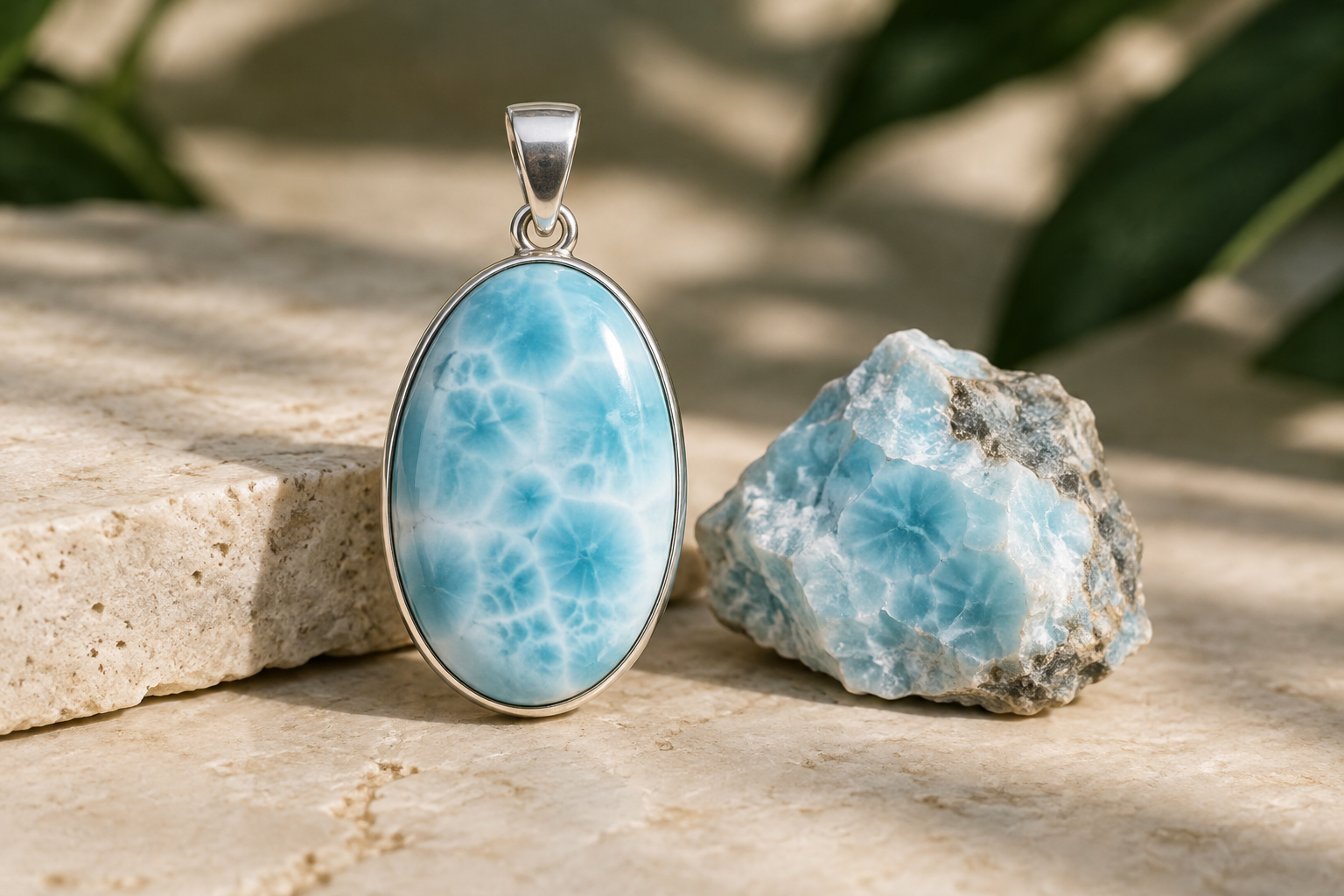
Meaning at a glance
Larimar jewelry meaning centers on its identity as blue pectolite from the Dominican Republic; claims that it universally symbolizes the ocean are modern interpretations, while origin, color characteristics, disclosure of treatments, and careful handling are factual concerns for buyers.
Short answer
Larimar jewelry meaning: larimar is the blue variety of the mineral pectolite associated with mines in the Dominican Republic; today many people read oceanic or calming symbolism into its blue tones, but that symbolism is a modern interpretation rather than an ancient or universally documented cultural meaning. The material’s origin, color range, and practical care needs are documented concerns for anyone buying or wearing larimar.
What larimar is and where it comes from
Scientifically, larimar is a blue variety of pectolite. The Gemological Institute of America (GIA) describes it as blue pectolite associated with the Dominican Republic and treats that identity and origin as defining characteristics of the material. When sellers label a stone as larimar, they are signaling both the mineral species (pectolite) and a geographic connection to the Dominican Republic.
Because the name “larimar” is tied to that locality, origin is a core part of what buyers mean when they ask about larimar jewelry meaning. For buyers seeking the material’s characteristic color and texture, verified origin and clear disclosure from reputable dealers are important.
Documented history versus modern interpretations
Documented historical information about larimar is limited in the sense that the scientific literature and museum resources focus on its mineralogy, locality, and gemological traits rather than long traditions of symbolic use. The GIA’s work on blue pectolite emphasizes identification and origin, and the Smithsonian’s educational materials place minerals like pectolite in the broader context of gem and mineral study rather than attributing long-standing cultural symbolism.
In contrast, many contemporary meanings attached to larimar—for example, its association with the sea, healing, or specific spiritual properties—are modern personal or marketing interpretations. These contemporary associations have become popular through tourism, jewelry marketing, and personal storytelling, but they are not the same as a documented historical cultural tradition. It is accurate to present oceanic and calming symbolism as contemporary and individual rather than universal or ancient.
Color, variations, and gemological context
Larimar’s most distinctive feature is its blue color, which ranges from pale sky blue to deeper blue tones and can include white or greenish veining. The GIA’s research on blue pectolite documents these color variations and treats them as part of the material’s identity.
As a mineral specimen used in jewelry, larimar sits within the broader category of gemstones and minerals that the Smithsonian presents as both geological objects and objects of adornment. That context helps explain why collectors and jewelers are interested in color, pattern, and the way individual cabochons or beads display veining and tonal variation.
How larimar appears in jewelry
Modern jewelry commonly uses larimar as polished cabochons, beads, and small inlays. Artisans and commercial jewelers favor cabochon cuts because the stone’s color zones and cloudlike patterns show best with a smooth, domed surface. Larimar is often set in pendants, earrings, and bracelets where the stone can be appreciated visually; rings are also made, although protective settings are advisable if a piece will be worn daily.
Design choices around larimar tend to emphasize its color and pattern. Settings that frame a single, well-matched cabochon highlight the stone’s surface patterning, while bead strands or mixed-stone designs play against complementary materials. These are contemporary jewelry practices rather than part of any documented historical ritual use.
Buying: identity, treatment disclosure, and practical checks
When buying larimar, ask sellers for clear information on origin and any treatments. The Gemological Institute of America’s materials on gem treatment recommend that laboratories and dealers disclose treatments and enhancements that affect appearance or durability, and buyers should rely on that principle when assessing larimar purchases.
Request a provenance statement or lab report when possible, especially for higher-value pieces. Closely inspect the stone for cracks or friable areas, since mineral specimens used as gems vary in toughness. For higher-value purchases, a reputable gemological laboratory report confirming identity and origin adds confidence.
Care and preservation
Larimar is best treated as a relatively delicate gemstone compared with many traditional jewelry gems. The Smithsonian’s educational framing of gems and minerals reminds readers that minerals differ in hardness and durability, which affects care. For larimar, gentle cleaning with mild soap, lukewarm water, and a soft cloth is the safest general approach; avoid steam and ultrasonic cleaners unless a lab or experienced jeweler has confirmed the stone can tolerate them.
Avoid exposing larimar to harsh chemicals, extended direct sunlight for prolonged periods if concerned about surface fading or thermal stress, and knocks or pressure that could chip or crack the stone. When wearing larimar in a ring intended for daily use, choose protective settings such as bezel or partial-bezel mounts and store pieces separately to prevent abrasion.
Selection, gifting, and cultural respect
If you are buying larimar as a gift, consider both the recipient’s style and the story you want the piece to tell. Because modern oceanic symbolism is a popular interpretation, you can responsibly communicate that symbolic association while acknowledging that the connection is contemporary rather than an ancient cultural meaning. Framing the stone’s Dominican origin respectfully—crediting the locality and choosing ethically sourced pieces—honors where the material comes from.
Choose a reputable seller who discloses origin and any treatments, and consider asking whether proceeds support local Dominican communities if that is important to you. Present a larimar piece with information about its mineral identity and origin so the recipient can appreciate both its natural history and any personal meaning you attach to it.
Closing thoughts
Larimar jewelry meaning rests on two different kinds of truth: a verifiable mineral identity and origin documented by gemological authorities, and modern personal or marketing interpretations—often ocean-associated—that people adopt for emotional or aesthetic reasons. For buyers and gift-givers, giving priority to clear disclosure, careful selection, and gentle care will preserve both a piece’s appearance and its provenance story.
Frequently asked questions
What exactly does 'larimar' mean?
Larimar refers to the blue variety of the mineral pectolite that is associated with the Dominican Republic; the name signals both the mineral species and the locality rather than a single symbolic meaning.
Is larimar only found in the Dominican Republic?
Larimar is the trade name used for blue pectolite from the Dominican Republic; buyers should ask sellers for origin disclosure and request a lab report when provenance matters to their purchase.
Does larimar have a traditional cultural meaning tied to the sea?
Oceanic symbolism attached to larimar is a modern interpretation popular among tourists and jewelry buyers; it should be presented as a contemporary personal or marketing meaning rather than a documented historical tradition.
Are larimar stones treated or enhanced?
Treatments and enhancements can affect many gem materials; the Gemological Institute of America recommends that any treatments be disclosed, so buyers should ask sellers directly and seek documentation for higher-value pieces.
How should I clean my larimar jewelry?
Use mild soap, lukewarm water, and a soft cloth for routine cleaning; avoid steam and ultrasonic cleaners unless a qualified gemologist confirms they are safe for the particular piece.
Can larimar fade or change color over time?
Significant permanent color change is not commonly reported as a general property, but because minerals vary in stability, avoid harsh chemicals, prolonged extreme heat, and unnecessary abrasion; ask the seller about any known treatments that could affect color stability.
What should I ask the seller when buying larimar?
Ask about origin (Dominican Republic), whether the stone has been treated, whether a lab report is available, and about return and repair policies; purchasing from a reputable dealer increases the chance of accurate disclosure.
Is larimar suitable for everyday wear?
Larimar can be worn regularly, but because it is not as hard as some traditional gemstones, choose protective settings, avoid rough activities while wearing it, and store pieces separately to prevent scratching.
Sources and further reading
- Blue Pectolite from the Dominican Republic — Gemological Institute of America
- Gem Treatment — Gemological Institute of America
- Gems and Minerals: Beauties and Building Blocks — Smithsonian National Museum of Natural History