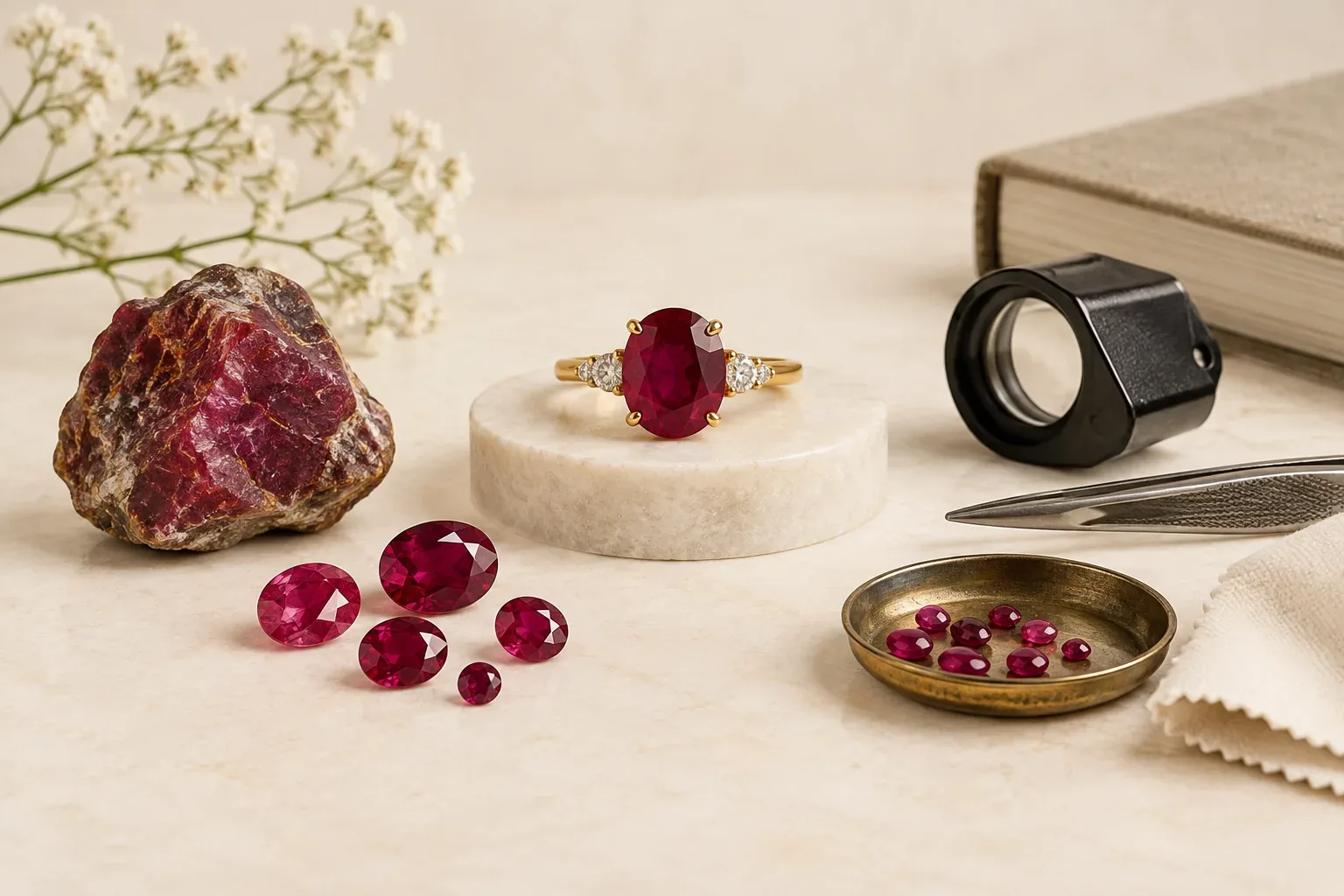
Meaning at a glance
This ruby buying guide defines the buyer’s decision criteria (color, clarity, cut, treatments, and certification), explains practical trade-offs, gives safe-care and gifting guidance, and makes clear which statements require a qualified jeweler or gemological laboratory to verify.
Direct answer: what a 'ruby buying guide' should give you
A useful ruby buying guide gives clear definitions of the decision criteria (color, clarity, cut, weight), explains common treatments and their disclosure, identifies practical trade-offs between appearance and price, outlines safe care, and states the limits of what a consumer can confirm without a qualified jeweler or a gemological laboratory report. This article follows that evidence-led approach and points to when you must insist on written disclosure or third-party testing.
How historians and written evidence are treated here
Readers often expect historical attributions—who prized rubies, and what they meant in specific cultures or periods. The approved evidence set for this article does not include primary historical sources detailing ruby meanings in particular cultures, so this guide does not invent or assert precise historical beliefs. Instead, I separate documented, source-backed information (for example, trade and consumer-protection guidance) from commonly repeated cultural attributions that appear in modern summaries but are not verified here.
Documented, evidence-backed points (what our sources support)
Gemological and consumer-protection organizations make clear that treatments, their detectability, and disclosure are central consumer questions when buying any colored gemstone. The Gemological Institute of America (GIA) states that treatments exist, affect detectability and durability concerns, and therefore create specific consumer questions about disclosure and care. The U.S. Federal Trade Commission requires clear distinctions among natural, lab-created, treated, and imitation materials and recommends written seller disclosures. Market reports from trade publishers show growing consumer demand for gemstone rings and birthstone jewelry, which shapes where rubies are commonly purchased and worn (see the Professional Jeweller and Imaginaire Digital sources).
Common historical attributions — clearly marked as modern summaries, not new documentary claims
Across jewelry writing you will see rubies associated with passion, protection, and nobility and cited in connection with many cultures. Those attributions are widely repeated in modern jewelry literature and retail copy, but because the approved evidence set for this article does not include the primary historical documents or museum catalogues that would verify each claim, I present these attributions as contemporary summaries rather than as documented historical fact. If you need precise historical citations (for example, a claim about a specific royal collection or a seventeenth-century text), consult dedicated historical or museum sources or request provenance documentation from a dealer.
Color: the single biggest visual decision
Color is the most influential visual and price factor for rubies. Buyers consider hue (the basic color), tone (lightness to darkness), and saturation (color intensity). Different markets and personal tastes favor different balances of those three variables. Trade reporting shows that gemstone rings and engagement pieces are strong demand drivers, which means many buyers prioritize color that photographs and wears well in ring settings (see Imaginaire Digital and Professional Jeweller for market context).
Because color is subjective, evaluate ruby color under natural daylight when possible and compare stones side by side. Ask the seller whether the stone has been treated to alter color and request written disclosure; treatments change visual appearance and can affect value and care needs (see GIA and the FTC on treatments and required disclosure).
Clarity and inclusion trade-offs
Most natural rubies contain inclusions. Inclusions affect transparency and brilliance; in some stones they create desirable effects, while in others they reduce apparent color or durability. Buyers must balance a clearer appearance against the higher cost of very clean stones and against the possibility that a very included stone may be more fragile. Because treatments (for example, clarity enhancement) exist and can be difficult to detect without specialized equipment, insist on written disclosure of any clarity treatments and consider asking for a qualified jeweler’s inspection or a laboratory report if the stone’s clarity materially affects your purchase decision.
Cut, shape, and setting considerations
Cut affects how the ruby returns light and therefore the perceived color and brilliance. Cuts and shapes for rubies vary from traditional ovals and cushions to modern fancy cuts and cabochons. For colored stones, proportion and symmetry that maximize color without making the stone look dark are often preferred. Because market reporting shows demand for sculptural and vintage-inspired settings, consider how a chosen cut will sit in a ring or pendant and how prongs or bezels will influence light entering the stone (Professional Jeweller and Imaginaire Digital describe broader jewelry demand trends that make these considerations relevant).
Treatments, lab-created stones, and disclosure
Treatments are common in the colored-gem market and can include heat treatment or clarity enhancements. The GIA emphasizes that treatments vary in detectability and in their effect on durability and value. The Federal Trade Commission requires clear written distinctions among natural, lab-created, treated, and imitation materials. Always ask the seller for clear, written disclosure about whether the ruby is natural, lab-grown, and whether it has undergone treatments. For significant purchases, request a gemological laboratory report from a reputable lab and verify that the lab’s report explicitly lists treatments and origin claims.
What you can and cannot verify without a lab or qualified jeweler
You can visually assess color, basic cut, and some surface flaws without specialized equipment. You cannot, with certainty, verify treatments that are internal or microscopic, determine geographic origin reliably, or detect sophisticated clarity or color enhancements without a qualified jeweler’s microscope and, often, laboratory testing. For claims that materially affect value—such as “untreated natural ruby” or a stated country of origin—insist on a current report from a recognized gemological laboratory and on written seller disclosure; the FTC recommends written disclosures for consumer protection.
Value and practical trade-offs
Value combines color, clarity, cut, carat weight, and the presence or absence of treatments. In practical shopping, buyers trade off color versus clarity and size versus quality: a slightly smaller stone with more desirable color may be more pleasing and cost-effective than a larger, duller stone. Treatments commonly reduce market value compared with similar untreated stones; that effect is part of why buyers should require disclosure and lab reports for high-value purchases.
How rubies appear in jewelry today
Current market demand reported by trade publishers shows strong interest in gemstone engagement rings, birthstone necklaces, and sculptural or vintage-inspired settings, so rubies commonly appear in rings, pendants, and cluster jewelry. Settings in rings often use prongs or bezels that expose the stone to light and wear; pendants and earrings frequently use closed-back settings which can change the stone’s apparent color. Consider how the setting will affect what you see and the stone’s exposure to knocks and daily wear.
Care guidance: everyday wear and special care
Because treatments and mounting styles affect durability and care needs, ask the seller about any necessary precautions. The GIA highlights that treatment and durability questions are important for consumers, and the FTC underscores the need for disclosure so a buyer can follow correct care. For routine care, avoid harsh chemicals and store gemstone jewelry separately to prevent knocks and abrasion. For any unusual or high-value stone, ask a qualified jeweler about safe repair and re-setting procedures and whether any treatments affect recommended cleaning methods.
Practical and respectful selection or gifting guidance
For gifts, consider the recipient’s style, the intended use (daily wear versus occasional), and whether they prefer natural or lab-grown stones. If the recipient is sentimental about origins or treatments, ask whether they want a laboratory report or provenance documentation. For engagement rings or significant presents, insist on a written disclosure of treatments and, when appropriate, an independent laboratory report. If you are buying on a budget, prioritize the one attribute that matters most to the recipient—often color for rubies—and choose a reputable seller who provides clear return policies and written disclosure.
What to ask the seller before you buy
Ask whether the ruby is natural, treated, or lab-created and request written disclosure. Ask for a gemological laboratory report if the purchase is significant, and confirm the seller’s return policy and aftercare recommendations. For high-value purchases, have a qualified jeweler inspect the stone and confirm the seller’s claims, and if provenance or origin is important, insist the seller provide documentation that supports the claim.
Frequently asked questions
How can I tell if a ruby is treated or natural?
You cannot reliably detect many internal treatments with the naked eye. Ask the seller for written disclosure and, for significant purchases, request a gemological laboratory report. A qualified jeweler can perform preliminary testing, but laboratory analysis is the definitive method for many treatments.
Do lab-grown rubies have the same value as natural rubies?
Lab-grown rubies can have the same chemical and physical properties as natural stones but generally trade at different price levels. The Federal Trade Commission requires sellers to disclose whether a gemstone is lab-created or natural; for value comparisons, request written disclosure and current market advice from a reputable jeweler.
What documentation should I insist on when buying a ruby?
Insist on written disclosure about whether the ruby is natural, treated, lab-created, or an imitation. For higher-value purchases, ask for a current report from a recognized gemological laboratory that states treatments and, if claimed, geographic origin.
Can I clean a ruby at home?
Basic cleaning—warm water, mild soap, and a soft brush—is usually safe, but final care depends on any treatments and the setting. Because treatments can affect recommended cleaning, ask the seller or a qualified jeweler for care instructions and avoid harsh chemicals and ultrasonic cleaners unless you have confirmation the stone and its setting are safe for those methods.
Is color or clarity more important for rubies?
Color is usually the dominant factor for rubies, but balance is key. Many buyers prefer a strong, appealing color even if the stone has minor inclusions. Personal preference and the intended use should guide which attribute you prioritize.
When should I get a laboratory report?
Obtain a laboratory report for purchases where the stone’s treatment status or origin materially affects value—typically for larger, more expensive rubies or when the seller claims the stone is untreated or from a specific location.
Sources and further reading
- Imaginaire Digital — Imaginaire Digital
- Professional Jeweller / PRYA Jewellery Search Insights — Professional Jeweller / PRYA Jewellery Search Insights
- Gemological Institute of America — Gemological Institute of America
- Federal Trade Commission — Federal Trade Commission