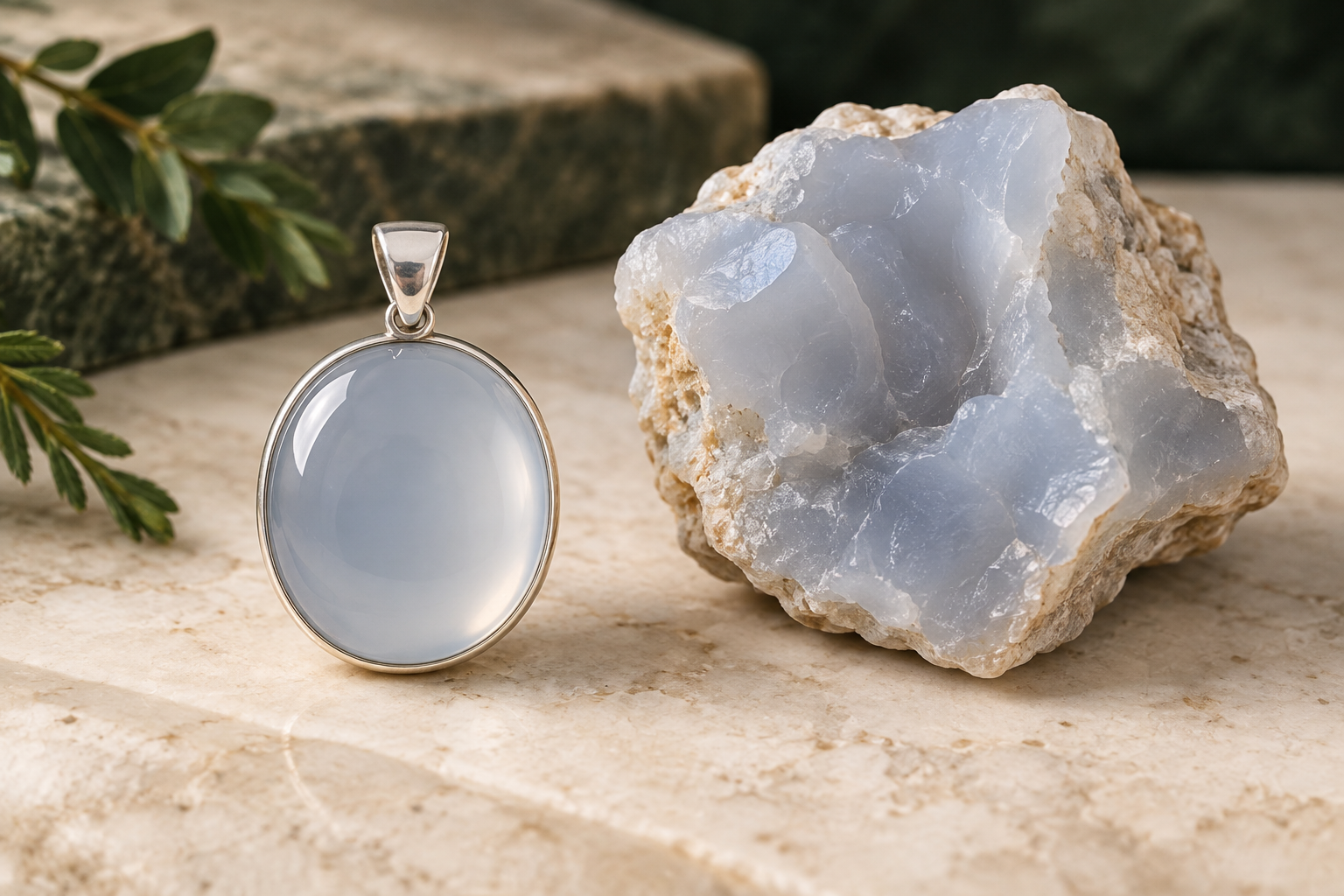
Meaning at a glance
Chalcedony jewelry meaning centers on a gem family identity: chalcedony is microcrystalline quartz that appears under many variety and trade names; treatment and dyeing must be disclosed, and symbolic meanings are largely modern interpretations rather than universally documented historical beliefs.
Quick answer
Chalcedony is a microcrystalline form of quartz that includes many named varieties; dyeing, heat treatments, and the use of trade names must be disclosed, and any symbolic meanings offered today are modern or personal interpretations rather than universally documented historical facts.
What chalcedony is and the common named varieties
Chalcedony describes a group of microcrystalline quartz forms rather than a single, distinct mineral. That family label covers a wide range of colors and patterns that have received separate names in gem, lapidary, and trade contexts. The Smithsonian National Museum of Natural History identifies chalcedony as part of the broader quartz family and treats agate, onyx, carnelian, chrysoprase, and similar stones as related varieties and trade names within that system.
Because chalcedony occurs in many colors and banding patterns, jewelers and dealers commonly use specific variety names to describe material: for example, agate for banded chalcedony, onyx for some banded or layered material with contrasting colors, carnelian for orange-red material, and chrysoprase for apple-green chalcedony colored by nickel-bearing inclusions. Trade and marketing often add further labels (for example, 'blue chalcedony' or other color descriptors). Buyers should understand that these variety and trade names sit under the technical umbrella of chalcedony.
Documented historical evidence: what museums and mineral collections show
Collections and museum records document that microcrystalline quartz forms—cataloged under chalcedony and its variety names—have been worked into beads, intaglios, seals, and decorative objects for a long time. Curatorial descriptions in major natural history and archaeological collections treat these materials by mineral identity and variety, and museums maintain records tying specific objects to findspots, dates, and cultures when such provenance exists. The Smithsonian National Museum of Natural History provides a taxonomic approach to quartz that helps curators and researchers identify and label museum specimens.
That said, the presence of chalcedony in a museum collection is not, by itself, proof of a single, universal symbolic meaning across time or place. Provenance and context are crucial: the label on an object will document where and when it was used, and those details are the basis for any historical interpretation offered by a museum or academic study. For accurate culture- or period-specific claims, consult the primary object records and archaeological reports associated with the pieces in question.
Historical meanings versus modern interpretations
When people today speak of the 'meaning' of chalcedony—associating it with calm, protection, communication, or other qualities—those attributions are generally modern interpretations or personal beliefs. Commercial and metaphysical sources often promote consistent themes (for example, calming energy or good luck), but such themes are not universally documented across historical sources, and they vary by modern tradition.
Documented historical meanings, when they exist in scholarly sources or museum records, are specific to cultures, communities, and contexts. Museums and academic publications record cultural uses and attributions when there is clear evidence. The resources approved for this article emphasize mineral identity and variety (Smithsonian) and the importance of disclosure for treatments and trade practices (Gemological Institute of America) rather than cataloging universal symbolic meanings. In short, treat historical symbolic claims with attention to provenance and with caution when relying on modern marketing or broad metaphysical statements.
How chalcedony appears in jewelry and decorative traditions
Chalcedony appears in jewelry in many forms: carved cameos and intaglios, smooth cabochons, tumbled beads, beads strung into necklaces and rosaries, inlays, and polished slices set as pendants or earrings. Variety names tend to guide style choices—carnelian is often used for warm-toned cabochons and signet-style pieces, agate is common as beads and polished slices that show banding, and chrysoprase is prized for its apple-green color and used in settings where color is the main attraction.
Because chalcedony takes a good polish, it is popular for carved motifs, particularly cameos and figurative carvings, where the surface luster and even color enhance carved details. Some jewelry styles emphasize the stone’s natural banding or translucence; others rely on uniform color and smooth surfaces. The same mineral family also appears in beadwork and folk jewelry traditions where local material availability and lapidary techniques determined how chalcedony was used.
Dyeing, treatments, and what to expect when buying
Chalcedony is sometimes heat-treated, dyed, or otherwise altered to enhance color uniformity or to produce hues that are rare in untreated material. Because many chalcedony varieties are porous at the microscopic level, dyes can penetrate and create vivid or uniform color. The Gemological Institute of America stresses that gem treatments—especially those that affect appearance permanently or temporarily—should be disclosed to buyers, and reputable sellers will state whether a stone has been dyed, heated, impregnated, or coated.
If you are buying chalcedony, ask whether the piece is described using a trade name or variety name and whether any enhancement has been applied. Request written disclosure of treatments when possible. For rare or high-value items, consider asking for a gemological report or for the seller’s policy on returns if undisclosed treatments are later detected. Transparency about treatment and naming prevents surprises and helps you compare value across similar pieces.
Practical selection and respectful gifting guidance
When selecting chalcedony for yourself or as a gift, match the stone’s aesthetic and durability to how the piece will be worn. Chalcedony is a durable, polishable form of quartz suitable for everyday pendants, earrings, and many rings, but heavier daily wear—such as rings subject to knocks—may show chips or abrasions over time depending on setting and cut. Consider cabochons and bezel settings for pieces intended for frequent wear because those presentations protect edges more than exposed faceted mounts.
Respect cultural context when gifting pieces that use historical motifs or traditional forms. If a piece incorporates iconography or a style strongly associated with a particular culture, learn what it signifies from reliable museum or community sources before presenting it as a gift. If you are buying with symbolic intent—for example, to convey calm or protection—state clearly that meaning is a modern interpretation so the recipient understands its contemporary nature rather than assuming a documented historical provenance.
Care and routine maintenance
Chalcedony, as a microcrystalline quartz, is relatively hard and takes a good polish. For routine cleaning, warm water, a few drops of mild dish soap, and a soft brush or cloth are effective. Rinse thoroughly and dry with a soft cloth. Avoid prolonged exposure to household chemicals such as bleach or strong acids and avoid steam cleaning or ultrasonic cleaners when the stone is known to be dyed or stabilized, because some enhancement processes can be affected by heat, steam, or solvents.
Store chalcedony jewelry away from harder materials that might scratch the surface, and keep separate compartments for pieces with delicate settings. For carved or porous pieces, occasional professional cleaning and inspection by a trusted jeweler will help maintain the appearance and identify any necessary repairs to settings or mountings.
Frequently asked questions
Is chalcedony the same as agate or carnelian?
Chalcedony is the umbrella term for microcrystalline quartz; agate, carnelian, onyx, and chrysoprase are variety or trade names used to describe particular colors, banding, or appearances within the chalcedony family.
Are chalcedony stones commonly treated or dyed?
Yes. Some chalcedony materials are heat-treated or dyed to enhance or change color. Reputable sellers should disclose any treatments, and buyers can request written disclosure or documentation.
How should I clean chalcedony jewelry?
Clean chalcedony with warm water, a mild soap, and a soft brush or cloth, then rinse and dry. Avoid harsh chemicals and take caution with steam or ultrasonic cleaners, especially for dyed or stabilized pieces.
Do historical sources assign a single symbolic meaning to chalcedony?
No single symbolic meaning is universal. Museums and academic sources record specific cultural uses where evidence exists, but modern symbolic attributions (calming, protection, etc.) are generally contemporary interpretations rather than universally documented historical facts.
What should I ask a seller when buying chalcedony?
Ask about the exact variety or trade name, whether the stone has been dyed, heated, or otherwise treated, and whether the seller provides any written disclosure or a gemological report for high-value items.
Is chalcedony durable enough for everyday jewelry?
Chalcedony, as a form of quartz, is relatively hard and takes a good polish, making it suitable for many types of everyday jewelry. However, settings and intended wear should be considered to protect edges and carved details.
Sources and further reading
- All Sorts of Quartz — Smithsonian National Museum of Natural History
- Gem Treatment — Gemological Institute of America