Meaning at a glance
Diamond laser inscription explained: a modern, microscopic laser marking applied to a finished diamond for identification, certification matching, personalization, or security; buyers should use inscriptions together with written disclosure and laboratory paperwork, understand the trade-offs and limits of what can be checked without a qualified jeweler or gemological laboratory, and follow simple care and verification steps.
What a diamond laser inscription is and how it’s used
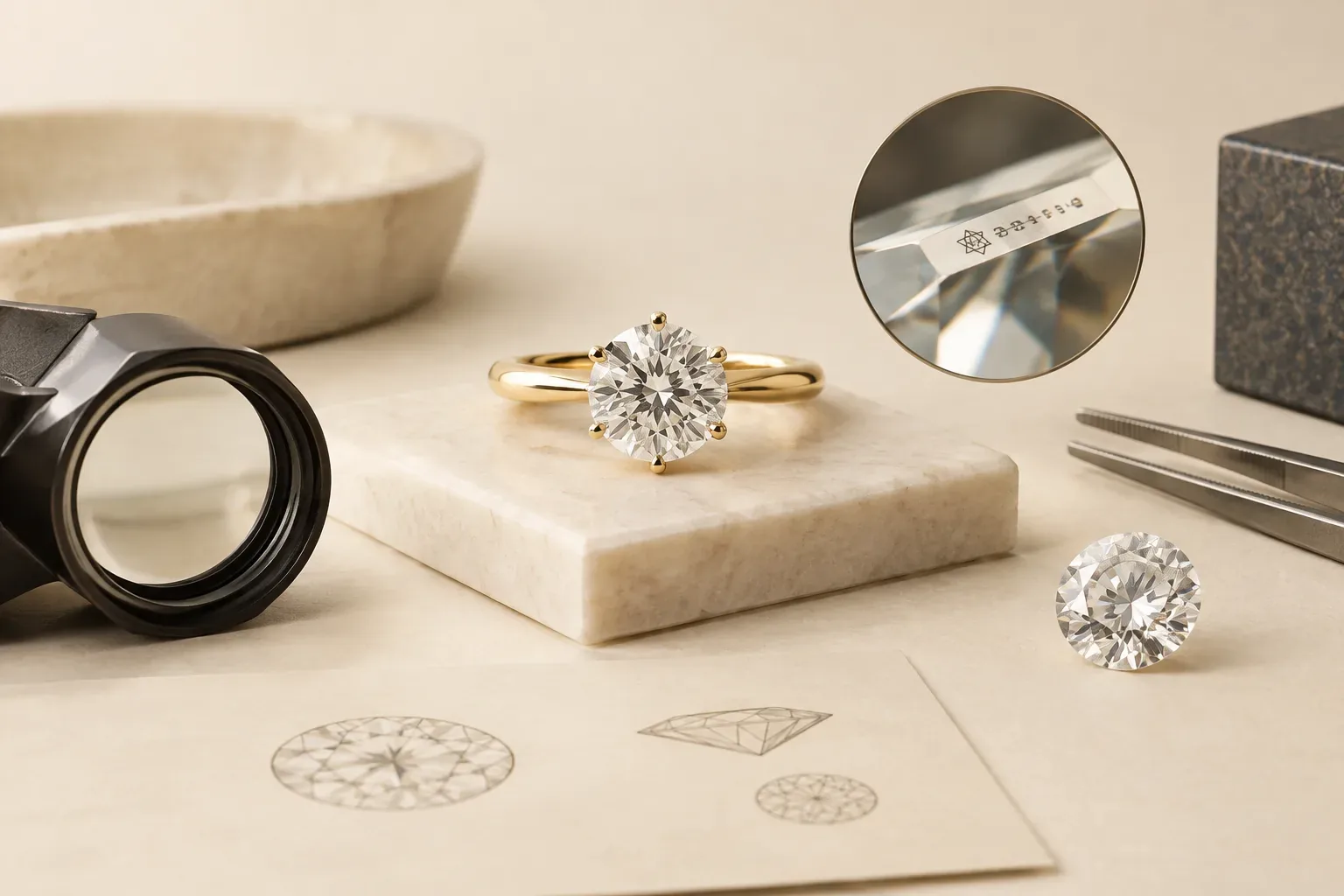
A laser inscription is a microscopic mark placed on a diamond’s surface by a focused laser beam. In commercial practice this mark is commonly used to record a laboratory report number, a jeweler’s inventory code, or a short personalization such as initials. Because the mark is generally very small, it is intended to be read using magnification and to be minimally visible to the naked eye.
In retail and secondary markets, inscriptions serve practical roles: they help match a loose or set diamond to its independent laboratory report, support chain-of-custody tracking, and provide an additional security feature if a diamond is lost or stolen. Imaginaire Digital’s market data indicates sustained consumer search interest in engagement-related jewelry categories where inscriptions are often used to link a diamond to paperwork and provenance.
Historical evidence and cultural context
Available, approved references for this article do not document a long cultural history for laser inscriptions; they are a technology-driven practice tied to the availability of fine lasers and modern gemological services. In other words, laser inscription is a modern marking method rather than an ancient cultural tradition.
Because the technique depends on laser technology and modern gemological reporting, the relevant period is the contemporary commercial era when laboratories and retailers began offering microscopic identification marks alongside certificates. If you are interested in earlier traditions of marking or inscribing gemstones in specific cultures or historical periods, seek specialist historical sources; the governmental and gemological references cited here focus on modern disclosure, detectability and consumer protection rather than pre-modern symbolism.
Documented (commercial) meanings versus modern personal interpretations
Documented commercial meanings for laser inscriptions are straightforward and consistent in the trade: they identify a stone, record a laboratory report number, or carry an inventory or security code. The Federal Trade Commission emphasizes that consumers should expect clear, written seller disclosures about gem origin, treatments and material type; inscriptions are one element that should be supported by the seller’s paperwork.
Modern personal interpretations—such as treating an inscription as a romantic message, secret vow, or talisman—are individual and subjective. Those meanings are meaningful to the giver and recipient but are not documented by the consumer-protection or gemological authorities cited here as having any universal symbolic status. Keep the distinction clear when you rely on an inscription for sentimental value versus when you need it as documentary proof.
How laser inscriptions appear in jewelry
Inscriptions are most often placed on parts of a cut diamond that are least visible in common mounting positions, typically the girdle. When a diamond is set, especially in styles like solitaire engagement rings, the inscription may be completely hidden from casual view but accessible to a jeweler with magnification.
Jewelry that emphasizes certification and resale value—engagement rings, high-value studs, and investment-grade stones—often uses engraved diamonds so the stone can be matched to its independent laboratory report if removed from its mounting. Retailers and labs may list the inscription string on paperwork so that the stone is traceable across ownership changes.
Decision criteria and practical trade-offs when choosing an inscribed diamond
When you compare diamonds, consider inscriptions as part of a bundle of documentation rather than a standalone guarantee. Prioritize stones that come with an independent laboratory report and clear seller disclosure. The Federal Trade Commission advises consumers to demand written disclosure about material origin, treatments and the nature of any identifying marks or labelling.
Practical trade-offs are typically modest: many inscriptions add little to purchase price but increase administrative security and resale clarity. The most important trade-off is whether you will keep the inscription intact: any later re-cutting, re-shaping or aggressive repolishing can remove a surface inscription, so if you anticipate major alterations to a stone, an inscription is less useful as a permanent identifier.
Also weigh privacy and personalization. A short personal message or initials can be meaningful to a gift recipient, but remember that such an inscription has no independent legal status unless it is corroborated by documentation from a recognized laboratory or a contractual seller disclosure.
Care, durability and what you can verify without a lab
Basic care for an inscribed diamond follows normal diamond care: avoid harsh hand treatments that could change the mounting and consult a qualified jeweler for maintenance. The Gemological Institute of America notes that treatments and their detectability raise consumer questions about durability and special care; while a laser inscription is not a treatment of the diamond’s material composition, any physical alteration to a stone’s surface could affect an inscription.
What you can verify yourself is limited but useful. With a loupe or inexpensive microscope you can often see an inscription and confirm that the string of characters on the stone matches the number printed on a seller’s paperwork. That visual match is a practical, immediate check buyers can perform in-store or under magnification at home.
What you cannot conclusively verify without a qualified jeweler or a gemological laboratory is whether the inscription was applied by a recognized laboratory, whether the inscription has been altered, or whether the stone’s lab report actually pertains to the plotted and weighed stone in hand beyond the inscription match. For questions about origin, treatments, and formal identification, the Federal Trade Commission and the Gemological Institute of America recommend written documentation and laboratory testing when necessary.
Practical guidance for selection and gifting
If you are buying a diamond as an engagement ring or a keepsake, ask the seller to provide any laboratory report number that should match the inscription and verify the match visibly before finalizing the purchase. Keep all paperwork with the ring; inscriptions are most useful when paired with an independent lab report and a clear sales receipt.
For gifting a personalized inscription, discuss expectations with the recipient if possible. If the inscription is intended as a security feature, make sure the seller records it in the sales documentation and that the recipient can access the lab report details later. In markets where consumer searches show sustained interest in engagement and high-value jewelry—per Imaginaire Digital—clear documentation and traceability are features many buyers expect.
If a diamond will be altered after purchase—resized mounting, re-cut, or major repolishing—disclose this to the jeweler and understand that such work may remove or obscure an inscription. For heirs and resale, preserve original paperwork and consider photographing the inscription under magnification to retain a record.
Limits and final recommendations
Diamond laser inscription explained must include limits: an inscription helps tie a stone to paperwork and offers a visible marker, but it is not a substitute for independent laboratory certification or seller disclosure. The Federal Trade Commission emphasizes the consumer need for clear written disclosure about a gem’s origin and treatments. The Gemological Institute of America highlights that detectability and proper disclosure of gem treatments and characteristics are central consumer concerns.
When in doubt about an inscription’s meaning or permanence, request that the seller show you the laboratory report and explain how the inscription is recorded in their documentation. For high-value purchases, consider a pre-purchase inspection by a qualified jeweler or independent lab to verify that the inscription and the accompanying paperwork match the physical stone.
Frequently asked questions
Can I rely on a laser inscription as proof of a diamond’s origin?
No. A laser inscription is a useful identifier but should be corroborated by an independent laboratory report and seller disclosure. The Federal Trade Commission recommends written documentation for material origin and treatments, and an inscription alone is not a substitute for laboratory verification.
Will a laser inscription harm my diamond?
Laser inscriptions are microscopic marks intended to be minimally intrusive. For specific questions about durability and any impact on a particular stone, consult a qualified jeweler or gemological laboratory. The Gemological Institute of America notes that detectability and special care are important consumer issues when considering gem characteristics.
Can I see an inscription myself?
Often you can, with a jeweler’s loupe or a small microscope. A quick visual check that the inscription matches the lab report number is a practical step buyers can take before purchase.
Will normal wear remove an inscription?
Normal wear usually does not remove a microscopic laser inscription, but re-cutting, reshaping or aggressive repolishing can remove or obscure surface marks. Ask the seller whether any future work might affect the inscription.
Should I ask for the inscription number on my paperwork?
Yes. Keep the laboratory report and sales receipt together with the inscription information. Documentation paired with the physical inscription is the most useful arrangement for security, resale and insurance purposes.
Sources and further reading
- Imaginaire Digital — Imaginaire Digital
- Gemological Institute of America — Gemological Institute of America
- Federal Trade Commission — Federal Trade Commission