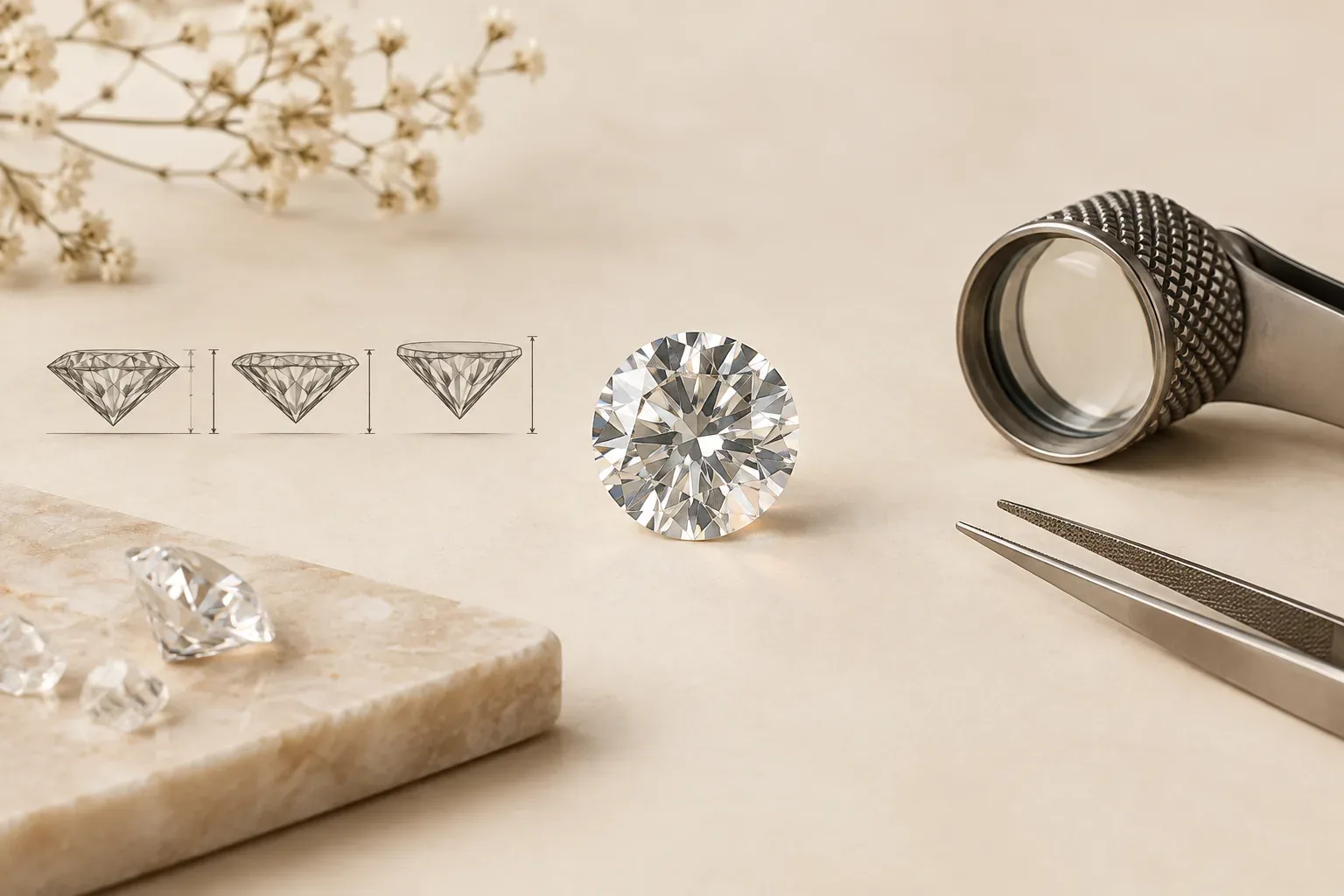
Meaning at a glance
Diamond depth percentage explained: it is the ratio of a diamond’s vertical depth to its diameter expressed as a percentage; it helps determine face-up size and light performance, but it is only one of several proportion measurements that affect appearance and value, and accurate verification requires a grading report or a qualified gemologist.
Direct answer — diamond depth percentage explained
Diamond depth percentage explained: the depth percentage is the diamond’s vertical depth divided by its average diameter, shown as a percentage, and it is used by sellers and graders to summarize one important proportion that affects how large a gem looks from above and how it returns light. It matters because the same carat weight can look smaller or larger when depth varies, and extreme depths can reduce sparkle or make a stone appear dark at certain angles.
That short definition is the foundation for every practical decision a buyer makes about cut and appearance. Beyond the single number, meaningful evaluation uses it together with table percentage, cut grade (when available), and light performance assessment. For reliable verification you should consult a grading report from a reputable laboratory or a qualified jeweler; you cannot accurately measure or confirm the official depth percentage by eye alone.
What the number represents and how it’s calculated
The depth percentage compares the diamond’s vertical measurement from table to culet (or to the bottom of the girdle) with its diameter. Jewelers express that ratio as a percent so that diamonds of different sizes remain comparable. Merchants and labs routinely include the depth percentage on listings and grading reports because it is a compact way to show one of the stone’s basic proportions.
In practice, the depth percentage is a single data point used with other proportions. It does not alone determine brightness or value. A stone’s light return also depends on pavilion and crown angles, symmetry, and facet polish—attributes that will appear separately on a full grading report or in a vendor’s light-performance notes.
Historical evidence and documented sources
The approved sources for this article do not provide culture-by-culture histories of diamond symbolism or technical cutting conventions. Instead, the Gemological Institute of America (GIA) focuses on treatments, disclosure, detectability, durability and special care for gem materials, while the Federal Trade Commission (FTC) deals with consumer protection, clear distinctions among natural, lab-created, treated and imitation materials, and written seller disclosures. Imaginaire Digital reports contemporary market demand trends rather than historical symbolism or cutting practices.
Because the approved references emphasize consumer protection, treatment disclosure and market trends rather than detailed historical narratives, this article separates verifiable technical points about depth percentage from broader historical or cultural claims that would require specialist historical sources to document precisely.
Documented historical meanings versus modern personal interpretation
Documented historical meanings of diamonds and diamond cutting are not supplied by the three approved sources used for this article, so any culture-specific historical assertions would require other primary historical references. For clarity and accuracy, this piece treats the depth percentage as a modern, technical proportion used by cutters, sellers and grading laboratories rather than a symbol with a consistent historical meaning across cultures.
Modern personal interpretations about depth percentage focus on appearance and practicality: many buyers interpret a lower depth percentage as meaning a wider face-up appearance for the same carat weight and a higher depth percentage as meaning a deeper look or less apparent size when viewed from above. Those are contemporary consumer interpretations about appearance and value rather than documented cultural symbolism, and individual preferences vary widely.
How depth percentage appears in jewelry descriptions and grading reports
Retail listings, certificate reports, and jeweler appraisals often list the depth percentage near other proportion metrics, such as table percentage and the gem’s measurements in millimetres. When a diamond is accompanied by a laboratory report, the depth percentage is a standard numeric entry that helps compare stones on a like-for-like basis.
In practical terms, the number helps a buyer or appraiser predict the stone’s face-up size relative to weight and to screen for extreme proportions that can affect light return. Jewelers will also display side-on photographs or interactive imaging to show how proportions translate to appearance, because a single percentage cannot convey all aspects of optical performance.
Decision criteria and practical trade-offs to consider
Treat the depth percentage as one input among many. If your priority is the largest apparent diameter for a given carat weight you will often prefer proportions that produce a wider face-up look, but this can come at the cost of light performance if other parameters are compromised. Conversely, proportions optimized for light return can sacrifice some face-up diameter for better brilliance and scintillation.
Another trade-off is budget versus visual priorities. Two diamonds with the same carat weight and clarity might show different face-up sizes and brilliance because of depth and table relationships. Buyers often weigh whether they prioritize visible spread, measured brilliance, or a certified cut grade. Where a grading laboratory provides an overall cut grade, that grade should be considered alongside the depth percentage because it integrates multiple proportion and performance factors.
Care, treatments, and longevity considerations
The Gemological Institute of America documents that treatments and material properties affect detectability, durability and special care requirements. While depth percentage itself does not change how you clean a diamond, treatment history, setting style, and the stone’s durability characteristics do influence care instructions and inspection frequency.
Settings that hold deeper gems might expose different areas of the girdle or pavilion to knocks; a secure setting and routine inspection are sensible. For treated or non-natural materials, follow any special care guidance disclosed at sale and consider independent verification of treatment claims before assuming normal durability.
What you can and cannot verify without a qualified jeweler or laboratory
You can visually compare two diamonds to see which appears larger from above and you can ask a seller for measurements and the depth percentage. However, you cannot reliably and accurately measure the depth percentage yourself with a loupe or unaided eye. Official proportions and cut-related assessments are best verified by a reputable laboratory grade report or by a qualified gemologist using calibrated instruments.
The Federal Trade Commission advises that consumers should receive clear written disclosures about whether a gem is natural, lab-grown, treated or an imitation and that seller-provided information be accurate and documented. If a listing lacks a laboratory report or clear disclosure, request one before purchase or consider an independent appraisal.
Practical selection and gifting guidance
When selecting or gifting a diamond, decide which visual qualities are most important: largest apparent face-up size, maximum brilliance, or a certified cut grade. Ask the seller for the diamond’s measurements, depth percentage, table percentage, and any grading laboratory report. If presentation and visible size matter more than certification, choose a stone whose face-up appearance pleases the recipient; if assurance and resale value matter, insist on an independent laboratory report.
If the recipient values certification and disclosure, request certified reports and a written disclosure about origin and any treatments, in line with the FTC’s guidance. For respectful gifting, be mindful that some recipients care deeply about origin or lab-grown status. Clarify these preferences in advance where possible, and when buying on a budget consider compromising on non-visual attributes such as milgrain or a particular setting style rather than on transparency about the stone’s characteristics.
Final practical checklist before buying
Ask for a detailed description that includes depth percentage, table percentage, measurements in millimetres, and any available cut grade. Request a lab report from a reputable laboratory and verify the seller’s written disclosures about whether the diamond is natural, lab-grown, or treated. Examine images or video showing a face-up view and side profile so you can see how depth translates to appearance.
If in doubt, obtain an independent appraisal or seek a second opinion from a qualified gemologist. Use the depth percentage as a decision tool rather than a single rule: combine it with visual assessment, certification, and the recipient’s preferences to make a respectful and well-informed choice.
Frequently asked questions
What exactly is diamond depth percentage?
Depth percentage is the ratio of a diamond’s vertical depth to its average diameter, expressed as a percentage. It summarizes one of the stone’s key proportions and appears on many grading reports and product listings.
Why does depth percentage matter when buying a diamond?
Depth percentage helps predict how large a diamond will appear when viewed from above and influences how light behaves inside the stone. It is an important factor in assessing face-up size and part of evaluating overall cut and appearance.
Can I measure depth percentage at home?
No. Accurate depth percentage measurement requires calibrated instruments or a laboratory report. You can compare visual face-up size between stones, but official proportions should be verified by a qualified jeweler or grading laboratory.
Does a higher or lower depth percentage mean a better diamond?
Neither automatically. Extremely shallow or extremely deep proportions can have negative effects on appearance; the optimal depth depends on other proportions and the desired balance between face-up size and light performance.
Should I insist on a lab report when buying?
Yes. The Federal Trade Commission recommends clear written disclosures about origin and treatments, and a reputable laboratory report documents proportions, treatments and other important details that help you compare stones reliably.
Do treatments or lab-grown diamonds affect depth percentage?
Treatments and lab-grown production methods do not inherently dictate depth percentage; both natural and lab-grown diamonds may be cut to a wide range of proportions. Always request disclosure and documentation, as urged by the FTC, and consult lab testing guidelines from organizations such as the GIA for treatment detectability and care.
Sources and further reading
- Imaginaire Digital — Imaginaire Digital
- Gemological Institute of America — Gemological Institute of America
- Federal Trade Commission — Federal Trade Commission